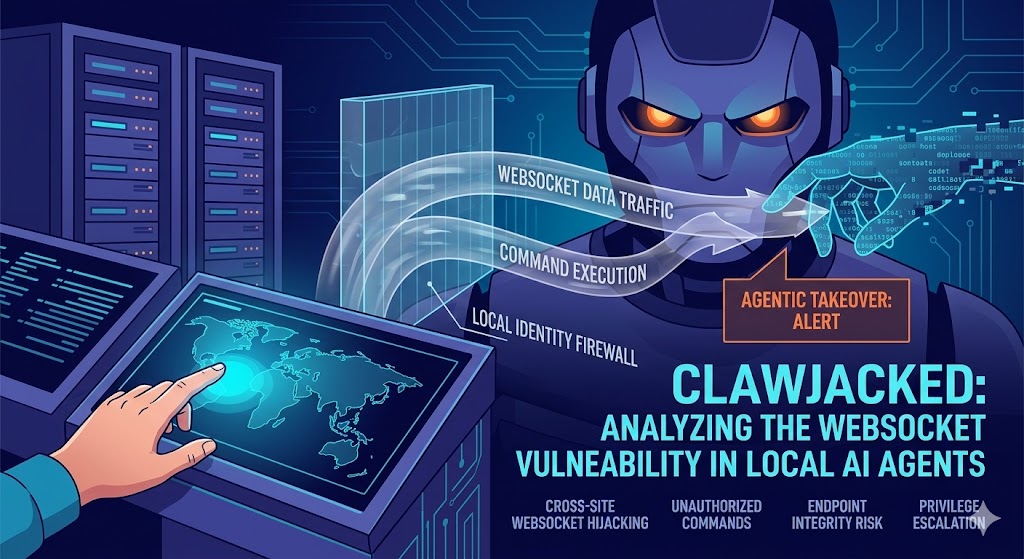
As the industry shifts toward the 2026 On-Device AI Pivot, the architectural reliance on local gateways has introduced a critical, often overlooked attack surface. The recently disclosed ClawJacked vulnerability in the OpenClaw framework highlights a fundamental flaw in how local AI agents communicate with browsers via WebSockets.
This isn’t just a minor bug; it is a high-severity exploit that allows malicious websites to hijack locally running AI agents, turning a productivity tool into a sophisticated “insider threat.”
The Anatomy of the ClawJacked Exploit
Unlike traditional vulnerabilities that target third-party plugins or external APIs, ClawJacked resides in the core system of the OpenClaw gateway. To provide a seamless user experience, OpenClaw (and many similar local AI frameworks) uses WebSockets to bridge the gap between the user’s browser and the AI model running as a background process.
Technical Vector: Cross-Site WebSocket Hijacking (CSWH)
The vulnerability stems from a lack of rigorous Origin Validation during the WebSocket handshake. Here is how a potential attack unfolds:
- The Trap: A user visits a compromised or malicious website while their local OpenClaw gateway is active (typically listening on
localhostor127.0.0.1). - The Handshake: The malicious site executes a JavaScript snippet that attempts to initiate a WebSocket connection to the default OpenClaw port.
- The Failure: Because the OpenClaw gateway fails to verify the
Originheader of the request, it accepts the connection, believing it to be a legitimate command from the user’s own interface. - The Takeover: Once the connection is established, the attacker can send prompts directly to the AI agent.
The “Agentic” Danger: From Data Leaks to System Execution
In 2026, AI agents are no longer just passive chatbots. They are Agentic, meaning they have permissions to read local files, execute terminal commands, and interact with other local services like Docker or Kubernetes.
- Privilege Escalation: If your AI agent has “Code Execution” or “File System” access enabled, a successful ClawJacked exploit allows an attacker to exfiltrate your
.envfiles, SSH keys, or even wipe local databases. - Firewall Bypass: Since the traffic originates from the browser to
localhost, most traditional perimeter firewalls and even Demystifying and Breaking Client Isolation in Modern Wi-Fi Networks (Internal Link) fail to flag this as malicious inbound traffic.
Strategic Mitigation: Securing the Local AI Gateway
To protect your infrastructure against ClawJacked and similar WebSocket-based exploits, engineering leaders must move beyond default configurations.
1. Mandatory Origin Filtering
Gateways must be configured to only accept handshakes from a strict allowlist of domains. Any request where the Origin header does not match the local UI should be dropped immediately.
2. Implementation of CSRF Tokens for WebSockets
While WebSockets don’t inherently use CSRF protection, implementing a one-time-use token during the initial HTTP upgrade request ensures that only the authorized local frontend can open a socket.
3. The Principle of Least Privilege (PoLP) for AI
Limit the “agency” of your local models. Use sandboxed environments (like gVisor or lightweight VMs) to run AI agents that require system-level access.
Expert Insight: “The convenience of local AI must not come at the cost of endpoint integrity. If an AI agent can write code, it can also write malware under the right (or wrong) instructions.” — Susiloharjo Analysis.
Conclusion: The Final Identity Firewall
The ClawJacked vulnerability serves as a sobering reminder that Local Compute is the Final Identity Firewall. As we delegate more autonomy to AI agents, the security of the communication layer—specifically WebSockets and local gateways—becomes as critical as the model’s weights themselves.
Integrity is the only currency that matters in a post-LLM world. Patch your gateways, restrict your origins, and never trust a local connection by default.
External References & Further Reading:
- The Hacker News: ClawJacked Flaw Lets Malicious Sites Hijack Local AI Agents (General Tech Security Context)
- Wired Tech: Big Tech and the Rise of Prediction Market Insider Trading (Context on AI Corporate Integrity)
- OWASP: WebSocket Security Top 10 Guide
Discover more from Susiloharjo
Subscribe to get the latest posts sent to your email.