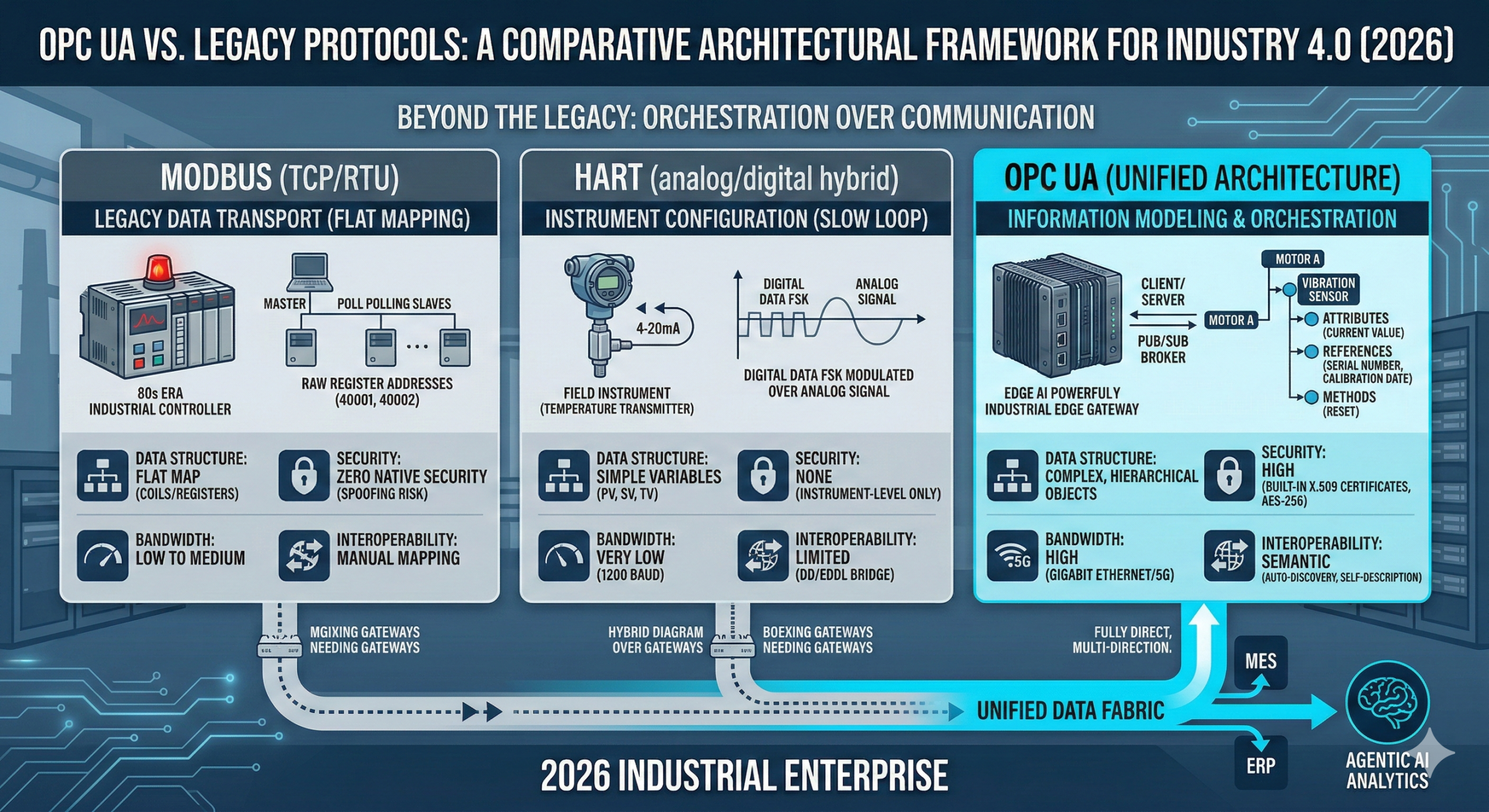
In the landscape of Industrial Automation and Control Systems (IACS), the transition from “data silos” to “interconnected intelligence” has been hindered by one primary factor: interoperability. While legacy protocols have served the industry for decades, the rise of OPC Unified Architecture (OPC UA) marks a fundamental shift from simple data transport to complex information modeling.
This article analyzes the architecture of OPC UA and provides a comparative framework against legacy standards like Modbus and HART to determine their roles in a 2026-ready infrastructure.
What is OPC UA? (The Information Model Approach)
Unlike its predecessor (OPC Classic), which was tied to Microsoft’s COM/DCOM technology, OPC UA is a platform-independent, service-oriented architecture (SOA). It does not just send “raw values”; it sends metadata, relationships, and context.
The core strength of OPC UA lies in its Information Modeling. A sensor is no longer just a register address (e.g., 40001); it is an object with attributes (Current Value), methods (Reset), and references (Manufacturer Data, Calibration Date).
Key Architectural Pillars:
- Transport Independence: Operates over TCP, WebSockets, or even MQTT (Pub/Sub).
- Built-in Security: Unlike legacy protocols, OPC UA includes mandatory X.509 certificate-based authentication and encryption (AES-256).
- Scalability: Runs on everything from a 15KB embedded chip to massive cloud-based ERP systems.
Comparative Analysis: OPC UA vs. Legacy Standards
To understand why OPC UA is replacing legacy protocols in the “Final Identity Firewall” [Internal Link: The 2026 On-Device AI Pivot], we must compare them across three critical dimensions:
1. OPC UA vs. Modbus (TCP/RTU)
Modbus remains the “Latin” of automation—simple and universally understood—but it is fundamentally limited.
- Data Structure: Modbus uses a flat mapping of Coils and Holding Registers. OPC UA uses hierarchical objects.
- Security: Modbus has zero native security. Anyone on the network can spoof a command. OPC UA provides granular security at the application level.
- The Verdict: Use Modbus for simple, point-to-point communication in isolated legacy loops. Use OPC UA for any system that touches the corporate network or the cloud.
2. OPC UA vs. HART (Highway Addressable Remote Transducer)
HART is the veteran of the process industry, known for modulating digital signals over 4-20mA analog loops.
- Bandwidth: HART is extremely slow (1200 baud). OPC UA operates at Gigabit Ethernet speeds.
- Capability: HART is designed primarily for instrument configuration and diagnostics. OPC UA is designed for high-speed data orchestration across an entire plant.
- The Verdict: HART is still relevant for “last-mile” instrument calibration. However, WirelessHART is increasingly being bridged into OPC UA gateways to make that data accessible to AI-driven analytics.
3. Comparison Table: At a Glance
| Feature | Modbus | HART | OPC UA |
| Architecture | Master/Slave | Master/Slave | Client/Server & Pub/Sub |
| Security | None | None | High (Encryption/Signatures) |
| Self-Description | No (Manual Mapping) | Limited (DD/EDDL) | Yes (Full Metadata) |
| Platform | Any | Any | Any (OS Independent) |
| Complexity | Low | Low | High (Initial Setup) |
The 2026 Perspective: The Role of Semantic Interoperability
As we integrate Agentic AI [Internal Link: ClawJacked & WebSocket Vulnerabilities] into manufacturing, the AI needs to “understand” the data it receives.
An AI agent cannot do much with a raw Modbus integer. However, via OPC UA, the agent can see that Node_ID_202 is a “Vibration Sensor” on “Motor A,” which has a “Critical Threshold” of 5.5mm/s. This semantic interoperability is what allows for true Predictive Maintenance and autonomous optimization.
Conclusion: Orchestration over Communication
The choice is no longer about which protocol is faster, but which protocol is smarter. Modbus and HART will continue to exist in the “brownfield” layers of industrial plants due to their sheer simplicity and installed base.
However, for any forward-looking infrastructure—especially those leveraging Edge Compute and AI—OPC UA is not just an option; it is the prerequisite. It transforms the factory floor from a collection of talking machines into a unified, searchable, and secure database.
Related: Confluent & Kafka: From Microservices to AI Data Streams.
Related: AI Agent Security Architecture: Lessons From Operation PowerOFF 2026.
External References:
- OPC Foundation: Unified Architecture Specifications
- IEEE Xplore: Evaluation of Security in Industrial Protocols
- ISA: ISA-95 Framework and OPC UA Mapping
Discover more from Susiloharjo
Subscribe to get the latest posts sent to your email.