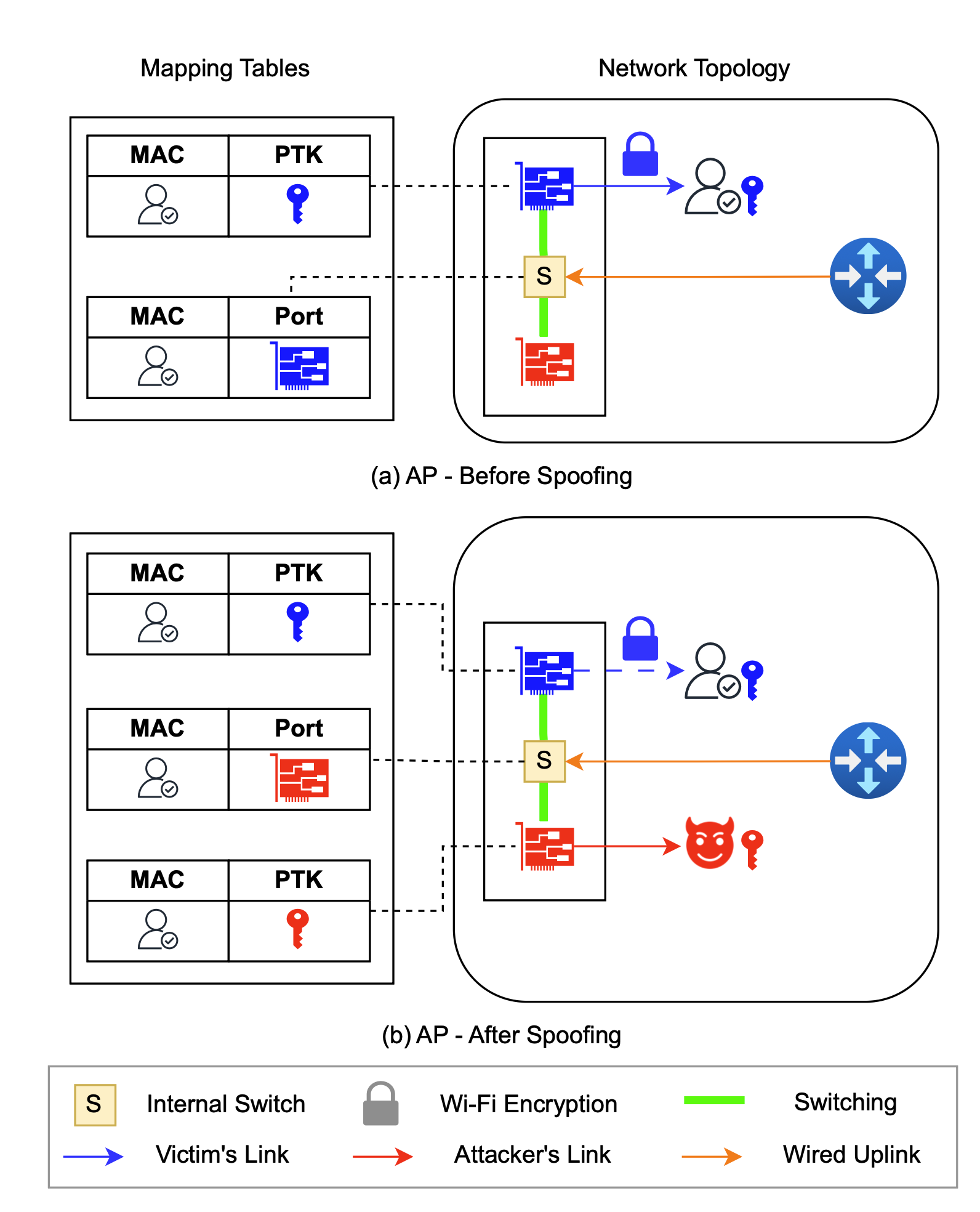
The fundamental assumption of public and enterprise Wi-Fi security—Client Isolation—has been effectively compromised. Recent research presented at the NDSS Symposium 2026 introduces AirSnitch, a sophisticated attack methodology that bypasses the layer-2 isolation mechanisms intended to prevent peer-to-peer communication between devices on the same wireless network.
While encryption standards like WPA2 and WPA3 ensure data confidentiality between a client and an Access Point (AP), Client Isolation is the final line of defense in shared environments. AirSnitch proves that this barrier is more porous than previously understood, effectively restoring an attack surface many assumed was closed in the late 2010s.
Technical Breakdown: The Cross-Layer Identity Desynchronization
AirSnitch exploits vulnerabilities in the way Wi-Fi management and data frames are handled at the lowest levels of the networking stack—specifically Layers 1 (Physical) and 2 (Data Link). The core of the exploit lies in the failure to bind and synchronize a client’s identity across these layers and the associated Access Point nodes.
The most potent variation of AirSnitch is a full, bidirectional Machine-in-the-Middle (MitM) attack. It leverages three primary technical pillars:
1. Port Stealing Adaptive to 802.11: Based on classic Ethernet port-stealing techniques, the attacker modifies the Layer-1 mapping that associates an internal network port with a victim’s MAC address. By connecting to the BSSID (often on a different frequency band like 2.4GHz while the victim is on 5GHz) and completing a four-way handshake, the attacker forces the AP to associate the victim’s MAC with the attacker’s port.
2. MAC-to-Port Hijacking: Once the mapping is hijacked, the AP switch directs all downlink traffic intended for the victim to the attacker instead. This traffic is encrypted using the attacker’s Pairwise Transient Key (PTK), allowing for effortless decryption.
3. Bidirectional Relay via ICMP: To maintain a stealthy MitM and prevent a total service outage for the victim, the attacker periodically reverts the mapping back to the victim’s original port by sending specific ICMP “pings.” This rapid “flipping” allows the attacker to intercept, modify, and relay traffic in real-time.
Vulnerability Landscape: From Consumer to Enterprise
The research, led by Xin’an Zhou, demonstrated that AirSnitch is not limited to cheap consumer routers. The team successfully validated the attack against a wide spectrum of hardware and software stacks, including:
* Enterprise Infrastructure: Cisco Catalyst 9130 and Ubiquiti AmpliFi systems.
* Consumer Flags: Netgear Nighthawk x6, TP-Link Archer AXE75, and ASUS RT-AX57.
* Open Source Stacks: DD-WRT and OpenWrt.
Crucially, the attack breaks the assumption that separate SSIDs (e.g., Guest vs. Corporate) on the same AP provide containment. If they share the same backend distribution system, an attacker on the guest network can trivially pivot to intercept authenticated corporate traffic.
Strategic Impact: The Enterprise Fallout
For CISOs and network architects, AirSnitch represents a paradigm shift. The reliance on link-layer isolation for compliance and security is no longer viable.
* IoT Infrastructure Fragility: Industrial IoT often utilizes isolation to segregate legacy sensors from mission-critical control systems. AirSnitch enables a low-privilege sensor to act as a bridge into secure segments.
Erosion of WPA3 Assumptions: While WPA3-SAE improves handshake security, it does not prevent the Layer-2 desynchronization targeted by AirSnitch. The attack targets frame handling post-authentication*, rendering standard encryption upgrades insufficient as a standalone fix.
* The Hardware Patch Dilemma: Many of the systemic weaknesses are rooted in silicon-level chip handling from major vendors like Qualcomm and Broadcom. Firmware mitigations may prove challenging and could lead to performance degradation in high-density environments.
The Analyst’s Recommendation: Zero Trust Wireless
The emergence of AirSnitch mandates a transition away from relying on link-layer controls. The following mitigations are essential for the 2026 threat landscape:
* Ubiquitous Application Encryption: Mandatory use of TLS 1.3 or higher for all internal traffic. Assume the local network is as compromised as the public internet.
* SDN-Driven Micro-Segmentation: Transition from MAC-based isolation to software-defined per-user VLANs or dynamic port profiling that binds identities more strictly at the controller level.
* Strict RADIUS Hardening: Organizations must prioritize the integrity of RADIUS packets, as AirSnitch can be used to hijack gateway MACs and potentially capture authentication frames for offline cracking.
AirSnitch is a reminder that in the realm of wireless communications, the “air” is a shared medium that can never be fully isolated through link-layer logic alone.
—
Source: AirSnitch: Demystifying and Breaking Client Isolation in Wi-Fi Networks, NDSS Symposium 2026 Proceedings.
Analysis by: Susiloharjo Strategic Intelligence Unit.
Related: Software Design Document: The Missing Bridge Between PRD and Code.
Related: The Telnyx PyPI Compromise: A Case Study in Modern Supply Chain Attacks.
Discover more from Susiloharjo
Subscribe to get the latest posts sent to your email.