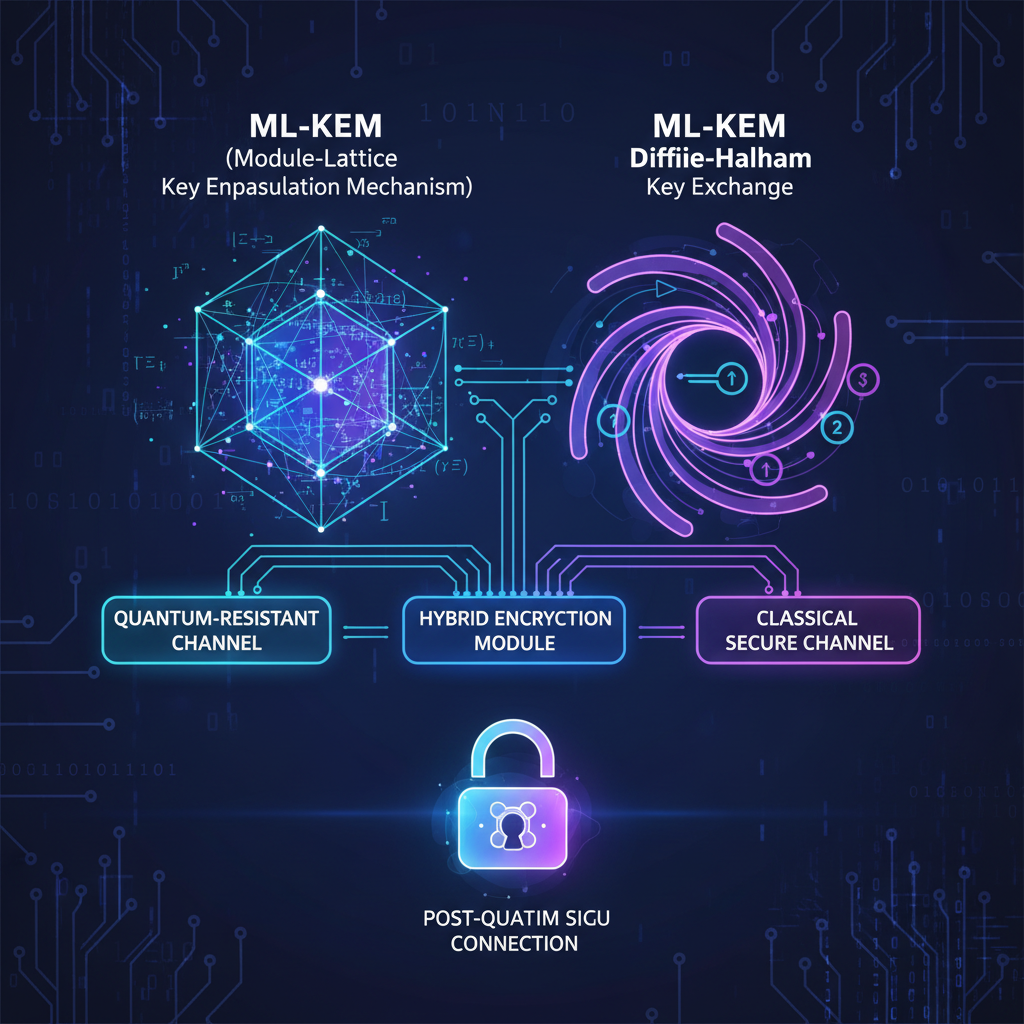
Why Hybrid ML-KEM is the Future of Post-Quantum IPsec Encryption
The cryptographic landscape faces an unprecedented paradigm shift. As quantum computing capabilities advance, the foundational algorithms protecting enterprise IPsec infrastructure face obsolescence. Hybrid ML-KEM emerges as the definitive solution, combining lattice-based post-quantum cryptography with classical Diffie-Hellman key exchange to deliver defense-in-depth protection for modern networks.
Understanding the Ciphersuite Bloat Problem
Early IPsec implementations, codified in RFC 9370, introduced a fragmented ecosystem of cryptographic algorithms. The specification mandated support for seven or more distinct cipher suites, creating significant interoperability challenges across vendor implementations. Network administrators encountered relentless configuration complexity, where mismatched algorithm selections resulted in connection failures, security downgrade attacks, and substantial operational overhead.
The proliferation of algorithm options, while intended to provide flexibility, paradoxically undermined the primary objective of secure communication. Each additional cipher suite represented a potential attack surface and a configuration vector for misconfiguration. Enterprise security teams spent disproportionate resources maintaining algorithm compatibility matrices rather than focusing on threat mitigation.
The Hybrid ML-KEM Architecture
Cloudflare’s adoption of Hybrid ML-KEM, as specified in draft-ietf-ipsecme-ikev2-mlkem, represents a strategic pivot toward cryptographic consolidation. The architecture implements a “belt-and-suspenders” security model, combining the NIST-approved ML-KEM algorithm (FIPS 203) with classical Diffie-Hellman key exchange.
This hybrid approach delivers comprehensive protection across multiple threat vectors. The ML-KEM component, based on the Module-Lattice-Based Key-Encapsulation Mechanism standard, provides robust resistance against quantum cryptanalytic attacks. Simultaneously, the classical Diffie-Hellman exchange maintains security against conventional cryptographic vulnerabilities, ensuring protection even if theoretical advances compromise one layer.
The implementation leverages the mathematical hardness of lattice problems, specifically the Module-Learning-With-Errors problem, which currently possesses no known efficient quantum solution. By layering this with established elliptic-curve cryptography, organizations achieve defense-in-depth that addresses both present and future threat landscapes. The NIST FIPS 203 standard provides the formal certification framework for this lattice-based approach.
Deployment and Implementation
Cloudflare has integrated Hybrid ML-KEM directly into the Cloudflare One Appliance, with automated updates deployed as of February 11, 2026. The IKEv2 Responder functionality provides seamless upgrade paths for existing enterprise VPN infrastructures without requiring wholesale hardware replacement.
The deployment model prioritizes operational simplicity. Matthew Prince, Cloudflare CEO, articulated the philosophy: “Securing the Internet against future threats shouldn’t be a complex burden.” This principle manifests in zero-touch provisioning, where the hybrid cipher suite negotiates automatically without administrative intervention.
Adoption metrics demonstrate market validation. According to Cloudflare Radar data, approximately 60% of human TLS traffic traversing Cloudflare’s network already employs hybrid ML-KEM protection. This widespread deployment indicates maturity and operational reliability sufficient for enterprise mission-critical applications.
Neutralizing Harvest Now, Decrypt Later Attacks
The “Harvest Now, Decrypt Later” attack vector represents the most immediate quantum-related threat to encrypted communications. Adversaries with sufficient resources intercept and store encrypted data streams today, anticipating future quantum computing capabilities to breaking current encryption standards. This threat is particularly acute for long-lived sensitive communications, government classified data, and intellectual property with extended confidentiality requirements.
The NIST 2030 deadline for post-quantum cryptographic migration provides a concrete timeline for organizational preparedness. Hybrid ML-KEM addresses this timeline directly, offering protection that becomes progressively more valuable as quantum computing capabilities mature. Organizations implementing hybrid architectures today insulate their communication infrastructure from both current classical threats and anticipated quantum cryptanalysis.
Classical IPsec vs Hybrid ML-KEM: A Technical Comparison
| Characteristic | Classical IPsec (RFC 9370) | Hybrid ML-KEM |
|---|---|---|
| Algorithm Count | 7+ cipher suites | 2 (ML-KEM + DH) |
| Quantum Resistance | None | Full (lattice-based) |
| Interoperability | Complex vendor matrix | Standardized single suite |
| Configuration Overhead | High (algorithm selection) | Low (automatic negotiation) |
| Forward Security | Classical only | Hybrid classical + quantum |
| NIST Compliance | Pre-quantum standards | FIPS 203 certified |
Enterprise Security Implications
For organizations evaluating cryptographic infrastructure upgrades, Hybrid ML-KEM provides a pragmatic migration path. The technology delivers immediate security improvements while maintaining backward compatibility with existing IPsec implementations. This incremental adoption model reduces deployment risk compared to wholesale cryptographic replacement strategies.
The integration with Zero Trust A2A security architectures represents a natural evolution. As autonomous agent orchestration becomes prevalent in enterprise environments, the demand for quantum-resistant channel encryption intensifies. Hybrid ML-KEM provides the cryptographic foundation necessary for securing machine-to-machine communications in post-quantum environments.
Security architects should prioritize hybrid deployment in high-value communication paths, particularly those involving sensitive data, long-term confidentiality requirements, or connection to critical infrastructure. The investment in hybrid cryptographic capability today yields compound security benefits as quantum computing transitions from theoretical threat to practical reality.
Conclusion
Hybrid ML-KEM represents the convergence of cryptographic rigor and operational pragmatism. By combining NIST-approved lattice-based cryptography with proven classical key exchange, organizations achieve robust protection against both current and future attack vectors. The deployment simplicity, demonstrated at scale through Cloudflare’s 60% TLS adoption rate, validates the approach for enterprise-wide implementation. As the 2030 NIST deadline approaches, Hybrid ML-KEM stands as the definitive solution for organizations committed to maintaining cryptographic relevance in the post-quantum era.
For organizations implementing comprehensive Zero Trust A2A security frameworks, hybrid post-quantum encryption provides an essential layer of protection against emerging threats.
Related: The Post That Changed How I Write About Tech.
Related: Post 4: Building the Agent Team — Supervisor, Coder, Reviewer, QC.
Discover more from Susiloharjo
Subscribe to get the latest posts sent to your email.