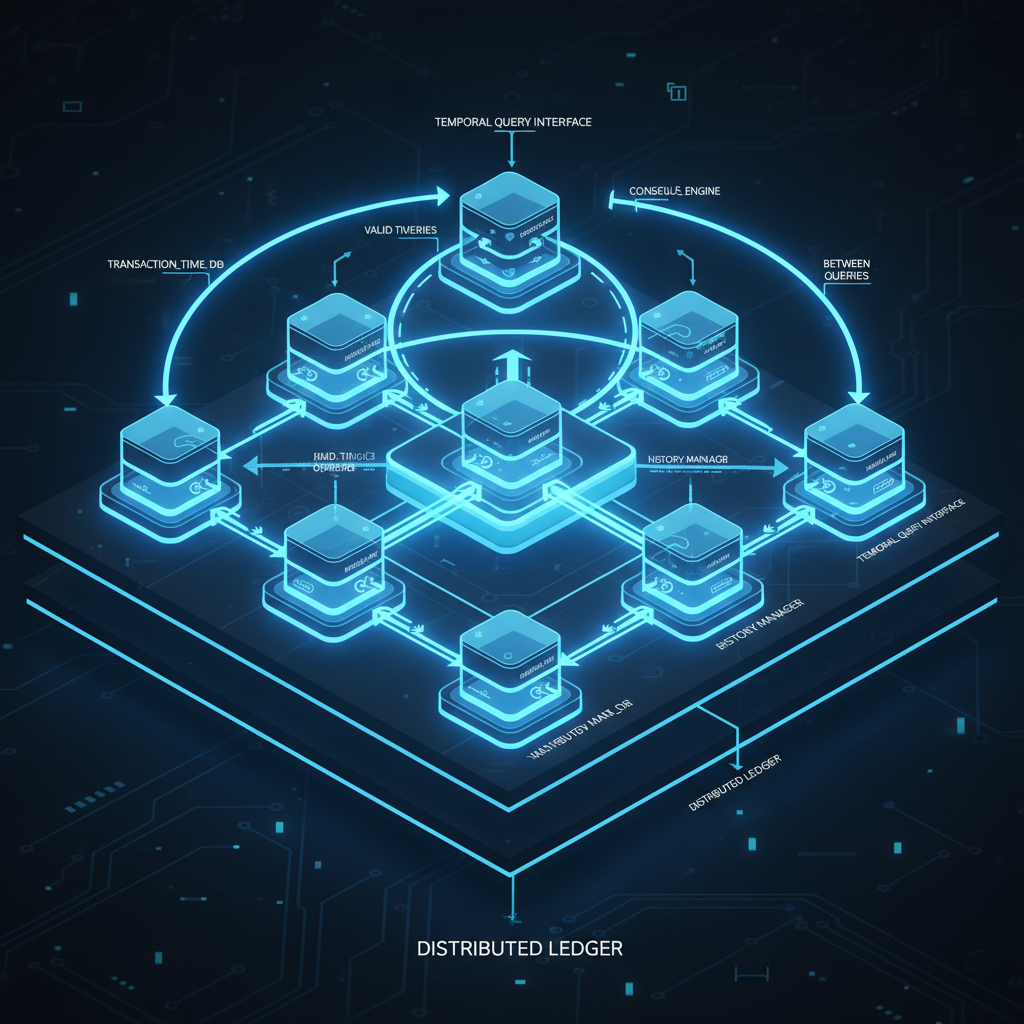
Understanding Bitemporal Data: The Foundation of Modern Ledger Architecture
In the realm of database systems, temporal modeling has long been a challenging frontier. Most traditional databases treat time as an afterthought—columns that store timestamps, queries that filter by date ranges, and application-level logic to reconstruct historical states. This approach works adequately for simple use cases but breaks down under regulatory scrutiny, audit requirements, and the complex data dependencies inherent in AI systems. TensorDB enters this landscape as a fundamentally different proposition: an AI-native bitemporal ledger database that treats time as a first-class architectural concern. This approach represents a significant evolution in database design, as documented in the original technical specification available on Dev.to.
The term bitemporal refers to the dual tracking of two distinct temporal dimensions. Valid Time represents when an event actually occurred in the real world—when a financial transaction was executed, when a customer record was created, or when a sensor reading was captured. Transaction Time (also known as system time) records when the data was persisted to the database. This distinction matters enormously for audit trails, regulatory compliance, and AI systems that need to reason about data state at arbitrary points in history.
TensorDB Architecture: Cloud-Native Design for AI Workloads
TensorDB’s architecture positions it squarely in the cloud-native era while maintaining compatibility with one of the most battle-tested database ecosystems on the planet. The system speaks the PostgreSQL wire protocol, which immediately grants it access to decades of tooling, driver support, and developer familiarity. Organizations can drop TensorDB into existing infrastructure without rewriting applications or retraining teams. For more on PostgreSQL’s temporal capabilities and standards, refer to the official PostgreSQL datetime handling documentation.
However, compatibility is merely the entry point. The underlying engine implements immutable storage principles that fundamentally change how data lifecycle is managed. Unlike conventional databases where UPDATE and DELETE operations overwrite or remove data, TensorDB preserves every change as a new record. This immutability is not a configuration option or an audit-mode toggle—it is the foundational design principle.
The cloud-native distribution means TensorDB is built to scale horizontally across distributed infrastructure. For AI workloads, this translates to the ability to handle massive vector embedding stores alongside structured relational data, all within a unified query engine. The native vector search capability is particularly significant for AI agents that need to perform similarity searches over embeddings while maintaining full transactional guarantees.
Core Features: Time-Travel Queries and Zero-Trust Audit Trails
Perhaps the most compelling capability of TensorDB is its native support for time-travel queries. Because every record carries both valid time and transaction time metadata, queries can reconstruct database state at any historical point with precision. Consider financial reporting scenarios: regulators may require demonstrating what the ledger showed at a specific moment in time, not just what it shows now. With TensorDB, this is a straightforward SELECT statement rather than a complex ETL pipeline rebuilding historical snapshots.
The zero-trust audit trail architecture assumes that the database itself may be compromised. Rather than relying on external logging systems or application-level audit columns, TensorDB cryptographically chains records in a manner that makes post-hoc manipulation detectable. This approach aligns with emerging regulatory requirements across financial services, healthcare, and data-intensive industries where audit integrity is non-negotiable. For organizations building autonomous agent orchestration security frameworks, these audit capabilities become essential for maintaining trust in AI-driven decision-making systems.
ACID compliance remains intact despite the immutable design. Transactions atomic, consistent, isolated, and durable—the foundational guarantees that make databases usable for mission-critical applications. TensorDB achieves this while adding ledger-level security properties that extend beyond traditional database access controls.
Comparative Analysis: Where TensorDB Fits in the Landscape
Understanding TensorDB requires placing it against the alternatives that organizations currently consider. Standard PostgreSQL offers rock-solid reliability and extensive feature sets but lacks native bitemporal modeling. ImmuDB provides immutable storage and cryptographic integrity guarantees but operates with a limited query model that sacrifices full SQL capabilities. Datomic offers temporal modeling with a functional programming paradigm but requires significant architectural shifts and lacks PostgreSQL compatibility.
TensorDB occupies a unique position: the immutability and audit properties of ImmuDB, the full SQL expressiveness of PostgreSQL, and the temporal modeling sophistication of Datomic—all unified in a cloud-native distribution with vector search capabilities.
| Feature | TensorDB | PostgreSQL | ImmuDB | Datomic |
|---|---|---|---|---|
| Bitemporal Modeling | Native (Valid Time + Transaction Time) | Manual via application logic | Transaction Time only | Native (Transaction Time + history) |
| SQL Support | Full SQL (PostgreSQL wire protocol) | Full SQL | Limited SQL subset | Proprietary query language (Datalog) |
| Immutability | Core design principle | No (overwrites on UPDATE/DELETE) | Core design principle | Append-only architecture |
| Vector Search | Native | Via extensions (pgvector) | No native support | No native support |
| Cloud-Native | Yes (distributed architecture) | Via third-party managed services | Via third-party managed services | On-premises or hosted |
| Zero-Trust Audit | Cryptographic integrity chains | Requires external logging | Cryptographic verification | History-based auditing |
| PostgreSQL Compatibility | Wire protocol compatible | N/A | No | No |
| AI Workload Optimization | Native vector + temporal + relational | Requires extensions | Not designed for AI | Not designed for AI |
Practical Implications for Enterprise Deployments
For organizations evaluating database infrastructure, TensorDB presents a compelling case in scenarios where audit requirements intersect with AI ambitions. Financial services firms dealing with regulatory mandates around transaction traceability can leverage bitemporal modeling without abandoning SQL-based reporting workflows. Healthcare systems managing patient records across temporal dimensions can maintain complete history while supporting modern machine learning pipelines.
The elimination of data loss concerns deserves particular attention. In conventional databases, the act of updating a record destroys the previous state unless explicit historical tables are maintained. TensorDB’s immutable design ensures that no data is ever truly deleted or overwritten—information loss becomes architecturally impossible rather than operationally mitigated.
The vector search integration deserves scrutiny from organizations building AI systems today. As retrieval-augmented generation (RAG) architectures become prevalent, the need for databases that can efficiently store embeddings, perform similarity searches, and maintain source provenance grows critical. TensorDB’s unified approach—combining relational storage, temporal queries, and vector operations—reduces architectural complexity that typically requires stitching multiple specialized systems together.
Looking Forward: The Convergence of Ledger, Vector, and Relational
The database landscape is fragmenting into specialized systems optimized for narrow use cases. Vector databases handle embeddings, time-series databases manage sensor data, blockchain ledgers provide immutability, and relational databases maintain operational records. TensorDB’s approach suggests a counter-trend: convergence around capabilities rather than data types.
For technical architects evaluating long-term infrastructure decisions, the question is no longer whether temporal modeling and AI capabilities should be integrated, but rather which platform will deliver that integration most effectively. TensorDB’s PostgreSQL compatibility lowers adoption barriers while its bitemporal ledger architecture addresses requirements that conventional databases simply cannot meet without extensive custom development.
The future of database systems belongs to platforms that treat time as a first-class concern and recognize that AI workloads require more than simple storage—they require intelligent data management that preserves history, ensures integrity, and enables reasoning across temporal boundaries. TensorDB represents a significant step in that direction.
Related: Building a Robust Data Pipeline for LLM Applications in 2026: The Data Engineer&.
Related: Understanding Personalized Healthcare and Integrated Health Data.
Discover more from Susiloharjo
Subscribe to get the latest posts sent to your email.