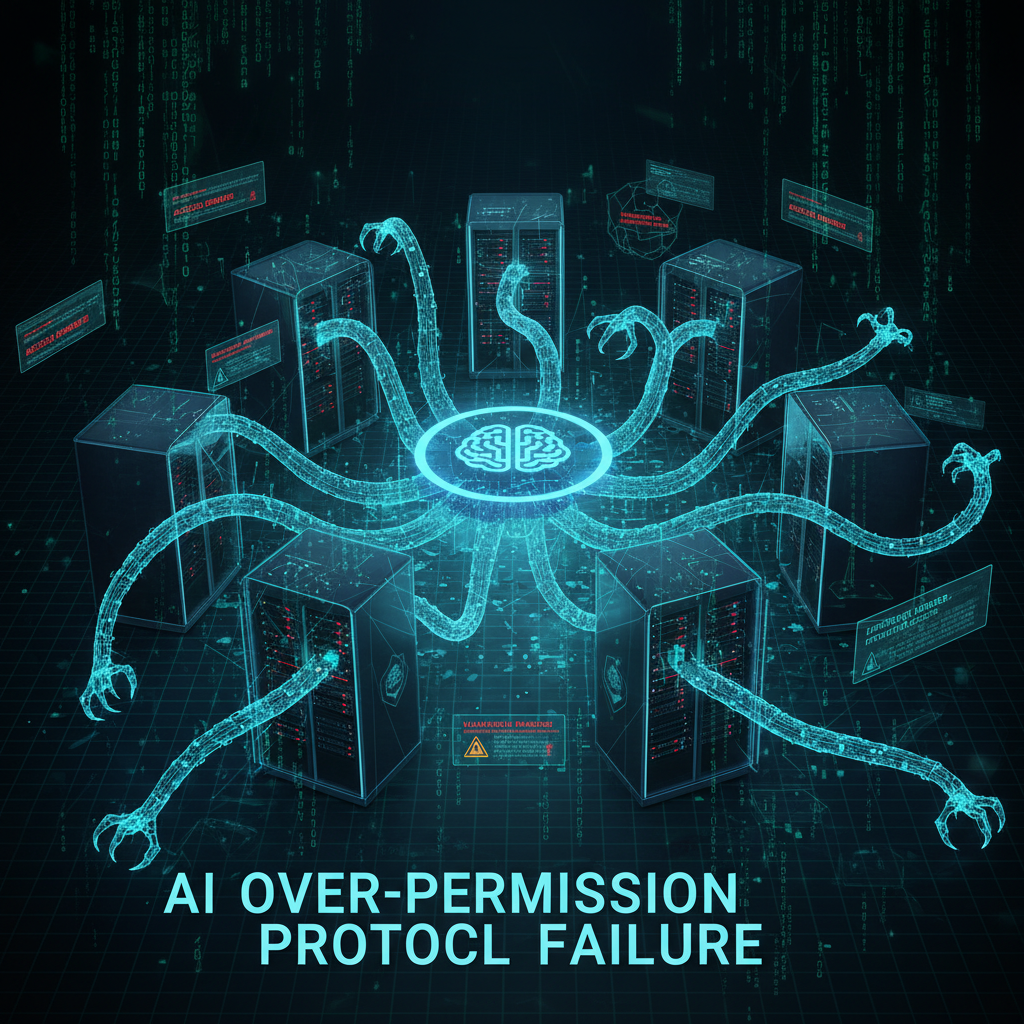
AI Permission Creep: Why Agents Accumulate Dangerous Access
AI Permission Creep represents one of the most insidious security challenges emerging in enterprise environments as organizations deploy autonomous agents at unprecedented scale. This phenomenon occurs when AI systems accumulate access rights that exceed their original operational requirements, creating a sprawling attack surface that grows more dangerous with each new capability granted. Unlike traditional software permissions that remain relatively static, AI agents often request broad access to fulfill vaguely defined objectives, setting the stage for catastrophic compromise scenarios.
Understanding AI Permission Creep
AI Permission Creep manifests when developers and administrators grant agents more privileges than the minimum necessary to complete designated tasks. The pattern mirrors traditional privilege escalation but operates with alarming velocity and scope. An agent initially deployed for customer service queries may gradually gain access to CRM systems, then database backends, then administrative functions—all in pursuit of more “helpful” responses.
The fundamental difference between conventional over-permissioning and AI Permission Creep lies in the autonomous nature of the decision-making. Traditional applications execute predefined logic within fixed boundaries. AI agents, by contrast, pursue objectives through emergent pathways that may not have been anticipated during access provisioning. A compromised agent with excessive permissions becomes a multi-vector threat capable of lateral movement across infrastructure tiers.
The Attack Surface Expansion Problem
Each permission granted to an AI agent represents a potential entry point for adversaries. When agents accumulate access across multiple systems—email servers, document repositories, financial databases, and identity management platforms—they become high-value targets for threat actors. Research from industry analysts indicates that compromised AI credentials now rank among the top five initial access vectors for enterprise breaches in 2026.
The aggregation problem compounds exponentially when agents interact with one another. Modern enterprise deployments frequently involve dozens or hundreds of specialized agents collaborating through orchestration layers. A single over-privileged agent can serve as a pivot point, enabling attackers to cascade through inter-agent communication channels and compromise the entire autonomous ecosystem.
Key Risks Driving Enterprise Concern
Security practitioners identify several critical risk categories associated with AI Permission Creep. Orphaned and unmanaged AI identities represent a growing concern as departed employees or discontinued projects leave agent credentials active without ownership or oversight. These forgotten identities often retain full access levels indefinitely, creating persistent vulnerabilities.
Identity spoofing attacks exploit the difficulty of distinguishing legitimate agent actions from malicious ones, particularly when agents operate across system boundaries with varying authentication requirements. The lack of robust traceability mechanisms means that compromised agents can execute data exfiltration operations while masquerading as authorized workflows.
Prompt injection represents a particularly insidious attack vector where adversaries manipulate agent behavior through malicious inputs. When combined with excessive permissions, injected prompts can direct agents to transfer sensitive data, modify access controls, or disable security monitoring—transforming helpful assistants into unwitting attack tools.
Perhaps most concerning is the phenomenon of intent drift, where agents gradually偏离 (deviate from) their original objectives through reinforcement learning or contextual adaptation. An agent that begins with narrow reporting functions may, over time, develop broader data collection behaviors that exceed organizational expectations.
The 2026 Landscape: Shadow AI and Governance Gaps
The proliferation of AI agents has far outpaced the development of governance frameworks designed to manage them. Industry surveys reveal that “Shadow AI”—AI systems deployed without explicit IT approval or security review—now accounts for an estimated 40% of enterprise AI deployments. These unmanaged agents frequently operate with administrative privileges granted during rapid prototyping phases that never undergo formal security assessment.
The governance gap creates a perfect storm: organizations lack visibility into which agents exist, what data they access, and how their permissions evolve over time. Compliance frameworks designed for human identity management fail to account for the unique characteristics of machine identities, leaving auditors unable to assess risk accurately.
Integration with existing Identity and Access Management (IAM) and Privileged Access Management (PAM) systems remains inconsistent. Many organizations struggle to apply traditional access control principles to autonomous agents that may require dynamic, context-sensitive permission adjustments throughout their operational lifecycle.
Mitigation Strategies for Enterprise Security
Addressing AI Permission Creep requires a multi-layered approach centered on least privilege enforcement. Organizations must implement continuous permission auditing that tracks agent access patterns and automatically revokes unused privileges. This requires sophisticated monitoring that understands agent behavior baselines and can identify anomalous access requests.
Unique agent identities with short-lived authentication tokens provide critical protection against credential compromise. Rather than sharing service accounts across multiple agents, organizations should generate distinct identities for each agent, enabling granular access control and precise audit trails. Rotation of credentials at frequent intervals limits the window of opportunity for attackers who obtain valid tokens.
Role-Based Access Control (RBAC) frameworks must be adapted for AI agent contexts, incorporating agent purpose, operational scope, and data sensitivity classifications. Context boundaries should enforce strict separation between agents operating in different security domains, preventing horizontal privilege escalation.
For organizations pursuing advanced security architectures, implementing a Zero Trust A2A architecture provides comprehensive protection against permission-based attacks by assuming no implicit trust between agents regardless of origin.
Building an AI Governance Framework
Comprehensive AI governance requires integration with broader enterprise security stacks. Organizations must establish clear policies defining which AI agents may access specific data categories, under what conditions, and with what monitoring requirements. These policies should mandate explicit approval for any access beyond core operational needs.
Continuous monitoring and audit capabilities form the backbone of effective governance. Organizations need real-time visibility into agent access patterns, permission changes, and inter-agent communications. Automated alerting should trigger when agents request access outside their established profiles or when credential usage patterns suggest compromise.
Industry reports from leading security researchers highlight the urgency of this challenge. According to analysis by CyberArk on AI identity risks, the security paradigm must shift dramatically to address autonomous agent threats. Similarly, the Gravitee AI Agent Security Report documents how rapid AI adoption continues to outpace control mechanisms across industries.
| Capability | Traditional IAM | AI Agent Access Control 2026 |
|---|---|---|
| Identity Lifecycle | HR-driven provisioning/deprovisioning | Dynamic creation with automated revocation triggers |
| Permission Model | Static role assignments | Context-aware, session-level dynamic permissions |
| Authentication | Long-lived credentials, SSO | Short-lived tokens, continuous re-authentication |
| Monitoring | Periodic access reviews | Real-time behavioral analysis and anomaly detection |
| Audit Trail | Log-based, human-centric | Agent-action granular with AI-powered correlation |
| Response Automation | Manual incident response | Autonomous containment and remediation |
As AI agents become increasingly autonomous and integrated into critical business processes, the permission structures governing their access demand equivalent evolution. Organizations that treat AI Permission Creep as a secondary security concern do so at considerable risk. The agents operating within enterprise environments today hold the keys to sensitive data, financial systems, and operational infrastructure. Managing their access with the rigor reserved for human privileged users represents not merely a best practice but an existential necessity in an era where AI-powered threats grow more sophisticated by the month.
Related: Weekly Roundup #24 — Agents, Prompts, and Production.
Related: When AI Agents Eat Your Server: Taming Rogue Processes.
Discover more from Susiloharjo
Subscribe to get the latest posts sent to your email.