
The Four-Agent Architecture: Decoding xAI’s Grok 4.20 and the Shift Toward Multi-Agent Problem Solving
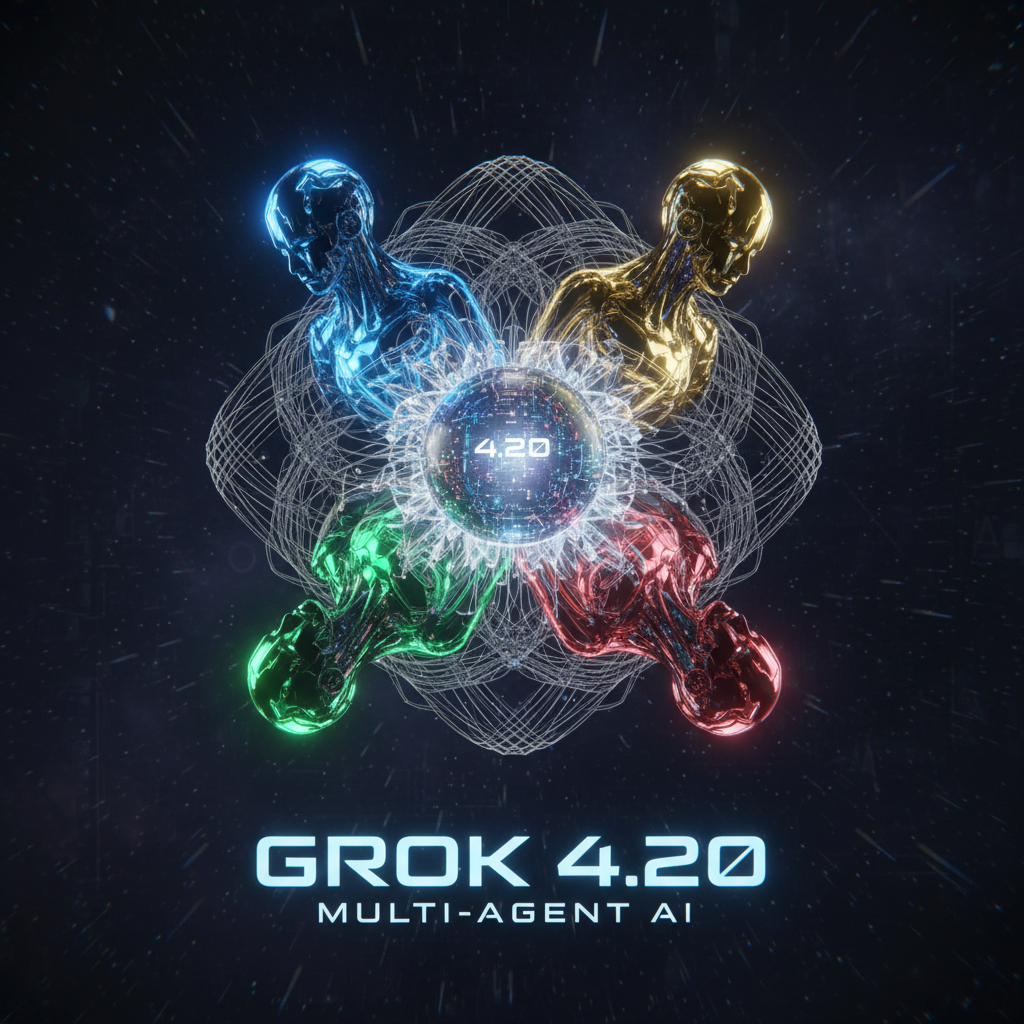
When xAI released Grok 4.20 in March 2026, the announcement carried more weight than a typical version bump. Buried beneath the performance benchmarks and capability claims was an architectural disclosure that signaled a fundamental reorientation of how large language models approach complex tasks. Grok 4.20 does not rely on a single monolithic inference path. Instead, it deploys a four-agent system—Reasoner, Coder, Researcher, and Orchestrator—each engineered for a distinct phase of problem decomposition and execution. The design marks a deliberate departure from the single-model paradigm that has dominated the industry since the earliest GPT-class systems.
The Grok 4.20 Architecture represents xAI’s answer to one of the most persistent bottlenecks in modern AI: the gap between general language understanding and reliable, multi-step task execution. A language model that can write poetry may still stumble when asked to debug a distributed system, gather supporting evidence, and validate its own output across three separate tool calls. Grok 4.20 attempts to close that gap by distributing cognitive labor across specialized agents that communicate through a structured orchestration layer. The result is a system that behaves less like a very large autocomplete engine and more like a miniature engineering team operating within a shared context window.
The Structural Shift: From Single-Model Inference to Multi-Agent Execution
For several years, scaling language models followed an intuitive logic: feed the model more parameters, more data, and more compute, and it will generalize better. The Grok 4.20 Architecture abandons this as the sole strategy. xAI recognized that raw parameter count does not automatically translate into reliable performance on compound tasks. A model trained to predict the next token across petabytes of text has no native mechanism for pausing, delegating a sub-problem to a specialized subroutine, and then synthesizing those results into a coherent response. That mechanism must be engineered.
Grok 4.20 addresses this through its four-agent design. Each agent is not a separate model instance in the traditional sense, but rather a dedicated processing role with its own inference pipeline, tool access, and feedback loop. The system allocates computational resources dynamically based on task complexity. Simple queries may resolve through the Orchestrator alone, while compound problems trigger the full agent chain: Researcher surfaces relevant context, Reasoner evaluates logical consistency, Coder produces executable artifacts, and Orchestrator manages the handoffs between them.
The Reasoner Agent: Logical Coherence Under Distributed Load
The Reasoner occupies the most conceptually demanding role in the Grok 4.20 Architecture. Where traditional language models apply a single forward pass to generate answers, the Reasoner agent engages in structured deliberation. It maintains an internal trace of logical dependencies, flags inconsistencies, and flags them before they propagate downstream to the Coder or Researcher agents. This explicit reasoning trace serves a dual purpose: it improves output quality and it provides interpretable audit trails for complex decision-making tasks.
In practice, the Reasoner agent in Grok 4.20 operates as a quality-control gate. When the Orchestrator routes a problem to it, the Reasoner decomposes the request into sub-claims and evaluates each against the available context. Claims that fail the logical consistency check are flagged for revision or passed back to the Orchestrator with a request for additional information. This iterative refinement distinguishes the Grok 4.20 Architecture from systems that rely on a single-shot inference pass, where errors committed early in the generation process tend to compound through the rest of the output.
The Coder Agent: Engineering Executable Outputs at Scale
Code generation has long served as a benchmark for language model capability. Grok 4.20 isolates this function within a dedicated Coder agent that has been fine-tuned specifically for software engineering tasks. The agent has access to compilation and execution environments, allowing it to validate its own outputs before returning them to the Orchestrator. This closed-loop execution model reduces the frequency of syntactically correct but semantically broken code that plagues many existing systems.
The Coder agent in the Grok 4.20 Architecture does not simply generate code snippets in response to prompts. It participates in a feedback cycle where the Reasoner agent’s logical evaluation and the Researcher’s contextual grounding inform the code it produces. When a user request involves building an API endpoint, the Researcher surfaces relevant documentation, the Reasoner validates the proposed logic, and the Coder generates, tests, and revises the implementation. This tri-agent collaboration produces outputs that are not only functionally correct but also aligned with the broader task objective established by the Orchestrator.
The Researcher Agent: Contextual Grounding and Information Synthesis
The third pillar of the Grok 4.20 Architecture is the Researcher agent. Its mandate is to gather, evaluate, and synthesize external information relevant to the task at hand. In traditional language model deployments, this function—if it exists at all—is implemented through brittle retrieval-augmented generation pipelines that lack deep integration with the model’s core reasoning loop. The Researcher agent in Grok 4.20 is architecturally native to the system, meaning it shares the same context management infrastructure as the other agents and can participate in the orchestration flow without costly context-switching overhead.
The Researcher agent draws from a curated set of information sources and tool APIs to assemble a relevant knowledge context before the Reasoner and Coder agents begin their respective phases. For compound research tasks, the agent can operate recursively—gathering information about the information it has already retrieved, refining the knowledge graph incrementally until the context is sufficient for downstream processing. This depth of integration is what allows Grok 4.20 to sustain coherent multi-step research chains that would degrade rapidly in a system relying on a single retrieval pass.
The Orchestrator Agent: Coordination Without Central Bottleneck
If the Reasoner, Coder, and Researcher agents are the specialists, the Orchestrator is the project manager. It receives the user’s initial request, decomposes it into phase-appropriate sub-tasks, routes those sub-tasks to the relevant agents, collects their outputs, and assembles a coherent final response. Critically, the Orchestrator in the Grok 4.20 Architecture is not a simple router. It maintains state across the entire task lifecycle, tracks dependencies between agent outputs, and can trigger re-execution of specific agent phases when downstream results reveal upstream deficiencies.
The Orchestrator’s design reflects xAI’s understanding that multi-agent systems are only as reliable as their coordination mechanism. Without effective orchestration, specialized agents produce excellent individual outputs that fail to combine into a useful whole. The Orchestrator prevents this by imposing a strict execution contract on each agent phase: outputs must meet defined format and completeness criteria before the Orchestrator advances the pipeline. This checkpoint-based workflow is conceptually similar to continuous integration in software engineering, where each stage of a build pipeline must pass validation before the artifact advances to the next environment.
Terafab Infrastructure: The Hardware Foundation for Distributed AI
No discussion of the Grok 4.20 Architecture is complete without examining the infrastructure that powers it. Grok 4.20 was trained on xAI’s latest Terafab compute cluster, a purpose-built facility designed to support the memory bandwidth and inter-agent communication demands of multi-agent inference. The Terafab name suggests a hierarchy beyond peta-scale computing, and the architecture of the cluster reflects the specific needs of a system where agents must communicate rapidly while maintaining independent inference contexts.
The Terafab cluster introduces a disaggregated memory architecture that allows individual agents within the Grok 4.20 system to maintain large working contexts without competing for a single GPU’s memory pool. This is a meaningful departure from earlier training infrastructure, which was optimized for batch training of a single large model. The Terafab design allocates memory and compute to agents dynamically, scaling individual agent contexts based on task requirements. For compound tasks that demand deep reasoning and large context windows simultaneously, this flexibility is not merely convenient—it is architecturally essential.
Why the Four-Agent Model Signals a Broader Industry Transition
xAI is not alone in exploring multi-agent architectures. The pattern of decomposing complex tasks across specialized model roles has emerged independently across multiple research groups and commercial AI labs. What distinguishes the Grok 4.20 Architecture is the degree to which the specialization is architecturally enforced rather than implemented through prompt engineering alone. When a language model begins its inference by routing a query through a dedicated Researcher agent before the Reasoner and Coder agents engage, the system is not simulating specialization through clever prompting. It is executing it as a first-class architectural decision.
This shift has implications that extend beyond Grok 4.20 itself. If multi-agent task decomposition becomes the dominant paradigm for high-capability AI systems, the metrics by which those systems are evaluated will need to change. Traditional benchmarks measure a single model’s accuracy on discrete tasks. The Grok 4.20 Architecture suggests a future where system-level benchmarks—measuring the quality of agent coordination, the reliability of cross-agent communication, and the robustness of orchestration logic—become as important as any single-agent performance metric.
The release of Grok 4.20 under the SpaceX umbrella also signals an organizational dimension worth noting. SpaceX’s engineering culture has historically prioritized vertical integration and proprietary tooling over off-the-shelf solutions. The Terafab infrastructure, the four-agent design, and the closed-loop execution model all reflect this ethos. Grok 4.20 is not merely a research contribution; it is a product of an engineering organization that has the infrastructure and the will to build its own path to capable AI.
Conclusion
The Grok 4.20 Architecture represents a substantive architectural bet by xAI: that the next frontier of AI capability lies not in further scaling of a single monolithic model, but in the organized collaboration of specialized agents. The Reasoner, Coder, Researcher, and Orchestrator agents each address a distinct failure mode of single-model inference—logical inconsistency, code reliability, contextual grounding, and execution coordination. Together, they form a system that approaches complex tasks the way an engineering team would: by decomposing the problem, applying specialized expertise to each component, and integrating the results under active orchestration.
Whether the Grok 4.20 Architecture achieves widespread adoption will depend on factors beyond raw performance metrics. The Terafab infrastructure required to run it efficiently is not accessible to most organizations, and the orchestration logic introduces its own failure modes that are not yet well understood. But the architectural direction is clear. The era of the single large model as the universal AI solution is giving way to something more structured, more distributed, and more deliberately engineered. Grok 4.20 is among the most concrete manifestations of that transition.
Internal Reference: For a deeper look at the infrastructure-level constraints that drive architectures like Grok 4.20, see our analysis of The Vera Rubin Architecture: How Nvidia’s H300 Is Solving the Trillion-Parameter Efficiency Bottleneck.
Source: New AI Model Releases and News — March 2026
Related: The Multi-Agent Tooling Explosion — Rowboat, Agno, and What It Means.
Related: AI Architecture Compaction 2026: Edge Inference Shift.
Discover more from Susiloharjo
Subscribe to get the latest posts sent to your email.