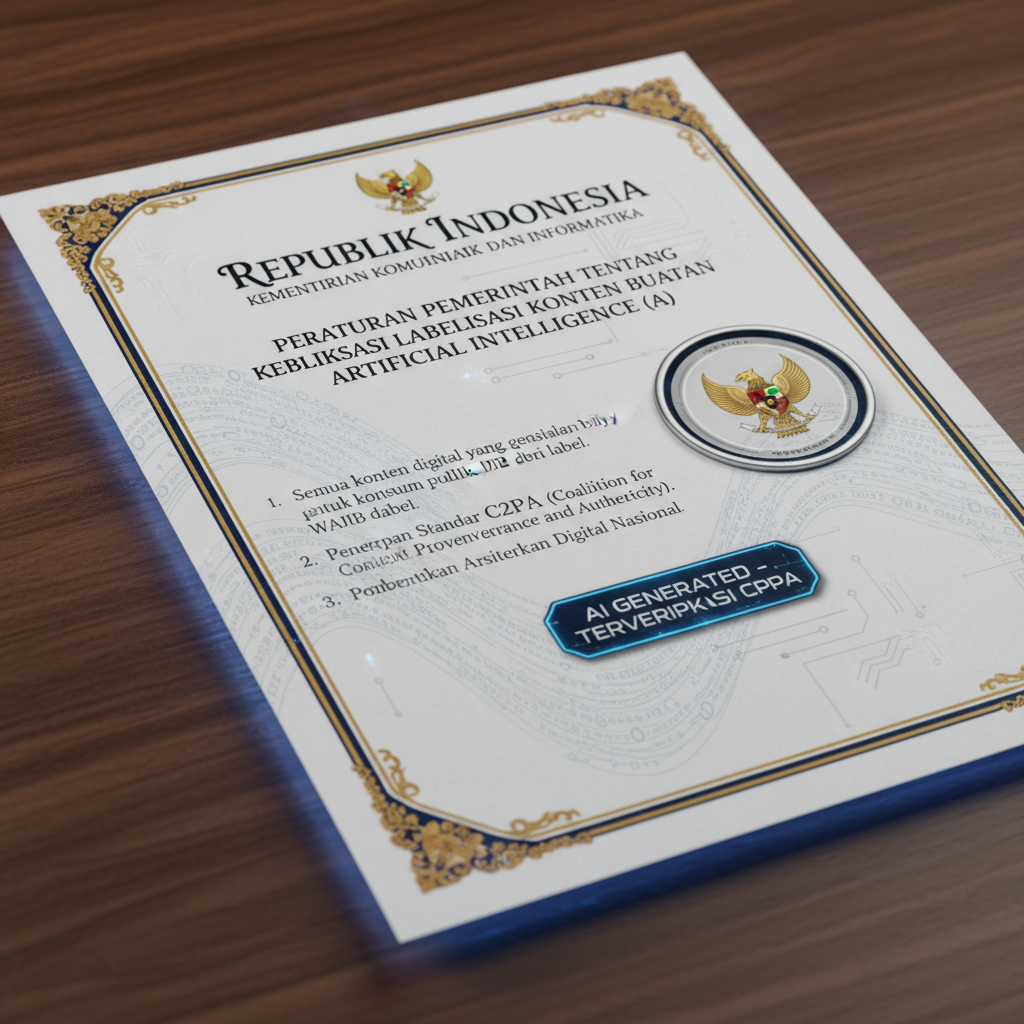
The Architecture of Trust: Decoding Indonesia’s New AI Content Labeling Mandate and the Future of Digital Provenance
In an era where synthetic media can mirror reality with uncanny precision, Indonesia’s recent move to implement a formal AI Content Labeling Mandate marks a significant turning point in the nation’s digital policy. As generative models proliferate, the necessity for transparency is no longer a matter of ethical best practice; it is becoming a cornerstone of information integrity. This mandate places the responsibility squarely on platforms and developers to ensure that the origin of digital content is verifiable, transparent, and accountable, mirroring a global shift toward stricter governance of autonomous creative systems.
For those tracking the evolution of intelligent systems, the context for this mandate is clear. As we move deeper into an era dominated by sophisticated models, understanding the underlying framework becomes essential. Readers interested in the broader technological landscape should review our analysis of the four-agent architecture, which highlights how multi-agent problem solving is already reshaping the digital ecosystem.
The Technical Foundations of the AI Content Labeling Mandate
At its core, the new AI Content Labeling Mandate is a requirement for technical clarity. Implementing such a policy requires a multi-layered approach to digital provenance. Unlike simple watermarks that can be easily removed or obfuscated, a robust labeling strategy integrates metadata directly into the file’s structure. This involves standardizing how AI-generated content is identified at the point of creation, ensuring that the provenance data survives compression, resizing, and reposting. The technical challenge lies not in the creation of these labels, but in their persistence throughout the lifecycle of the content across various platforms.
Beyond Watermarking: The C2PA Standard and Cryptographic Integrity
While visual watermarks provide a surface-level indication of synthetic origins, they are insufficient for the scale of current digital consumption. The industry is moving toward the Coalition for Content Provenance and Authenticity (C2PA) standard. C2PA provides an open technical specification that allows creators to embed tamper-evident provenance metadata into digital assets. By creating a cryptographic chain of custody, C2PA enables platforms to verify the history of an image, video, or audio file, proving whether it was generated or altered by AI. Indonesia’s adoption of such standards would move the needle from simple labeling to absolute verification.
Komdigi and the Regulatory Enforcement Landscape
The Ministry of Communication and Digital (Komdigi) faces the daunting task of enforcing these requirements. Enforcement is not merely a legal challenge but a technical one. Komdigi must develop mechanisms to scan for and validate metadata compliance without stifling the rapid innovation occurring within the local AI sector. This involves establishing auditing protocols for major platforms, ensuring that their generative APIs and interfaces output standard-compliant metadata. The regulatory success of the AI Content Labeling Mandate will likely depend on the Ministry’s ability to partner with tech giants to integrate these standards into the native infrastructure of the internet.
Comparative Analysis: Indonesia vs. The EU AI Act
Indonesia’s approach mirrors the ambition of the European Union’s AI Act, which classifies AI systems by risk levels and mandates strict disclosure requirements. However, where the EU focuses heavily on risk management and fundamental rights, Indonesia’s AI Content Labeling Mandate is deeply intertwined with the immediate need to combat disinformation in a highly connected society. The EU model provides a robust legal framework that Indonesia can adapt, but the local implementation must account for the unique linguistic and cultural nuances of the Indonesian internet, where rapid viral information cycles are the norm.
Challenges of Enforcement in Decentralized Ecosystems
Enforcement becomes significantly more complex in decentralized and open-source ecosystems. If a local user employs an open-source model running on local hardware to generate content, the connection between the creation and the labeling mandate is severed. Komdigi’s policy must therefore be nuanced enough to distinguish between enterprise-grade platform deployments and individual hobbyist use. The risk is that strict enforcement on major platforms might simply drive the creation of non-compliant synthetic content into decentralized, un-monitored environments, creating a two-tiered internet: one verified, one opaque.
The Future of Digital Provenance and User Trust
The long-term goal of the AI Content Labeling Mandate is to restore public trust in digital media. By creating a transparent ecosystem, users gain the ability to make informed decisions about the media they consume. As metadata standards evolve, we will likely see browsers and mobile operating systems automatically surfacing provenance information, giving users an ‘authenticity score’ for every piece of content they interact with. This is the future of digital provenance: a seamless, underlying verification layer that renders the distinction between authentic and synthetic media as clear as it is necessary.
As this mandate matures, the technical community must remain vigilant. Building an architecture of trust requires constant iteration, technical cooperation, and a willingness to adapt policies to the rapid pace of AI advancement. Indonesia is setting a precedent that will be closely watched by neighboring nations and the global community alike.
Related: The Four-Agent Architecture: Decoding xAI’s Grok 4.20 and the Shift Toward Multi.
Related: Build AIoT Predictive Line: Pharma Digital Twin Guide.
Discover more from Susiloharjo
Subscribe to get the latest posts sent to your email.