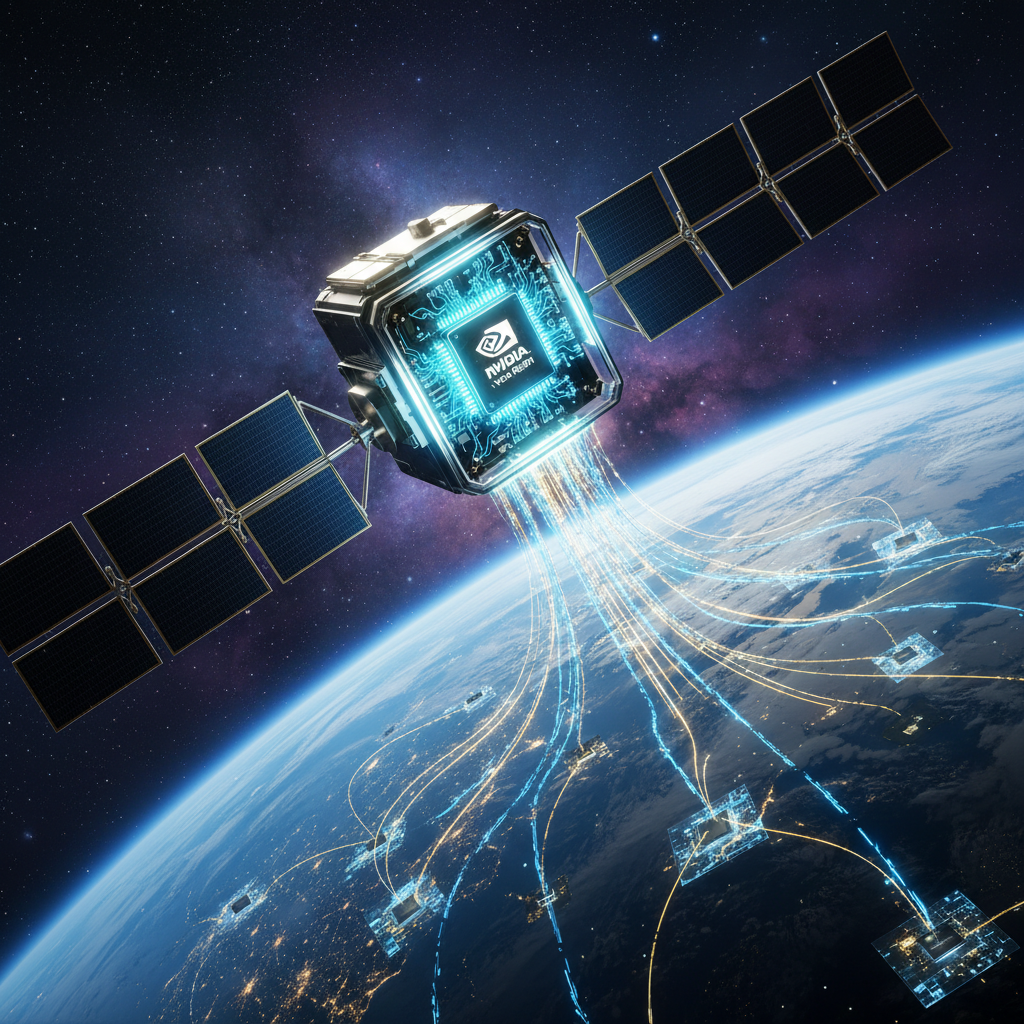
Space Computing AI: How NVIDIA’s Vera Rubin Module is Building Orbital AI Data Centers
Meta description: Space Computing AI reaches orbit with NVIDIA’s Space-1 Vera Rubin Module, delivering real-time autonomous control for lunar rovers and planetary infrastructure.
The boundary between terrestrial data centers and deep-space computing infrastructure is collapsing. NVIDIA’s March 2026 announcement of the Space-1 Vera Rubin Module marks a decisive pivot from experiment to operational reality: AI inference engines are now being qualified for orbital deployment, bringing physical intelligence to rovers, lunar habitats, and planetary bases without depending on Earth-bound round-trip latency.
The Architecture of Space-1: Data-Center Performance in a Space-Qualified Module
Space-1 Vera Rubin Module is not a scaled-down edge device repurposed for orbit. It is, in architectural terms, a full data-center compute node compressed into a radiation-hardened, thermally self-sustaining enclosure designed for launch vibration and extended orbital thermal cycling.
The module draws from the same silicon foundations as ground-based Rubin systems — delivering high-throughput AI inference within a power envelope and form factor that survives the gauntlet of space qualification. Companion hardware including IGX Thor and Jetson Orin Nano Super — configured for orbital thermal profiles — rounds out the compute fabric, providing sensor ingestion, real-time control loop closure, and model inference at distances where round-trip communication delays make cloud fallback untenable.
The engineering significance here is not simply miniaturization. It is the achievement of data-center-class computational density under constraints that terrestrial servers never encounter: single-event latch-up immunity, total-dose radiation tolerance across a multi-year mission profile, and passive thermal management in vacuum where convective cooling does not exist.
Radiation Hardening and Thermal Management: The Unsolved Problems That NVIDIA Solved
Two engineering challenges have historically kept high-performance AI out of orbit: radiation-induced bit-flipping in memory and compute logic, and the thermal impossibility of dissipating hundreds of watts in a vacuum environment. Space-1 addresses both through a combination of architectural redundancy, error-correcting memory hierarchies, and a thermal architecture that relies on radiation-capable heat pipes coupled to external radiators.
Radiation hardening at the transistor level remains expensive and slow. NVIDIA’s approach uses a combination of process selection, logic duplication with voting schemes, and software-level checksum verification to ensure that inference outputs remain deterministic even when cosmic ray events corrupt individual registers. The system does not attempt to prevent radiation interactions — it makes them irrelevant to the output.
Thermal management is solved through a layered approach: high-conductivity graphite composite spreading frames, phase-change heat storage for peak load transients, and deployable radiator surfaces that orient to deep space. The result is a thermal control system capable of maintaining junction temperatures within specification across illuminated and eclipse phases of low lunar orbit without active refrigeration.
Real-Time Autonomous Control: Rovers That Think Without Earth
The canonical use case for orbital AI has always been autonomous navigation and control — rovers that do not wait 1.3 seconds each way for a signal to reach Earth. With Space-1 Vera Rubin Module running onboard, rovers gain the ability to perform terrain classification, hazard detection, and path planning locally, at frame rates compatible with driving speeds that human operators would consider reasonable.
This is not teleoperation with added latency compensation. This is full onboard model inference: a convolutional vision pipeline feeding a sparse-attention world model, which in turn generates traversability cost maps updated in real time. The rover’s compute stack becomes the primary decision authority, with Earth serving as an oversight layer rather than a control hub.
Early deployment scenarios center on the Isaacman-administered NASA 2027 lunar lander missions, where pre-positioned robotic assets will need to assess landing zones, deploy surface infrastructure, and manage power budgets autonomously before human crews arrive. Space-1 provides the computational substrate those assets require to operate in a regime where command-and-control latency is measured in minutes, not milliseconds.
Physical AI Beyond Earth’s Atmosphere: When Machines Sense and Act in Context
Physical AI — the discipline of embedding perception, reasoning, and control into machines that interact with the physical world — has largely been demonstrated in controlled terrestrial environments. Space-1 extends that discipline to environments where the stakes are categorically different and where the operational context changes rapidly and unpredictably.
On the Moon, Physical AI must account for reduced gravity, electrostatic dust adhesion, thermal extremes spanning 200 degrees Celsius, and the complete absence of GPS or inertial reference systems calibrated for lunar geography. Space-1’s compute stack runs the sensor fusion, terrain mapping, and model-predictive control loops required to maintain operational continuity in these conditions without ground truth verification.
The broader implication is that the same architectural principles driving terrestrial Physical AI — unified perception-action models, real-time simulation-based validation, continual on-device fine-tuning — are now being ported to environments where they were previously considered impractical. Orbital deployment of Space-1 is not an isolated milestone. It is proof that Physical AI is becoming environment-agnostic.
Hardware Ecosystem: IGX Thor, Jetson Orin, and the Orbital Compute Fabric
Space-1 does not operate in isolation. NVIDIA’s orbital compute ecosystem comprises three distinct compute tiers designed to handle different workload profiles across a mission lifecycle.
IGX Thor serves as the high-throughput inference node — the system that runs large vision-language models, performs multi-modal sensor fusion, and maintains the long-horizon mission planning state. Its architecture prioritizes throughput per watt, using adaptive voltage and frequency scaling to maintain performance within thermal budgets that vary with spacecraft attitude and solar loading.
Jetson Orin Nano Super handles the real-time control layer — the millisecond-scale sensor-to-actuator loops that govern stabilization, limb tracking, and immediate hazard response. Its hardware-accelerated video encoding and object detection pipelines operate continuously without consuming the inference budget of the primary IGX Thor node.
Together, these two tiers form a compute architecture that separates fast reflex from slow deliberation — the same architectural pattern used in autonomous vehicle stacks, now qualified for deep-space operation.
From Orbit to Lunar Base Infrastructure: The 2027 Mission Profile
The Isaacman-directed NASA missions of 2027 represent the first operational deployment window for this entire stack. The mission architecture calls for autonomous pre-positioning of infrastructure — power systems, communication relays, and habitat modules — ahead of human landing. Space-1-powered rovers will perform site survey, hazard clearance, and initial power system deployment without real-time human input.
This is a fundamentally different mission architecture than Apollo, where astronauts performed every meaningful action within line-of-sight and real-time communication. The 2027 profile treats autonomous infrastructure deployment as a prerequisite for crewed arrival — and Space Computing AI as the enabling technology that makes that prerequisite achievable.
The long-term trajectory is a fully autonomous lunar supply chain: rovers that mine, process, and construct; habitats that self-configure; power systems that self-optimize. Space-1 is the first iteration of the compute infrastructure that makes that trajectory credible rather than aspirational.
Conclusion: Orbital AI Is No Longer a Projection
Space-1 Vera Rubin Module, IGX Thor, and Jetson Orin represent a convergence of capabilities that shifts Space Computing AI from the category of “interesting research” into the category of “operational engineering.” The challenges of radiation hardening and thermal management have been solved to the point where they no longer represent disqualifying constraints. The use cases — autonomous rovers, lunar infrastructure, real-time planetary operations — are defined and scheduled.
For engineers evaluating this space, the relevant question is no longer whether orbital AI is feasible. It is how to design systems that exploit it: how to structure models for on-device inference under power and thermal budgets that fluctuate with spacecraft geometry, how to validate physical AI behavior in simulated lunar environments before deployment, and how to build the software stack that allows a lunar rover to reason about terrain without ever contacting Earth.
That question will define the next several years of planetary robotics. Space-1 has provided the hardware substrate to begin answering it in practice rather than in simulation.
For a deeper dive into the Vera Rubin architecture powering these systems, see the full technical breakdown at The Vera Rubin Architecture: How NVIDIA’s H300 is Solving the Trillion-Parameter Efficiency Bottleneck. Official NVIDIA documentation on the Space-1 program is available at NVIDIA Space Computing.
Related: NVIDIA Vera Rubin: The 288GB HBM4 Beast for Trillion-Parameter AI.
Related: The Vera Rubin Architecture: NVIDIA’s 2026 Answer to the Trillion-Paramete.
Discover more from Susiloharjo
Subscribe to get the latest posts sent to your email.