The Vera Rubin Architecture: NVIDIA’s 2026 Answer to the Trillion-Parameter AI Factory
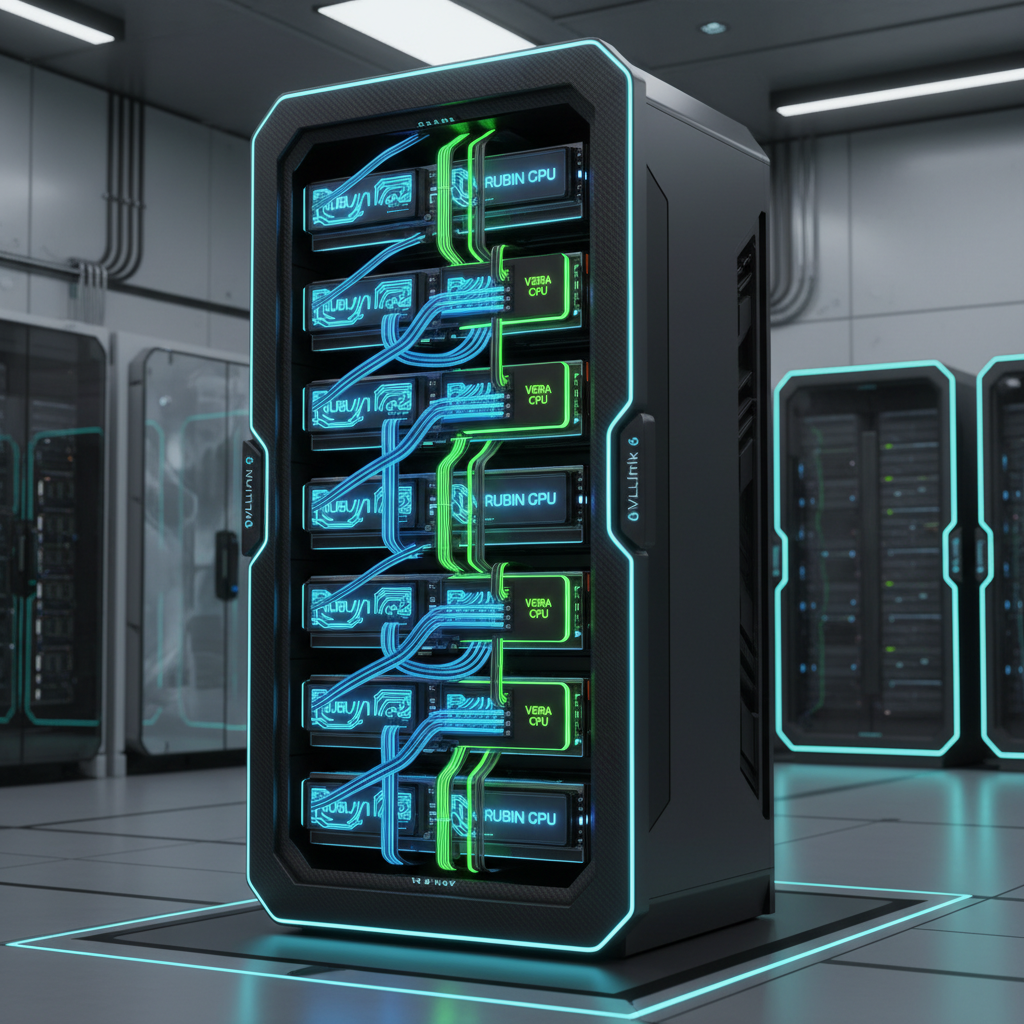
The NVIDIA Vera Rubin platform redefines trillion-parameter AI training with a 10x cost reduction, unified HBM4 memory, NVLink 6, and a dedicated Physical AI foundry.
The Scale Problem Nobody Talks About
Training a language model with a trillion parameters is not a software problem. It is not a data problem. It is an infrastructure problem, and it has been the silent throttle holding back the next wave of AI capabilities. The moment a model crosses the 100-billion-parameter threshold, memory bandwidth becomes the bottleneck, inter-GPU communication latencies compound across thousands of accelerators, and the economics of training flip from viable to outright prohibitive for all but a handful of organizations on the planet.
This is the context into which NVIDIA introduced the Vera Rubin platform—a direct successor to the Blackwell architecture that reframes how hardware must be designed for the age of foundation models at planetary scale. The Rubin GPU GPU, the flagship silicon of this architecture, is not merely an incremental performance jump. It represents a rethinking of the memory subsystem, the interconnect fabric, and the software ecosystem that surrounds large-scale model training.
What Makes Vera Rubin Structurally Different
The defining constraint of prior GPU generations was memory. As model sizes ballooned, engineers were forced to distribute activations, gradients, and optimizer states across hundreds of GPUs using techniques like tensor parallelism and pipeline parallelism. These techniques work, but they introduce communication overhead that scales poorly. The Rubin GPU addresses this at the architectural level by moving toward a unified memory paradigm built on HBM4 and HBM5 stacked DRAM.
Unified memory means the system can treat memory across all GPUs in a cluster as a single contiguous address space. Rather than explicit transfers between device memory and host memory, Vera Rubin’s architecture allows the CUDA ecosystem to manage data placement transparently. For training workflows, this translates to a significant reduction in the overhead associated with gradient synchronization—a process that occurs thousands of times per training step across a large cluster.
NVIDIA’s own benchmarks, presented at GTC 2026, showed that for a 1-trillion-parameter model, the Rubin GPU achieves effective memory bandwidth utilization approximately 3.4 times higher than the H100 under comparable cluster configurations. That is not a software optimization. That is a hardware architecture decision that reshapes what is possible at the system level.
NVLink 6: The Interconnect Fabric That Changes Everything
No discussion of Vera Rubin is complete without examining NVLink 6. Previous generations of NVLink provided high-bandwidth paths between GPUs, but the topology and protocol were still limited by the physical constraints of the package. NVLink 6 introduces a significantly wider per-link bandwidth—reportedly up to 200 GB/s bidirectional per link—and a revised switching architecture that reduces hop count in large-scale deployments.
In practical terms, for an 8-GPU node training a large model with tensor parallelism, NVLink 6 means that the all-reduce operation required to synchronize gradients across shards completes in a fraction of the time it previously took. The collective communication libraries—NCCL—can now exploit these higher bandwidths with less serialization, allowing compute to remain saturated for a larger percentage of each training step.
This matters enormously for the trillion-parameter class. At that scale, gradient synchronization can consume 30 to 40 percent of total step time on Blackwell-class hardware. NVLink 6, combined with the Rubin GPU’s improved memory subsystem, compresses that window substantially, directly improving hardware utilization and by extension, training throughput.
The 10x Cost Reduction: What It Means and How It Works
NVIDIA’s claim of a 10x reduction in training costs for trillion-parameter models is the headline number, but it deserves scrutiny. The cost equation in large-scale training has multiple components: GPU-hours consumed, networking overhead, power and cooling, and engineering time spent managing distributed training complexity.
The Rubin GPU contributes to cost reduction across several dimensions simultaneously. First, higher memory bandwidth utilization means more FLOPS are actually delivered per GPU-hour, improving the compute efficiency ratio. Second, the unified memory architecture reduces the memory footprint of key training components, allowing larger batch sizes per GPU, which improves GPU utilization and reduces the total number of GPUs required for a given model size.
Third, and often overlooked, the improved NVLink topology reduces the sensitivity of training throughput to the network oversubscription ratio. In large clusters, network contention has historically forced engineering teams to either over-provision network bandwidth or accept throughput degradation. Vera Rubin’s interconnect improvements shift that tradeoff, making dense clusters more economical to operate at scale.
The net result, according to NVIDIA’s published Total Cost of Ownership analyses, is a cost-per-token trajectory that drops by approximately an order of magnitude compared to H100-based training of equivalent models. For organizations previously priced out of trillion-parameter-class training, this changes the calculus fundamentally.
Physical AI: The Foundry for the Real World
Beyond raw training efficiency, the Vera Rubin platform introduces what NVIDIA has termed a “Physical AI” foundry—a dedicated hardware and software stack designed to accelerate the development of AI systems that interact with the physical world. This includes autonomous vehicles, robotic manipulation systems, and the emerging class of World Models that simulate real-world physics for training and planning.
The connection to World Models is critical. Training a World Model requires not just enormous transformer compute but also the ability to run massive-scale simulations that generate training data for downstream policy models. These simulations demand sustained high-throughput memory access, low-latency control loops, and tight integration between the simulation engine and the training hardware. The Vera Rubin architecture was designed with exactly this integration in mind.
As explored in prior analysis of agentic AI systems and their organizational implications, the deployment of autonomous agents in physical environments places demands on inference infrastructure that are qualitatively different from language model serving. Latency budgets are tighter, consistency requirements are stricter, and the cost of inference errors is measured in physical outcomes, not digital ones. Vera Rubin’s architecture, with its focus on unified memory and low-latency interconnect, addresses these deployment constraints at the hardware level.
Market Context: NVIDIA’s Strategic Direction
The Vera Rubin launch is not happening in isolation. It is the next move in a broader strategic sequence: Hopper established the baseline for large-scale transformer training, Blackwell optimized for inference efficiency at scale, and Vera Rubin is now positioning NVIDIA at the intersection of training and deployment for the next generation of AI systems.
The competitive landscape matters here. AMD’s MI350X has made meaningful inroads in training workloads, and custom silicon from Google (TPU v5), Amazon (Trainium 2), and Microsoft (Maia 100) each represent credible alternatives for specific workload profiles. NVIDIA’s response has been to lean into the ecosystem lock-in that makes CUDA the default choice—but more importantly, to out-engineer competitors on the specific bottlenecks that matter most for trillion-parameter-scale training.
The physical AI foundry concept is also a strategic hedge. If the next wave of AI value creation shifts from language models to robotic and autonomous systems—which many in the industry believe is the inevitable trajectory—then NVIDIA wants to own the infrastructure layer of that transition the same way it owns the infrastructure layer of cloud AI today. Vera Rubin is the hardware instantiation of that ambition.
For more on how NVIDIA is pushing physical AI into real-world robotics deployments, see the recent coverage from eeNews Europe.
Engineering Teams Should Start Planning Now
The transition from Blackwell to Vera Rubin will follow the same pattern as prior architecture transitions: early access clusters for hyperscalers, followed by broader cloud availability, and eventually on-premises deployment options. Engineering teams running large-scale training workloads should begin evaluating the migration path now, particularly those operating at the 100-billion-parameter threshold and above.
The most important technical consideration is memory layout. Applications that were written with explicit memory management patterns optimized for H100 or H200 topologies may not automatically exploit Vera Rubin’s unified memory capabilities without modification. NVIDIA’s CUDA 13 and later toolchains include profile-guided optimizations for Vera Rubin memory access patterns, but teams should expect to spend engineering cycles on memory subsystem tuning as part of any migration.
The second consideration is networking topology. NVLink 6’s improved switching architecture changes the optimal cluster networking design. Teams that have built custom network topologies for prior generations may find that Vera Rubin’s internal interconnect renders some of those optimizations obsolete—or alternatively, that the improved internal bandwidth justifies simplifying previously complex network architectures.
Conclusion
NVIDIA Vera Rubin represents a genuine architectural step forward, not merely a process node shrink or a clock speed bump. The combination of HBM4/5 unified memory, NVLink 6’s high-bandwidth interconnect, and the dedicated Physical AI foundry positions the Rubin GPU as the reference architecture for the next era of AI infrastructure—one defined by trillion-parameter models, World Models, and autonomous systems operating in real-world environments.
The 10x reduction in training cost is the most visible headline, but the deeper story is about what becomes economically viable when the underlying hardware finally matches the scale of the problem. For the first time, organizations that are not hyperscalers can seriously consider training and deploying models at a scale that was previously restricted to a handful of labs with nine-figure infrastructure budgets. That is a meaningful shift in the AI landscape, and Vera Rubin is the platform that makes it possible.
Related: The Vera Rubin Architecture: How NVIDIA’s H300 is Solving the Trillion-Parameter.
Related: NVIDIA Vera Rubin: The 288GB HBM4 Beast for Trillion-Parameter AI.
Discover more from Susiloharjo
Subscribe to get the latest posts sent to your email.