Security Lessons from Middle East War
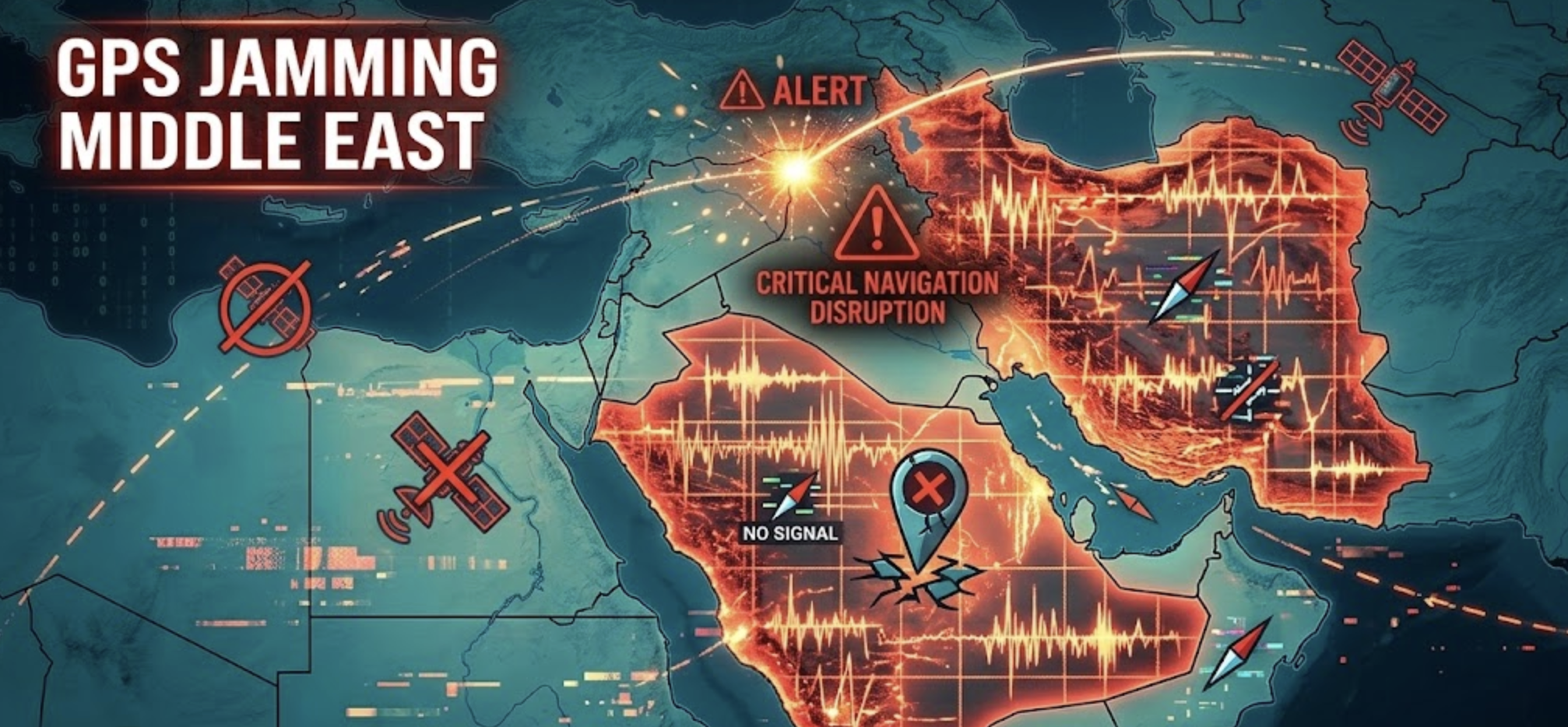
The Middle East has emerged as the primary testing ground for GNSS spoofing operations in 2026. Open-source intelligence indicates that the region experiences more coordinated GPS interference events than any other theater globally. This development carries profound implications for national security planners, critical infrastructure operators, and military strategists navigating the new landscape of hybrid warfare.
The Rise of Coordinated GNSS Disruption
Analysts observing the conflict zones note a significant evolution in electronic warfare tactics. What began as isolated jamming incidents has transformed into sophisticated, multi-vector spoofing campaigns capable of misleading both civilian and military positioning systems. The strategic use of GNSS disruption has become a cornerstone of modern asymmetric conflict, enabling non-state actors and state forces alike to level the technological playing field.
The technical architecture of these attacks has grown increasingly complex. Security researchers distinguish between two primary attack vectors: symmetric and asymmetric radio frequency operations. Symmetric attacks involve direct signal amplification, essentially overwhelming legitimate GNSS transmissions with stronger counterfeit signals. Asymmetric approaches exploit vulnerabilities in receiver firmware, manipulating navigation messages without requiring massive transmission power.
Evidence suggests that asymmetric techniques have gained preference among sophisticated operators. These methods offer lower detection profiles and can be executed with commercially available hardware. The democratization of spoofing capability represents a fundamental shift in the threat landscape, one that traditional defense frameworks struggle to address.
Maritime Implications: The Strait of Hormuz
The Strait of Hormuz presents a particularly concerning case study. Automatic Identification System data reveals persistent anomalies in vessel positioning throughout 2025 and early 2026. Shipping operators report navigation systems displaying false positions offset by several kilometers from actual locations. The implications for global energy markets, which depend heavily on tanker traffic through this chokepoint, cannot be overstated.
Maritime security analysts describe the situation as a form of economic coercion through technical means. The ability to manipulate AIS data, which under international law must be transmitted by vessels over 300 gross tons, creates opportunities for sanctions evasion, smuggling operations, and psychological operations against international shipping. The technology enabling these capabilities has proliferated rapidly, with GNSS spoofing-as-a-service platforms now offering subscription-based disruption capabilities to anyone with sufficient cryptocurrency.
From a strategic security standpoint, the Strait of Hormuz incidents demonstrate the vulnerability of systems designed assuming GNSS integrity. The International Maritime Organization has issued warnings, but technical standards for resilient navigation remain under development. The gap between threat evolution and defensive adaptation continues to widen.
Military Versus Civilian GNSS Robustness
The disparity between military and civilian GNSS resilience has become a critical factor in conflict calculus. Armed forces worldwide have invested heavily in encrypted signal capabilities, anti-spoofing algorithms, and complementary navigation systems. Civilian infrastructure, however, remains largely exposed.
| Capability | Military GNSS | Civilian GNSS |
|---|---|---|
| Signal Encryption | P(Y) code, M-code, encrypted PRS | Open service, C/A code only |
| Anti-Spoofing Modules | Hardware authentication, signal diversity | Basic cryptographic verification |
| Alternative Navigation | Inertial, celestial, quantum augment | Limited or none |
| Detection Capability | Real-time threat identification | Post-incident analysis |
| Redundancy Architecture | Multi-constellation, multi-frequency | Single-frequency, GPS-dependent |
| jammer Resistance | High-power tolerant, directed patterns | Vulnerable to deliberate interference |
The table above illustrates the fundamental asymmetry. While military systems incorporate multiple layers of protection, civilian receivers typically lack even basic authentication mechanisms. This vulnerability extends beyond navigation to encompass timing infrastructure upon which financial networks, telecommunications systems, and power grids depend.
The Spoofing-as-a-Service Threat Model
Open-source reporting has documented the emergence of commercial platforms offering GNSS disruption as a managed service. These operations function similarly to cloud computing providers, allowing clients to lease spoofing capabilities without developing internal expertise. The model lowers the barrier to entry for state and non-state actors seeking precision timing disruption capabilities.
Security analysts note that attribution remains extremely difficult in spoofing operations. The technical fingerprints of different attack tools can be masked through relay chains and signal routing. This ambiguity creates strategic space for plausible denial, complicating response frameworks under international law.
The implications for critical infrastructure protection are severe. Power grid operators, financial institutions, and telecommunications providers all depend on GPS timing with accuracies measured in nanoseconds. The potential for cascading failures through coordinated timing disruption represents a systemic risk that transcends traditional cybersecurity paradigms.
Defensive Posture and Strategic Recommendations
From a hybrid warfare perspective, the Middle East experience offers several lessons. First, the assumption of GNSS reliability in conflict planning is strategically dangerous. Forces must develop and maintain alternative positioning capabilities, including inertial navigation systems, celestial navigation, and emerging quantum positioning technologies.
Second, civilian infrastructure protection requires immediate attention. The national security community must work with industry to deploy resilient timing alternatives, including fiber-optic time distribution and enhanced civilian signal authentication. The cost of inaction far exceeds the investment required for meaningful hardening.
Third, international governance frameworks must evolve to address the proliferation of spoofing capabilities. Current regulations prove inadequate against both state actors operating below thresholds of armed conflict and non-state groups leveraging commercial technology.
The Middle East has provided a laboratory for GNSS warfare that all nations now must study. The lessons emerging from this theater will shape military doctrine and critical infrastructure protection for decades. Those who fail to learn from these operations risk finding themselves technologically surprised at moments of maximum strategic consequence.
Related Article: LiteLLM on Embedded Linux: Orchestrating Lightweight LLMs at the Edge 2026
Source: GPS World – The Middle East is a Hotbed of GPS Spoofing
Related: AI Agent Security Architecture: Lessons From Operation PowerOFF 2026.
Related: AI Agent Security & DDoS: Lessons from Operation PowerOFF.
Discover more from Susiloharjo
Subscribe to get the latest posts sent to your email.