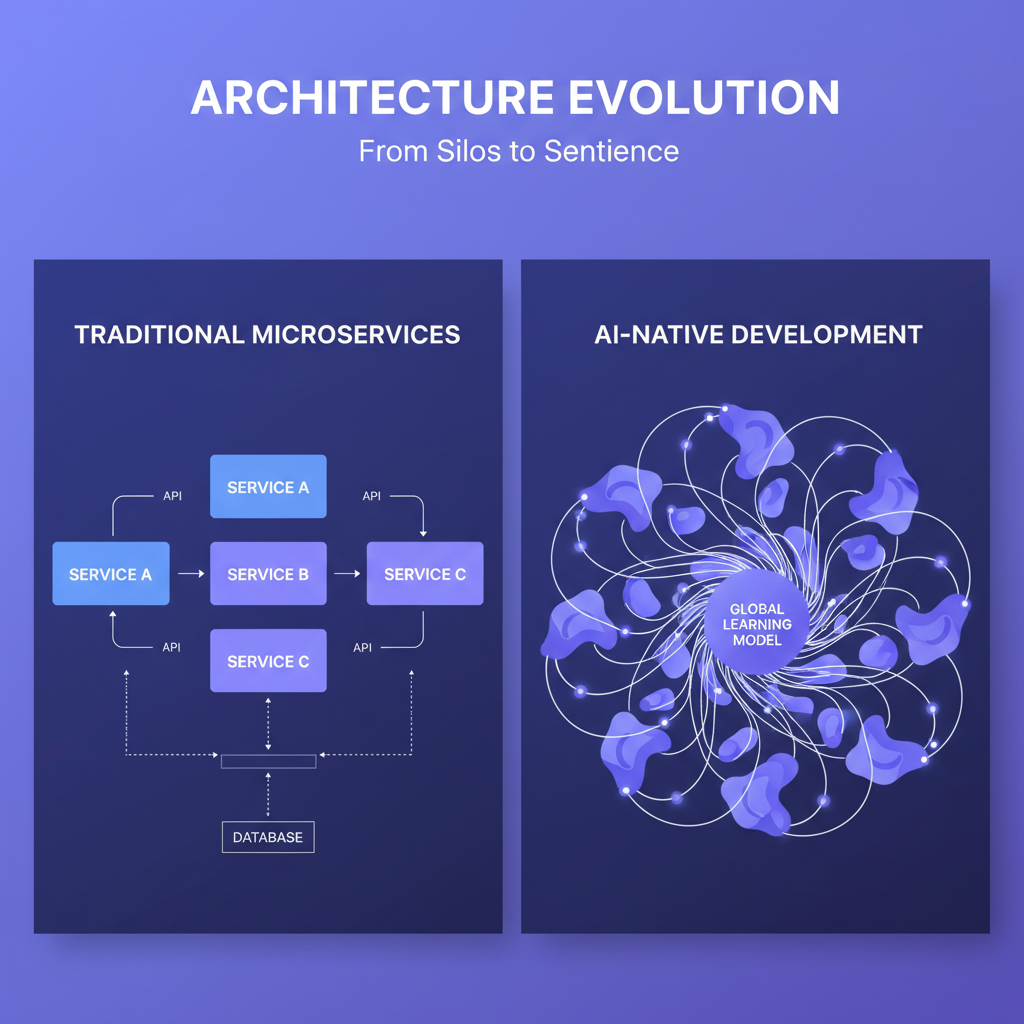
Beyond Microservices: Adopting 4 AI-Native Development Patterns in 2026
Introduction: The End of Microservices Era
The microservices architecture has dominated software development for nearly a decade. Since Martin Fowler popularized the pattern in 2014, companies large and small have adopted service decomposition to achieve scalability, team autonomy, and faster deployment cycles. However, the landscape is shifting dramatically.
As we move through 2026, a new paradigm is emerging: AI-Native Development. This isn’t just about adding AI features to existing monoliths or microservices—it’s about fundamentally rethinking how we build, deploy, and operate software. The rise of autonomous agents, large language models (LLMs), and new interoperability protocols is creating a seismic shift in software architecture.
In this article, we’ll explore four AI-Native development patterns that are redefining how engineers work in 2026. These patterns address the unique challenges of building AI-augmented systems: prompt management, agent orchestration, context sharing, and human oversight.
Pattern 1: Agentic Workflow
The first and most transformative pattern is the Agentic Workflow—a departure from traditional linear pipelines toward autonomous, multi-step agent execution. Unlike conventional software where every behavior is explicitly coded, agentic systems delegate complex tasks to AI agents that can reason, plan, and execute across multiple steps.
Tools like Claude Code, Cline, and Roo Code represent this shift. These aren’t just AI assistants that autocomplete code; they’re autonomous agents capable of:
- Understanding high-level intent and breaking it into executable tasks
- Iterating on solutions without human intervention for routine problems
- Self-correcting based on feedback from test runs or code reviews
- Coordinating with other agents to handle complex multi-file changes
In practice, agentic workflows look like this: a developer provides a specification, and the agent autonomously writes code, runs tests, refactors based on results, and submits a pull request—all while keeping the human in the loop for critical decisions.
The implications for development teams are profound. Instead of writing boilerplate code or manually coordinating between services, engineers become orchestrators of agent swarms. This doesn’t eliminate the need for skilled developers—it elevates their role to defining strategy, setting constraints, and validating outcomes.
Pattern 2: MCP Protocol (Model Context Protocol)
The second pattern addresses one of the most challenging problems in AI development: context management. As AI agents interact with multiple tools, data sources, and services, they need a unified way to share context—enter the Model Context Protocol (MCP).
MCP is rapidly becoming the standard for AI system interoperability. Originally inspired by JSON-RPC and similar protocols, MCP provides a clean abstraction layer that allows AI models to:
- Access external tools through standardized interfaces
- Share state and context between different AI components
- Interact with databases, APIs, and file systems in a uniform way
- Maintain conversation history and user preferences across sessions
Think of MCP as the “USB-C of AI”—a universal connector that enables any AI model to plug into any data source or tool. In 2026, major AI providers are adopting MCP as the de facto standard for agent interoperability.
For developers, MCP means不再需要为每个AI工具编写独立的集成代码. Instead, you define a single MCP server that exposes your data and tools, and any compatible AI agent can consume them. This dramatically reduces integration complexity and enables true plug-and-play AI ecosystems.
Related to this shift, the industry is also exploring Zero Trust A2A (Agent-to-Agent) communication, which extends security principles to autonomous agent interactions.
Pattern 3: LLM-Ops / AI CI/CD
If you’re familiar with DevOps, you’ll recognize the pattern: LLM-Ops applies the same principles of continuous integration, delivery, and monitoring to AI models, specifically LLMs. But it’s not just about automating model deployment—it’s about managing the entire lifecycle of prompts, fine-tuning, and evaluation.
The three pillars of LLM-Ops in 2026 are:
Prompt Versioning
Prompts are now treated as first-class code artifacts. Just as you version your source code, you version your prompts. Tools like PromptHub, Scale Spellbook, and custom solutions built on Git enable teams to:
- Track changes to prompts over time with full history
- A/B test different prompt variations
- Roll back to previous prompt versions when issues arise
- Collaborate on prompt engineering through PRs and code reviews
Evaluation Pipelines
Evaluating LLMs is fundamentally different from traditional software testing. You can’t assert exact outputs—instead, you need guardrails, quality metrics, and regression testing. Modern LLM-Ops pipelines include:
- Automated evaluation suites that measure helpfulness, harmfulness, and relevance
- Regression detection when model updates degrade quality
- Threshold-based gating for production releases
- Human annotation workflows for ambiguous cases
Continuous Fine-Tuning
Rather than static model deployments, LLM-Ops embraces continuous improvement. Teams collect production data, identify failure modes, and iteratively fine-tune models to address specific failure cases—all automated through CI/CD-like pipelines.
As Martin Fowler noted in his analysis of LLM-Ops, the discipline is becoming as critical as traditional DevOps. Meanwhile, platforms like InfoQ are documenting how mature organizations are operationalizing these practices.
Pattern 4: Human-in-the-Loop Architecture
The fourth pattern recognizes a crucial reality: AI should augment humans, not replace them. Human-in-the-Loop (HITL) architecture explicitly designs for human oversight at critical decision points. This isn’t just about ethics—it’s about building systems that are more robust, trustworthy, and aligned with business objectives.
HITL architecture comes in several forms:
Approval Gates
AI agents can propose actions, but humans must approve high-stakes operations. Examples include:
- Database schema changes requiring senior engineer sign-off
- Financial transactions above certain thresholds
- Production deployments that could affect customer-facing systems
- Content generation that may have legal or compliance implications
Feedback Loops
Instead of one-way AI execution, HITL systems create continuous feedback loops:
- Human ratings on AI outputs train better models over time
- Explicit corrections are incorporated into fine-tuning data
- User feedback triggers re-evaluation of AI decisions
Graceful Degradation
When AI confidence is low or edge cases arise, HITL systems seamlessly escalate to human operators. This ensures that AI handles the 80% of cases it’s excellent at, while humans handle the 20% where AI lacks certainty or context.
The business case for HITL is compelling: it combines AI speed with human judgment, reduces risk of catastrophic AI failures, and builds trust with stakeholders who might otherwise be skeptical of autonomous systems.
Microservices vs AI-Native: A Comparison
| Aspect | Microservices Architecture | AI-Native Architecture |
|---|---|---|
| Primary Unit of Deployment | Service/API | Agent/Prompt/Model |
| Inter-service Communication | REST, gRPC, Message Queues | MCP, A2A Protocols |
| State Management | Databases, Distributed Caches | Context Windows, Vector Databases |
| Error Handling | Retry circuits, fallbacks | Human escalation, confidence thresholds |
| Testing Focus | Unit, integration, contract tests | Evaluation suites, guardrail tests |
| Developer Role | Code implementer, service owner | Orchestrator, prompt engineer, evaluator |
| Scalability Model | Scale by replicating services | Scale by adding model capacity + context |
| Operational Complexity | High (service mesh, orchestrators) | Moderate (new tooling, different skills) |
Conclusion & Trade-offs
AI-Native development patterns represent a fundamental shift in how we build software. Agentic workflows automate routine tasks, MCP enables interoperability, LLM-Ops brings rigor to AI lifecycle management, and Human-in-the-Loop ensures we maintain control over high-stakes decisions.
However, these patterns come with trade-offs. Agentic workflowsrequire new debugging approaches and can produce unpredictable behaviors. MCP is still maturing as a standard. LLM-Ops demands new skills in prompt engineering and evaluation design. HITL adds latency and requires human availability.
The key insight for 2026 is this: **you don’t have to choose between microservices and AI-Native**. The mostsuccessful architectures will be hybrids—leveraging microservices for stable, predictable workloads while deploying AI-Native patterns for tasks that benefit from intelligence, autonomy, and adaptation.
The future belongs to teams that can balance these approaches thoughtfully.
Discover more from Susiloharjo
Subscribe to get the latest posts sent to your email.