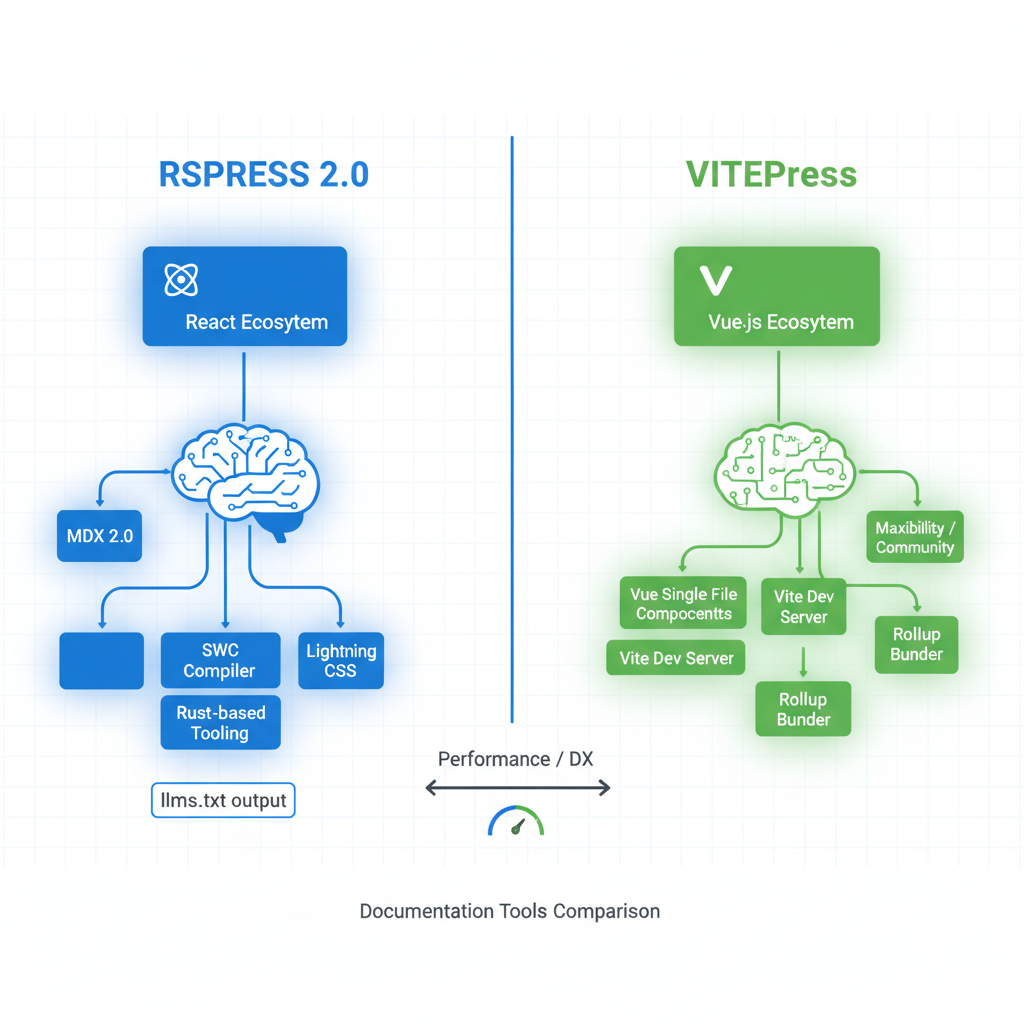
Beyond VitePress: How Rspress 2.0 Optimizes Docs for AI Agents
The documentation tooling landscape continues to evolve rapidly as artificial intelligence becomes an integral part of developer workflows. Rspress 2.0, released on January 30, 2026, represents a significant leap forward in how technical documentation is created, delivered, and consumed by AI agents. This static site generator introduces a fundamentally different approach to documentation architecture, one that prioritizes machine readability alongside human usability.
The Rise of AI-Native Documentation
Traditional documentation tools were designed exclusively for human readers. Developers created content optimized for visual presentation, navigation, and readability on screen. However, the emergence of large language models and AI-powered coding assistants has fundamentally changed this equation. Modern AI agents increasingly need to consume, parse, and synthesize documentation to provide accurate recommendations and generate code.
Rspress 2.0 addresses this shift through its innovative SSG-MD (Static Site Generation to Markdown) pipeline. Unlike conventional static site generators that focus primarily on producing HTML output for browsers, Rspress 2.0 renders documentation through React’s virtual DOM to produce clean, structured Markdown optimized specifically for AI agents and LLMs. This approach generates an llms.txt file alongside the traditional documentation site, providing AI systems with a clean, predictable format for information extraction.
The strategic importance of this feature cannot be overstated. Organizations investing in documentation now have a solution that serves both human developers and AI systems without requiring duplicate content creation or complex transformation pipelines.
Performance Powered by Rust
At the core of Rspress 2.0 lies a modern toolchain built on Rsbuild and Rspack, both leveraging Rust for maximum performance. This architectural choice delivers what the development team describes as “blazing fast build speed” and “instant startup” through lazy compilation and persistent caching mechanisms.
The performance characteristics of Rspress 2.0 contrast sharply with JavaScript-based alternatives. Rust’s memory safety guarantees and parallel processing capabilities translate into build times that can be orders of magnitude faster for large documentation projects. For teams managing extensive component libraries or multi-version documentation, this speed improvement translates directly into reduced CI/CD pipeline times and faster iteration cycles.
The persistent caching system further enhances performance by intelligently reusing compilation artifacts across builds. Documentation teams working on large projects report that subsequent builds complete in seconds rather than minutes, dramatically improving the development experience when making incremental documentation changes.
React Ecosystem Integration
Rspress 2.0 embraces the React ecosystem as its primary framework, offering full MDX support that allows developers to embed React components directly within Markdown files. This capability enables documentation authors to create interactive demonstrations, live code playgrounds, and dynamic examples that would be impossible to achieve with static content alone.
Component library maintainers particularly benefit from this integration. Documentation can showcase UI components with actual rendered examples, complete with interactive controls that allow readers to manipulate props and observe behavior in real-time. This approach produces documentation that is not merely descriptive but genuinely educational.
The React foundation also means that teams already invested in the React ecosystem can leverage existing component libraries, styling solutions, and development patterns without learning new abstractions or tooling.
Modern Search and Code Highlighting
Documentation discoverability remains critical for developer experience, and Rspress 2.0 provides robust search capabilities out of the box. The platform includes built-in full-text search functionality that indexes documentation content efficiently, providing instant results as users type queries. For organizations requiring more sophisticated search infrastructure, the system also offers Algolia plugin support for enterprise-grade search with advanced features like typo tolerance and analytics.
Code highlighting in Rspress 2.0 uses Shiki, a build-time syntax highlighter that produces VS Code-consistent highlighting. This represents a meaningful improvement over Prism-based solutions, as Shiki generates accurate highlighting for a broader range of programming languages and produces HTML that is visually consistent with what developers see in their editors. The build-time nature of Shiki also means that no JavaScript library needs to load in the browser for syntax highlighting to work, contributing to faster page load times.
Enterprise-Grade Features
Beyond the core documentation functionality, Rspress 2.0 includes features specifically designed for enterprise use cases. Multi-version documentation support allows teams to maintain and serve documentation for multiple versions of their software simultaneously, with clean navigation between versions. This capability proves essential for libraries and frameworks that need to support users on different release tracks.
Internationalization (i18n) support enables documentation teams to create and manage content in multiple languages, with automatic routing based on user locale or explicit language selection. The platform’s architecture makes it straightforward to maintain parallel translation trees while sharing common configuration and theming across language variants.
These enterprise features combine to make Rspress 2.0 suitable for organizations of significant scale, from startups with single-product documentation needs to large enterprises managing complex product portfolios across global markets.
Comparing Rspress 2.0 and VitePress
Understanding where Rspress 2.0 fits in the documentation landscape requires direct comparison with established alternatives. VitePress, while popular and capable, represents a different architectural philosophy centered on the Vue.js ecosystem. The following comparison highlights key differentiators that organizations should consider when selecting documentation tooling.
| Feature | Rspress 2.0 | VitePress |
|---|---|---|
| AI-Native Output | Yes – llms.txt generation | No |
| Build Speed | Rust-powered (Rsbuild/Rspack) | Fast (Vite-based) |
| Ecosystem | React + MDX | Vue.js + MDX |
| MDX Support | Full React components in Markdown | Full Vue components in Markdown |
| Search | Built-in + Algolia plugin | Algolia DocSearch integration |
The table above illustrates that while both tools offer modern documentation capabilities, their design priorities differ substantially. Rspress 2.0 explicitly targets AI agent consumption as a first-class concern, whereas VitePress focuses on traditional human-focused documentation with a polished Vue-based experience.
For organizations building autonomous agent orchestration systems or similar AI-forward infrastructure, Rspress 2.0’s AI-native architecture provides meaningful advantages in how AI systems can access and utilize documentation content.
Conclusion
Rspress 2.0 represents a thoughtful evolution in documentation tooling, recognizing that the audience for technical documentation has expanded beyond human developers to include AI agents and large language models. Its Rust-powered toolchain delivers exceptional performance, while its React-based architecture provides the flexibility needed for interactive documentation experiences.
The platform’s AI-native features, particularly the llms.txt generation capability, position it as a forward-thinking choice for organizations preparing for a future where AI-assisted development becomes the norm rather than the exception. Combined with enterprise features like multi-version support and internationalization, Rspress 2.0 offers a compelling alternative to established tools like VitePress for teams prioritizing AI agent compatibility alongside excellent human developer experience.
For teams evaluating documentation solutions in 2026 and beyond, Rspress 2.0 merits serious consideration as a platform designed specifically for the demands of AI-augmented development workflows.
Related: “ESP-IDF MCP Server: AI Agents Powered by Official Docs”.
Related: Simon Sinek: Beyond Start With Why — What Most Bios Miss.
Discover more from Susiloharjo
Subscribe to get the latest posts sent to your email.