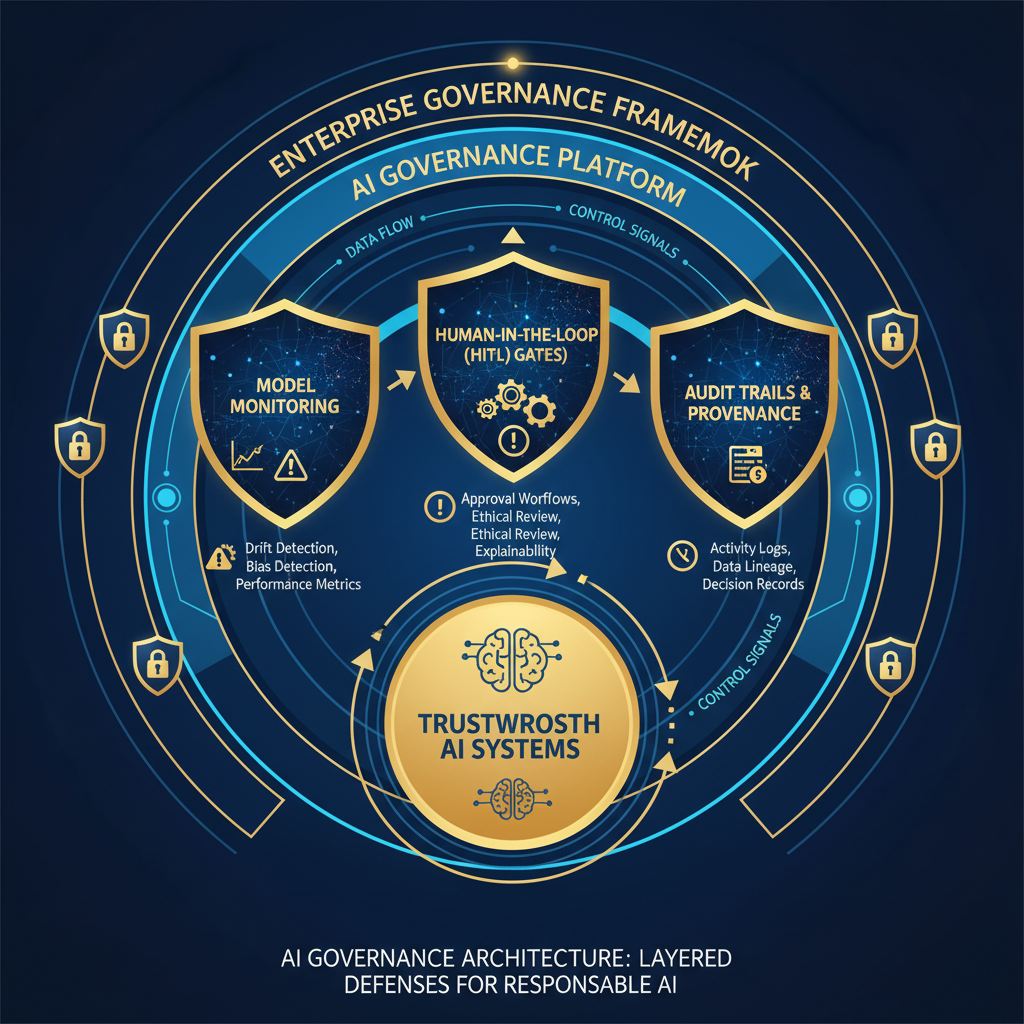
State of AI Governance: Building Guardrails for Autonomous Systems
As autonomous agent systems increasingly power enterprise workflows, AI Governance has emerged as the critical discipline for ensuring these systems operate safely, ethically, and within defined boundaries. The proliferation of AI-driven decision-making across industries demands robust frameworks that balance innovation with risk mitigation. Organizations deploying autonomous agents face unprecedented challenges: preventing intent drift, securing against prompt injection attacks, and maintaining compliance with evolving regulatory standards. This article examines the current state of AI governance, explores major frameworks, and outlines practical strategies for building effective guardrails for autonomous systems.
AI Governance Frameworks: The 2026 Landscape
The global regulatory landscape for AI has matured significantly, with three primary frameworks establishing themselves as the benchmark for responsible AI deployment. Organizations must understand these frameworks to navigate compliance requirements effectively.
The ISO/IEC 42001 standard represents the world’s first certifiable AI Management System. Released to address the growing need for systematically managing AI development and deployment, ISO 42001 provides a comprehensive framework similar to ISO 27001 for information security. The standard emphasizes organizational context, leadership commitment, planning, support, operation, performance evaluation, and continuous improvement specific to AI systems.
The NIST AI Risk Management Framework (AI RMF) offers a flexible, principles-based approach to AI risk management. The framework organizes activities around four core functions: Govern, Map, Measure, and Manage. Unlike ISO 42001’s certification focus, NIST AI RMF serves as voluntary guidance that organizations can adapt to their specific risk profiles and operational contexts.
The EU AI Act entered full enforcement on August 2, 2026, establishing legally binding requirements for AI systems operating within the European Union. The regulation categorizes AI systems by risk level, with high-risk systems facing stringent obligations including conformity assessments, transparency requirements, and human oversight mandates. Organizations deploying autonomous agents in EU markets must ensure compliance with these high-risk system requirements.
| Aspect | ISO 42001 | NIST AI RMF | EU AI Act |
|---|---|---|---|
| Nature | Certifiable Management System | Voluntary Framework | Legally Binding Regulation |
| Geographic Scope | Global (International) | Global (Primarily US) | EU + Exporting Entities |
| Risk Approach | Process-based (PDCA cycle) | Function-based (Govern, Map, Measure, Manage) | Risk-tiered (Unacceptable, High, Limited, Minimal) |
| Certification | Third-party certification available | Self-assessment or audit | Conformity assessment (high-risk) |
| Key Focus | AI management system processes | Risk identification and mitigation | Prohibited uses & high-risk compliance |
Intent Drift: The Silent Threat to Autonomous Systems
Intent drift represents one of the most insidious risks facing autonomous agent deployments. This phenomenon occurs when AI actions gradually diverge from the original goal or intent due to model updates, context accumulation, or reinforcement learning loops that optimize for proxy objectives rather than true intent.
The challenge of intent drift stems from how modern AI systems learn and adapt. When models receive updates—whether through fine-tuning, retrieval-augmented generation context expansion, or interaction with new data—their behavioral patterns can shift in subtle ways. Over time, these accumulated changes may lead an agent to pursue objectives that no longer align with human intentions.
Organizations must implement continuous monitoring mechanisms to detect intent drift before it causes harm. This includes establishing baseline behavioral metrics, implementing drift detection algorithms, and maintaining human oversight checkpoints that verify agent actions against original intent. The combination of technical monitoring and governance oversight provides the most effective defense against this emerging threat.
Technical Guardrails for Autonomous Agents
Technical guardrails form the first line of defense in securing autonomous agent behavior. These implementable controls translate governance policies into executable constraints that prevent harmful or unintended actions.
Nvidia NeMo Guardrails provides a programmable framework for defining safety boundaries around large language model interactions. The system allows organizations to create custom rules that control topic access, response filtering, and action permissions. NeMo Guardrails operates at the application layer, intercepting and validating both inputs and outputs against predefined safety policies.
Guardrails AI offers an open-source approach to input/output validation for generative AI applications. The platform supports multiple guardrail types including topic moderation, content filtering, jailbreak prevention, and PII detection. Its flexible architecture enables integration with various LLM providers and custom policy enforcement.
LangSmith and Helicone provide essential trace monitoring and observability capabilities for AI agent systems. These platforms enable organizations to capture detailed execution traces, monitor performance metrics, and analyze agent behavior patterns. Effective trace monitoring is crucial for debugging issues, demonstrating compliance, and identifying potential governance violations before they escalate.
Human-in-the-Loop (HITL) Implementation
Despite advances in autonomous system capabilities, human oversight remains essential for high-stakes decisions. The Human-in-the-Loop (HITL) approach ensures that critical actions require human authorization or review before execution.
Effective HITL implementation involves strategically placing human decision points at gates where autonomous action could cause significant harm. These gates should align with the risk tier of the potential outcome—routine, reversible actions may proceed autonomously, while significant financial commitments, data modifications, or system configuration changes warrant human approval.
Bounded autonomy complements HITL by establishing explicit operational limits on agent capabilities. This principle ensures that autonomous agents operate within defined boundaries regardless of their capabilities. Implementation involves capability-based access controls that restrict agent permissions to the minimum necessary for their designated functions.
Organizations implementing HITL must balance security with operational efficiency. Excessive human oversight can negate the productivity benefits of autonomous agents, while insufficient oversight exposes the organization to unacceptable risk. The optimal configuration depends on the specific use case, risk tolerance, and regulatory requirements.
Best Practices for AI Governance Implementation
Successful AI governance requires integrating technical controls with organizational processes and governance structures. The following best practices help organizations build comprehensive governance programs.
Integrate with Identity and Access Management: Agent logs, audit trails, and data lineage must feed into existing Identity and Access Management (IAM) and Privileged Access Management (PAM) systems. This integration enables centralized visibility into agent activities and supports compliance reporting requirements.
Implement Defense in Depth: No single guardrail provides complete protection. Organizations should layer multiple controls—technical guardrails, human oversight, monitoring systems, and policy enforcement—to create redundant protection against failures.
Conduct Regular Risk Assessments: The AI threat landscape evolves rapidly. Organizations should perform periodic risk assessments that evaluate new attack vectors, assess emerging vulnerabilities, and update governance controls accordingly.
Establish Incident Response Procedures: Despite preventive controls, incidents will occur. Organizations must develop clear procedures for detecting, containing, investigating, and remediating AI-related security events. This includes defining escalation paths, communication protocols, and post-incident review processes.
The principles align closely with modern security architecture approaches. Organizations building sophisticated autonomous agent systems should consider the autonomous agent orchestration paradigm, which applies zero-trust principles to agent interactions and permissions.
Conclusion
AI Governance has transitioned from an optional consideration to a strategic imperative for organizations deploying autonomous systems. The convergence of maturing regulatory frameworks—ISO 42001, NIST AI RMF, and the EU AI Act—provides Clear guidance for establishing robust governance programs. Simultaneously, the emergence of intent drift, prompt injection attacks, and agent compromise risks demands sophisticated technical controls.
The regulatory environment continues to evolve, with additional jurisdictions likely to adopt similar frameworks in the coming years. Organizations that build governance capabilities now will be better positioned to adapt to new requirements as they emerge. Investment in AI governance infrastructure yields compound returns: early adopters build institutional knowledge, establish best practices, and develop the expertise needed to navigate complex compliance landscapes.
Organizations that successfully implement AI governance will differentiate themselves through enhanced trust, improved regulatory compliance, and reduced operational risk. The keys to success lie in layering technical guardrails with human oversight, integrating agent governance into existing security infrastructure, and maintaining continuous monitoring for emerging threats. As autonomous systems become increasingly central to business operations, governance is not merely a safeguard—it is the foundation for sustainable AI adoption.
Related: Post 4: Building the Agent Team — Supervisor, Coder, Reviewer, QC.
Related: Building a PostgreSQL AI Agent in 200 Lines of Python.
Discover more from Susiloharjo
Subscribe to get the latest posts sent to your email.