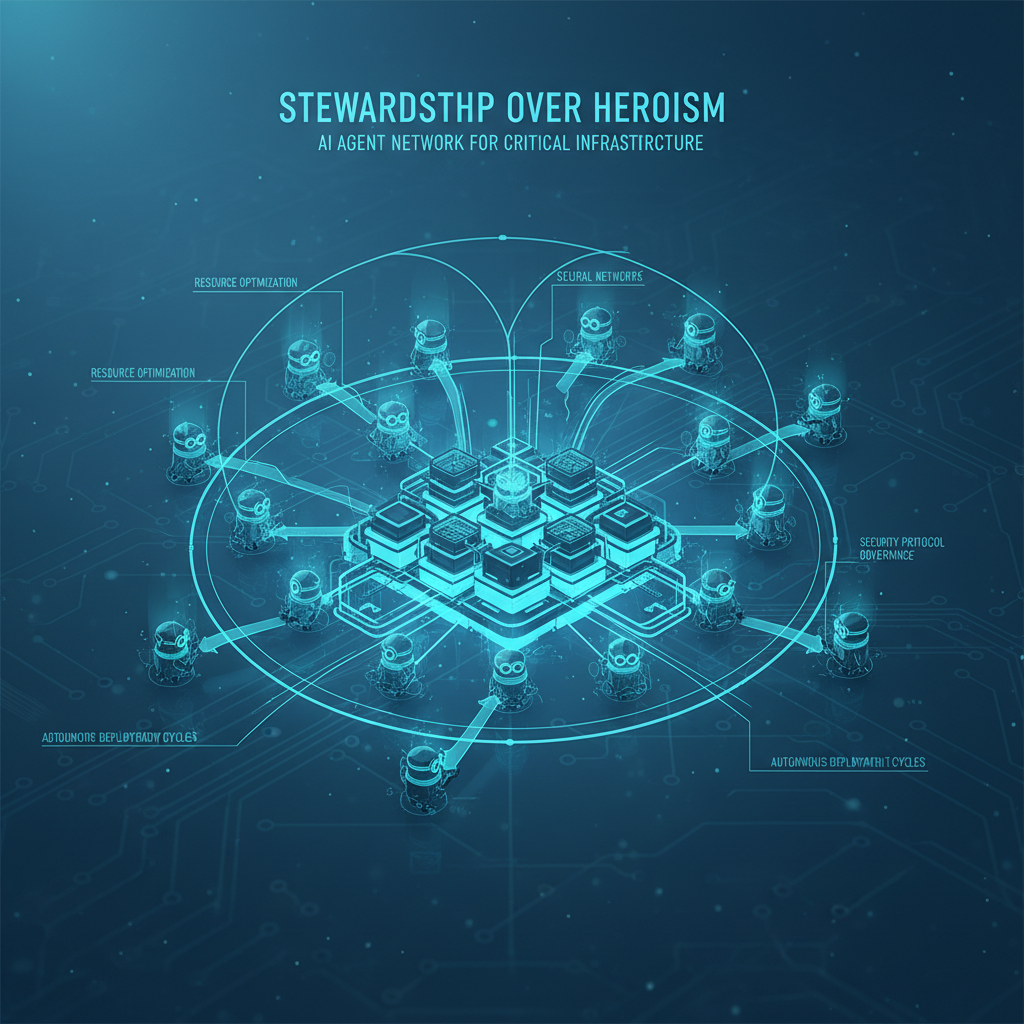
Beyond Chatbots: How Agentic AI is Redefining Organizational Structures from Heroism to Stewardship
The software industry stands at a inflection point. For decades, engineering organizations have operated on a model of human heroism: skilled engineers diagnose production fires, manually patch critical systems, and carry institutional knowledge that no ticket tracker can capture. That model is now being stress-tested at scale—and a growing number of engineering leaders are asking whether heroism is a feature or a bug.
At Stripe, the question yielded an unexpected answer. The company’s internal agentic infrastructure—informally called the “Minions” system—now generates and merges approximately 1,300 pull requests per week with no direct human coding. The system’s architecture offers a rare, detailed look at how autonomous AI agents can operate within a production engineering environment, and more importantly, what their existence means for how organizations are structured.
What Is Agentic AI? Moving Beyond Reactive Prompts
To understand the shift Stripe represents, it helps to define the distinction clearly. Traditional large language model applications operate reactively: a user submits a prompt, the model generates a response, and a human evaluates the output. The model has no persistent memory of prior actions, no awareness of downstream consequences, and no ability to pursue multi-step goals across sessions. It is a powerful autocomplete engine dressed in conversational clothing.
Agentic AI inverts this paradigm. Rather than responding to single prompts, agentic systems are granted agency—the ability to perceive context, plan a sequence of actions, execute those actions against an environment, observe outcomes, and iterate. These systems can spawn sub-agents, call tools, read and write files, run tests, and make decisions within predefined guardrails. They are not chatbots with better vocabulary; they are autonomous programs that use language models as their reasoning engine.
This distinction matters because it changes the nature of the human role. A chatbot makes a human more productive per session. An agentic system makes a human’s judgment more scalable across time and volume.
Inside Stripe’s Minions: Blueprints, Nodes, and the Architecture of Autonomous Code
The ByteByteGo analysis of Stripe’s internal tooling reveals an architecture that is deliberately hybrid. Rather than building a monolithic AI system that attempts to do everything, Stripe’s Minions infrastructure is constructed from composable units called “Blueprints.” Each Blueprint defines a specific workflow—a migration, a refactor, a dependency update—and combines two categories of nodes.
The first category is deterministic nodes. These perform reliable, side-effect-free operations: reading a file, parsing a configuration, running a specific test suite, validating a schema. Deterministic nodes are predictable by design. They represent the fraction of software work that is procedural and verifiable—operations that require no judgment call, only correctness.
The second category is agentic nodes. These invoke language models to make decisions that require reasoning: determining whether a migration is safe given the current state of a codebase, deciding how to resolve a merge conflict, identifying which test cases are most likely to catch a regression in a given change. Agentic nodes are where the system’s intelligence lives, and where the system’s limitations become visible.
The genius of the Blueprint architecture lies in how these node types compose. Deterministic nodes provide reliability anchors—they guarantee that file operations succeed, that tests run, that outputs are parseable. Agentic nodes provide flexibility—they handle the cases that require understanding intent, context, and tradeoffs. Together, they produce a system that is both more reliable than a pure LLM approach and more capable than a pure automation approach.
1,300 Pull Requests Per Week: What the Numbers Actually Mean
The headline figure is striking: approximately 1,300 pull requests merged per week, with no direct human authorship. But the figure deserves closer examination because it reveals both the power and the boundaries of the current system.
These are not creative, novel pieces of architecture. They are, in the majority of cases, mechanical refactors that follow well-understood patterns: updating deprecated API calls across a service, bumping dependency versions, rewriting test assertions after an interface change. The work that Minions performs is precisely the kind of work that burns out senior engineers—not because it is difficult, but because it is tedious, high-volume, and requires deep context to execute correctly.
This is the first and most immediate value of the system: it absorbs the volume work that would otherwise crowd out an engineer’s ability to do meaningful architectural thinking. But the second-order effect is more interesting. When routine mechanical work is offloaded to agents, the remaining human work shifts toward boundary cases, architectural decisions, and the kinds of judgment calls that require understanding business context, organizational politics, and long-term system health.
In other words, the Minions system does not replace senior engineers. It makes senior engineers’ time more valuable by eliminating the work that dilutes their attention.
The Pendulum of Tension: Developer Experience Versus System Reliability
Lesley Cordero has articulated what many engineering leaders feel instinctively: there is a persistent tension in software organizations between developer experience and system reliability. Improving developer experience often means making tradeoffs that increase system complexity or reduce strict control. Improving reliability often means adding friction that slows down developers.
Agentic AI complicates this pendulum in a fundamental way. When AI agents are writing code, the question of who is accountable for that code’s correctness becomes genuinely ambiguous. Is it the agent? The engineer who prompted it? The team that deployed the agent? The organization that defined its constraints?
Stripe’s Blueprint model addresses this through what amounts to a contract model: Blueprints define not just what an agent should do, but what it is allowed to do, what it must verify before acting, and what conditions require human escalation. This is less a technical constraint and more a governance structure encoded into the system’s architecture.
The pendulum does not disappear—it swings differently. Instead of balancing developer velocity against system reliability, engineering leaders now balance agent autonomy against organizational accountability. The tools change; the fundamental tension does not.
From Heroism to Stewardship: The Organizational Shift No One Is Discussing
The most underappreciated consequence of agentic AI adoption is not technical—it is organizational. The engineering profession has long celebrated heroism: the senior engineer who pulls an all-nighter to save a launch, the architect who holds the entire system in their head, the on-call engineer who personally diagnoses a production incident at 3 AM. This heroism is genuine, often admirable, and fundamentally unsustainable.
Stewardship represents a different operating philosophy. A steward does not personally perform every critical task; a steward ensures that the systems under their care are healthy, that the agents operating within them are properly constrained and monitored, and that human judgment is applied where it matters most. The shift from heroism to stewardship is not a demotion of human engineers—it is a redefinition of their role at a higher level of abstraction.
Concretely, this means engineers increasingly become designers of agentic behavior rather than executors of individual tasks. They define the Blueprints, set the deterministic guardrails, establish the escalation paths, and monitor the system’s outputs. The day-to-day work of writing and reviewing mechanical code gives way to the meta-work of designing the systems that write and review code at scale.
This transition is not without friction. It requires engineers to develop new competencies—prompt engineering discipline, systems thinking at the organizational level, and comfort with delegation to agents whose reasoning is not always transparent. It also requires organizations to rethink performance evaluation, since the traditional metrics of individual coding output become less relevant in an agentic environment.
World Models: The Grounding Layer That Makes Agentic Planning Possible
There is a technical reason why earlier generations of autonomous AI agents failed to achieve production-grade reliability: they lacked a coherent model of the environment they were operating in. A language model generating code in a vacuum cannot verify that the code it generates will integrate correctly with an existing system. It cannot anticipate how a refactor will affect dependent services. It cannot plan across multiple steps with confidence that intermediate states will be correct.
World Models address this gap by providing agents with a predictive understanding of their environment. Rather than treating each prompt as an isolated event, World Models allow agents to simulate the consequences of actions before executing them—to build an internal representation of how a system is likely to respond to a given change. This predictive grounding is what transforms a powerful autocomplete engine into a capable planning agent.
The connection to systems like Stripe’s Minions is direct: the Blueprints architecture works precisely because it combines the World Model-style predictive reasoning of agentic nodes with the grounded, verifiable operations of deterministic nodes. Neither component is sufficient alone. Without deterministic guardrails, agentic nodes make too many errors. Without agentic reasoning, deterministic nodes cannot handle the variability of real-world codebases.
For organizations exploring agentic AI, this architecture offers a design principle: build the reasoning layer on top of a reliable execution layer, not instead of one. The future of reliable agentic systems is hybrid by necessity.
What Engineering Leaders Should Take Away
Stripe’s Minions system is not a preview of a distant future—it is a current production system operating at significant scale. The lessons it offers are practical, not theoretical.
First, the architecture matters more than the model. Stripe’s success with Blueprints demonstrates that the organizational value of agentic AI comes from well-designed workflows, not from raw model capability. The models are commoditizing rapidly; the architecture of how they are combined with deterministic operations is where competitive differentiation lives.
Second, the human role is not diminishing—it is elevating. As agents handle volume work, the remaining human work shifts toward judgment, design, and accountability. Organizations that invest in developing engineers’ ability to design and oversee agentic systems will compound their advantage over those that treat agentic AI as a headcount replacement.
Third, governance is a technical problem. The question of what agents are allowed to do, under what conditions they must escalate, and how their outputs are audited is not an HR conversation—it is an engineering architecture conversation. Systems like the Minions make this explicit by encoding governance directly into the Blueprint structure.
The transition from heroism to stewardship is underway. The organizations that understand it as an architectural and philosophical shift—not just a tooling upgrade—will be best positioned to navigate what comes next.
Explore the World Models foundation that enables this class of autonomous systems in our introduction to World Models and their role in bridging LLMs and physical reality. For a detailed breakdown of the Minions architecture, see the ByteByteGo case study on Stripe’s pull request automation.
Related: Vibe Coding vs Agentic Engineering: Where I Draw the Line.
Related: Image AI Models Drive App Growth Beyond Chatbots.
Discover more from Susiloharjo
Subscribe to get the latest posts sent to your email.