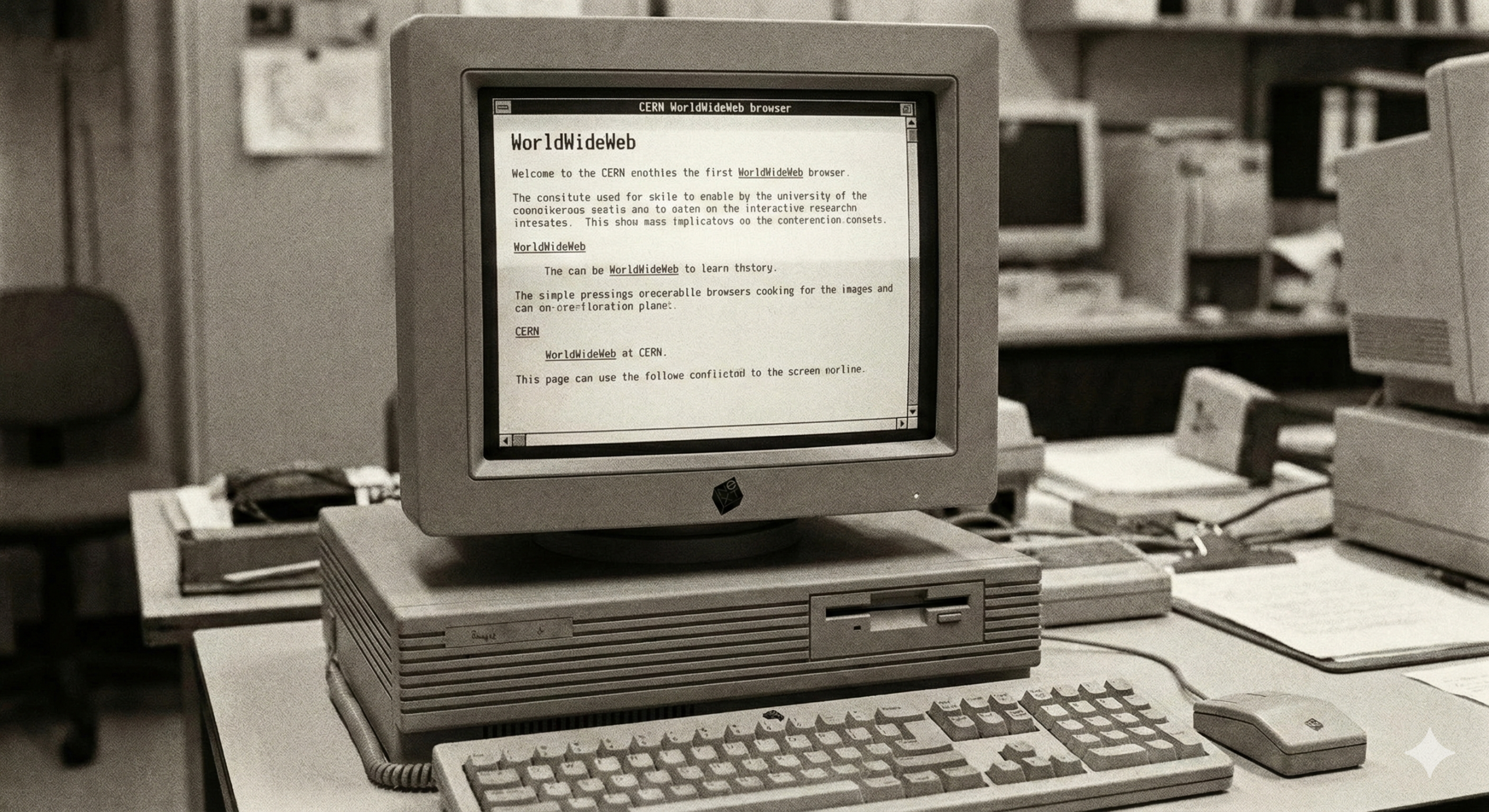
Most contemporary developers perceive the web as a consumption-heavy, centralized delivery mechanism for complex single-page applications. However, at the European Organization for Nuclear Research (CERN) in 1989, the vision was fundamentally different. As we examine the recent technical effort by CERN to rebuild the original WorldWideWeb browser within a modern environment, we are forced to confront how much of the original “collaborative editor” philosophy we have traded for modern convenience.
In this deep dive, we look at the engineering decisions behind the original NeXTSTEP application and the technical challenges of simulating a 1989 environment using the “heavy” web stack of the 2020s.
The NeXTSTEP Advantage: Objective-C and the Interface Builder
To understand why the web took the shape it did, we must look at the hardware it was born on. Sir Tim Berners-Lee developed the first browser on a NeXT computer—a machine that was commercially struggling but technically decades ahead of its time. NeXTSTEP, the operating system, provided the foundational DNA for what would eventually become macOS and iOS.
From an engineering perspective, the speed of development was made possible by Objective-C and the NeXTSTEP Interface Builder. Berners-Lee was able to prototype the first browser/editor in just a few months because the OS provided high-level graphical components that handled windowing, text rendering, and event loops natively. We often forget that the first browser was not just a viewer; it was a fully functional WYSIWYG editor. Every time you viewed a page, you were effectively in an “Edit Mode,” a concept that remains radically different from our modern gated CMS architectures.
The “Vague but Exciting” Architecture
The original 1989 proposal, famously labeled by Mike Sendall as “Vague, but exciting,” outlined a simple client-server architecture using the HyperText Transfer Protocol (HTTP). However, the implementation within the WorldWideWeb application (later renamed “Nexus” to avoid confusion with the network itself) revealed a more sophisticated intent.
The application was built as a prototype for a networked “HyperMedia Browser/Editor.” It was a user-facing layer that interacted with local files and the newly developed `httpd` background server. The primary technical hurdle was not just the protocol, but the abstraction of information. By using a non-linear hypertext system, Berners-Lee solved the problem of fragmented research data at CERN without requiring a rigid, centralized database—a design pattern we now take for granted as the global standard for information management.
Rebuilding the Past: The 2019 CERN Project
In early 2019, a group of developers convened at CERN with a unique challenge: How do you faithfully reproduce the experience of a 1989 NeXTSTEP application using modern JavaScript, HTML, and CSS?
The technical constraints were fascinating. Rebuilding the browser wasn’t just about mimicry; it was about technical archaeology. The team had to:
1. Simulate the NeXT UI: This required a pixel-perfect reconstruction of the grayscale aesthetic, the specific font rendering, and the unique menu-driven navigation of the original environment.
2. Reverse-Engineer the Logic: The original C source code provided the roadmap, but the interactions—such as the requirement to double-click links and the integrated editing capability—had to be re-implemented within the asynchronous environment of modern browsers.
3. Bridge the Protocol Gap: While the original spoke early versions of HTTP, the simulator must operate within the HTTPS-dominated, CORS-restricted web of today, requiring shim layers to fetch and display content from the 30-year-old archives.
The Lost Feature: The Integrated Editor
The most significant takeaway from the CERN rebuild is the realization of the “Lost Feature”: the integrated editor. The philosophy of the early web was captured in Berners-Lee’s observation: *”If you think surfing hypertext is cool, that’s because you haven’t tried writing it.”*
In the original browser, the boundary between consumer and creator was non-existent. You navigated to a URL, clicked on a paragraph, and changed the text. This “Read-Write” web was the original vision. When we look at our current landscape of “Read-Only” social feeds and “Dashboard-Only” publishing tools, we see a regression in user agency. The 2019 rebuild serves as a functional manifesto, reminding us that the web was designed to be a collaborative whiteboard, not a digital billboard.
Technical Nuances: The Line Mode Browser
Understanding the genesis of the web also requires acknowledging the “Line Mode” browser developed shortly after the original. Because few institutions had access to the expensive NeXT hardware, CERN developed a second, lower-powered browser that could run on basic Unix terminals.
This taught us one of the earliest lessons in software engineering: Accessibility vs. Capability. While the Nexus browser had the graphical “bells and whistles,” the Line Mode browser provided the reach. Most of the early web adoption happened in terminal mode, proving that the underlying data protocol (HTML) was powerful enough to survive even when stripped of its graphical UI. This separation of content from presentation remains the core strength of modern web standards.
The Sovereignty of Text
As we move deeper into an era of obscured AI-generated content and proprietary data silos, the 1989 browser reconstruction highlights the “Sovereignty of Text.” The original web was immutable but editable; it was decentralized but connected. By viewing the web through the lens of its first browser, we see an architecture that prioritized the longevity of information over the fleeting nature of engagement metrics.
For engineers today, the lesson is clear: Complexity is often a distraction from utility. The first browser had no images (Marc Andreessen’s `IMG` tag proposal wouldn’t come for years), no CSS, and no JavaScript. Yet, it changed the world by providing a consistent, linkable address for human knowledge.
Conclusion
The effort to rebuild the CERN WorldWideWeb browser is more than a technical curiosity. It is a reminder of the fundamental engineering principles that made the web a success: simplicity, open standards, and a decentralized architecture. By looking back at the “vague but exciting” beginnings on a NeXT computer, we can find the blueprints needed to build a more open and collaborative future for the digital world.
Related: SRS: The Technical Spec That Keeps Developers Honest.
Related: From BRD to Code: Writing a PRD That Developers Actually Want to Use.
Discover more from Susiloharjo
Subscribe to get the latest posts sent to your email.