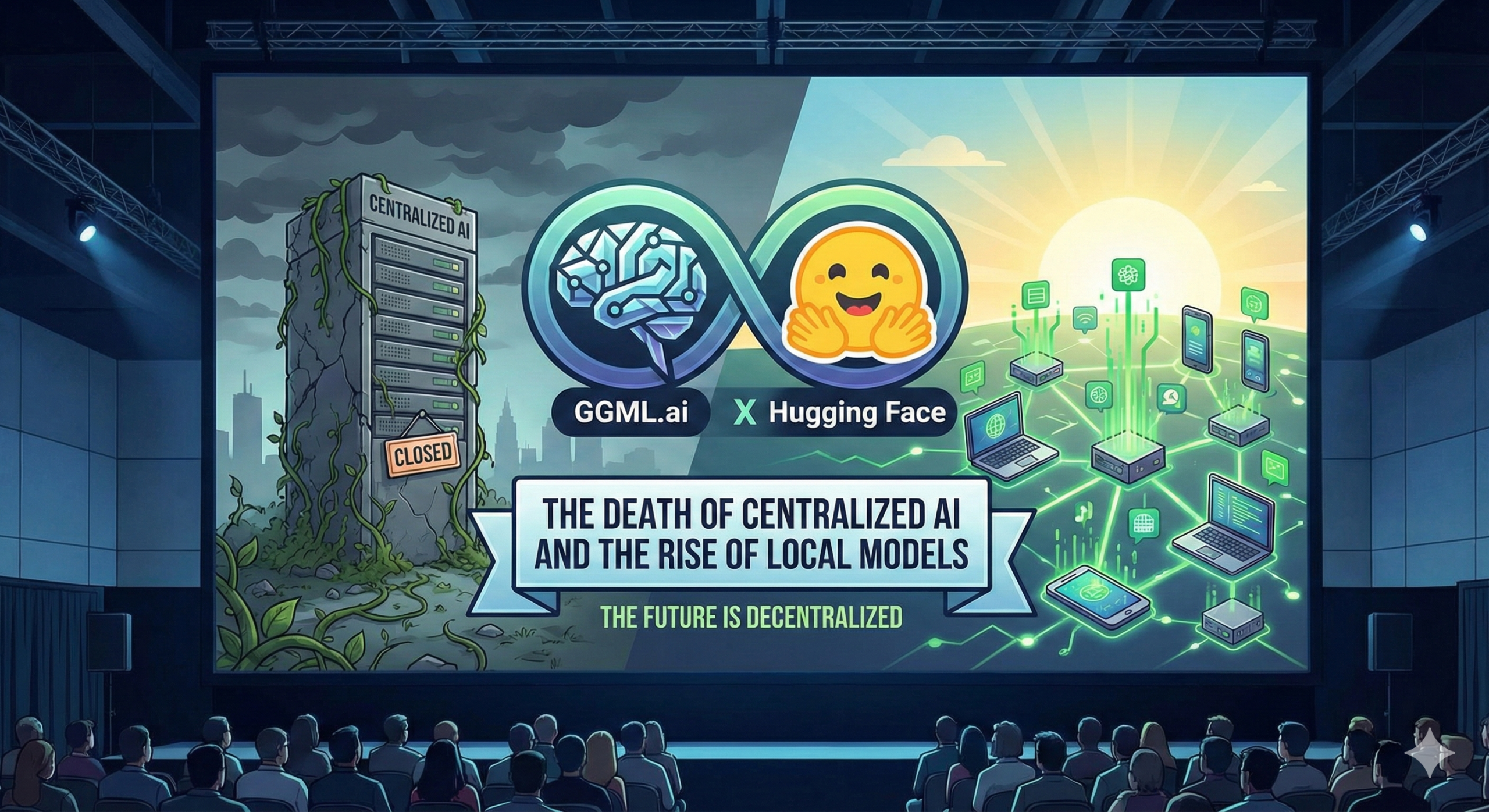
GGML.ai x Hugging Face: The Death of Centralized AI and the Rise of Local Models
In the rapid evolution of Large Language Models (LLMs), we have reached a critical inflection point. For the past three years, the industry narrative has been dominated by a “bigger is better” philosophy, pushing models into the trillions of parameters and confining them to massive, centralized GPU clusters owned by a handful of hyperscalers. However, a quiet revolution has been brewing in the engineering trenches—a movement toward decentralized, local inference that prioritizes privacy, latency, and cost-efficiency over brute-force scale.
The recent partnership between GGML.ai and Hugging Face is not just a corporate alliance; it is a declaration of independence for local AI. It signifies a fundamental shift in how we build and deploy intelligent systems. We believe this marks the beginning of the end for the pure centralization of AI capability.
The Bottleneck of Centralization
When we look at the current state of AI deployment, we see a massive efficiency gap. Centralized models like GPT-4 or Claude 3.5 Sonnet are engineering marvels, but they come with a significant “tax” on developers: the inference latency of the network, the high cost of token-based billing, and the inherent privacy risks of sending proprietary data to a third-party server.
From an infrastructure perspective, the true bottleneck is not intelligence, but VRAM. GPUs are expensive, scarce, and power-hungry. For most production use cases—ranging from code completion to complex document analysis—running a trillion-parameter model in a multi-node A100 cluster is often an overkill. As practitioners, we found ourselves stuck between the high performance of centralized APIs and the high complexity of self-hosting raw PyTorch models on expensive hardware.
The GGML Breakthrough: Inference for Everyone
This is where Georgi Gerganov’s work with GGML changed the game. What began as a project to run Llama on a MacBook (`llama.cpp`) evolved into a sophisticated C-based tensor library optimized for CPU and Apple Silicon. GGML (and its successor, GGUF) fundamentally reimagined how we approach modern AI inference.
The core innovation of GGML lies in its aggressive quantization techniques. By converting 16-bit or 32-bit floating-point weights into 4-bit, 5-bit, or even 2-bit integers, we can shrink models dramatically without a catastrophic loss in perplexity. This allows a 70B parameter model, which would normally require two A100 GPUs (80GB VRAM each), to run on a standard consumer-grade workstation or even a high-end laptop with shared memory.
We observed that the shift to GGML was more than just a speed optimization; it was a shift in accessibility. By bypassing the heavy Python dependency stack (PyTorch/Transformers) for inference, GGML allowed us to integrate LLMs directly into native C++ applications, CLI tools, and edge devices. This minimized the “cold start” problem and reduced the memory footprint, making “Local AI” a reality rather than an experimental curiosity.
The Hugging Face Alliance: Standardization at Scale
Hugging Face has long been the “GitHub of AI,” the repository where all models live. However, for a long time, the gap between the “Research Model” (safetensors/bin) and the “Deployed Model” (GGUF/GGML) was wide. Developers had to manually convert models, hunt for compatible quantizations on community repositories like TheBloke, and hope that the architecture was supported by their local runner.
The partnership with GGML.ai changes this by integrating GGUF support directly into the Hugging Face ecosystem. This standardization means that we can now treat local models as first-class citizens. When a model is released, the quantized local versions are no longer afterthoughts; they are generated and hosted alongside the full-precision weights.
For us as engineers, this solves the “Training-Serving Skew” problem that plagued early local AI adoption. We can now move from research to local deployment with a single consistent format, ensuring that the performance we see in the lab is exactly what the end-user experiences on their device.
Rethinking the AI Architecture: The Local-First Approach
With the GGML x Hugging Face alliance, we can now advocate for a “Local-First” architecture. Instead of defaulting to an API call for everything, we can design systems that follow a hierarchical intelligence model:
1. Level 1 (Edge/Local): Fast, quantized models (like Llama 3 or Qwen) running on the user’s hardware for 80% of routine tasks (summarization, simple queries, PII scrubbing).
2. Level 2 (In-House Server): Medium-sized models running on private GPU clusters for more complex reasoning.
3. Level 3 (Centralized API): Massive frontier models used only for the most difficult 5% of tasks that require world-class reasoning.
This architecture is not just cheaper; it is more resilient. It mitigates the risk of vendor lock-in and protects user data by ensuring that the most sensitive computations never leave the local machine.
Technical Nuances: Optimization and Quantization
One of the most frequent questions we face is: “Doesn’t 4-bit quantization ruin the model’s intelligence?” The short answer is: surprisingly, no.
Research into quantization has shown that LLM weights are not uniformly distributed; many are near zero and contribute little to the final output. By using techniques like K-Quants within GGML, we can preserve the “important” weights with higher precision while compressing the rest. In our internal tests, a 4-bit quantized version of a 70B model often outperforms a full-precision 13B model across almost every benchmark, despite occupying roughly the same amount of memory.
Furthermore, GGML’s ability to offload specific layers to the GPU (hybrid inference) allows us to maximize whatever hardware is available. If you have an NVIDIA card with 8GB of VRAM and 32GB of system RAM, GGML can place the first 20 layers on the GPU for speed and the remaining layers in system memory. This flexibility is something that traditional cloud-native frameworks simply cannot offer.
The Death of Centralization: A Sovereignty Movement
The rise of Local AI is more than just a technical trend; it is a movement toward digital sovereignty. When we rely on centralized APIs, we are at the mercy of the provider’s pricing, uptime, and censorship policies. If a provider decides to “deprecate” a model version or “guardrail” certain topics, our applications break or lose functionality overnight.
Local models running in GGUF format are immutable. They belong to us. We control the system prompt, we control the parameters, and we control the data. This level of autonomy is essential for the next generation of enterprise AI, where data privacy is non-negotiable and deterministic behavior is required.
Conclusion: The Road Ahead
The GGML.ai x Hugging Face partnership marks the maturity of the Local AI ecosystem. We are moving away from a world where AI is a utility provided by a few massive companies, toward a world where intelligence is a feature of the software itself, running everywhere from the cloud to the coffee shop laptop.
As engineers, our task is now to master these local tools. We must stop asking “Which API should I use?” and start asking “What is the smallest, most efficient model that can solve this problem locally?” The era of lazy centralization is ending; the era of efficient, sovereign intelligence has begun.
Local models are no longer the “lite” version of AI. They are the future of AI.
Related: GGML.ai x Hugging Face: The Death of Centralized AI and the Rise of Local Models.
Related: The Rise of World Models: Bridging the Gap Between Large Language Models and Phy.
Discover more from Susiloharjo
Subscribe to get the latest posts sent to your email.