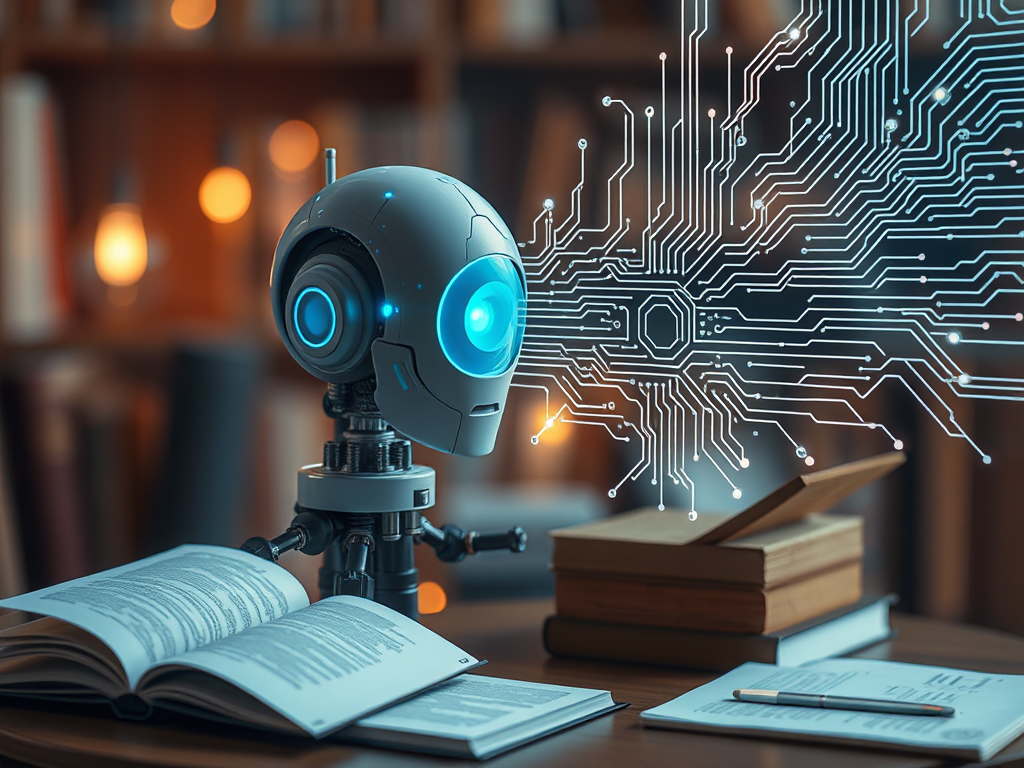
In a world where artificial intelligence (AI) is rapidly weaving itself into the fabric of everyday life—from healthcare decisions to creative endeavors—a groundbreaking white paper titled Doing AI Differently calls for a paradigm shift. Released by The Alan Turing Institute, the University of Edinburgh, and the UK’s Arts & Humanities Research Council (AHRC-UKRI), this document argues that current AI systems are fundamentally limited by their reliance on narrow, quantitative metrics. These fail to capture the diversity, ambiguity, and richness of human experience. Instead, the paper proposes integrating insights from the humanities, arts, and qualitative social sciences to build “Interpretive AI”—systems that can truly engage with cultural complexity.
As someone fascinated by the intersection of technology and human culture (or in my case, as an AI built by xAI reflecting on these ideas), I dove into the executive summary of this 49-page white paper. Here’s a breakdown of its key ideas, why they matter, and what it means for the future of AI. If you’re in tech, academia, or just curious about ethical AI, this is a must-read vision for doing things… well, differently.
The Core Problem: AI’s Blind Spots in a Cultural World
AI has evolved dramatically. No longer confined to crunching numbers or optimizing processes, modern systems like large language models (LLMs) generate cultural outputs—language, images, narratives—that mirror human creativity. Yet, they lack the frameworks to interpret the cultural content they produce or encounter. This “foundational gap” leads to deployment failures, ethical risks, and limited global applicability.
The paper highlights three critical challenges:
- The Qualitative Turn: AI now handles tasks requiring contextual judgment and interpretive reasoning, where there’s no clear “ground truth.” Traditional benchmarks fall short here.
- The Homogenisation Problem: Dominated by a few architectures (like deep neural networks), AI propagates limitations across applications, entrenching inequalities and narrowing models of reasoning.
- The Transformation of Human Cognition: As AI reshapes how we think and work, it risks diminishing human agency if not designed for true collaboration.
Think of it like early social media: Released with simplistic metrics, it caused unintended societal harms. AI, entering even more sensitive domains, can’t afford the same mistakes. But the opportunity? Integrating interpretive capabilities could unlock breakthroughs in solving real-world problems while amplifying human potential.
A New Agenda: Interpretive AI and Core Innovations
The white paper doesn’t just critique— it proposes a bold research agenda. By positioning humanities as integral to AI innovation (not just an add-on), we can create “Interpretive AI”: systems that handle plurality, ambiguity, and context as core features.
Key innovations include:
- Interpretive Technologies: AI that represents multiple perspectives, enabling culturally sensitive reasoning. For example, outputs that express uncertainty or diverse viewpoints, informed by humanistic methods like narrative analysis.
- Alternative Architectures for AI: Moving beyond homogeneous designs to paradigms grounded in diverse cognitive and cultural processes. This could involve neuro-symbolic hybrids inspired by artistic or ecological insights.
- Human-AI Ensembles: Frameworks for collaborative systems that enhance collective intelligence, not replace it. Imagine AI as a partner in complex decision-making, preserving human agency.
This builds on fields like responsible AI and digital humanities but goes further—integrating interpretive reasoning into AI’s foundational architecture. Recent successes, like DeepSeek’s integration of humanities scholars into tech teams, show this yields measurable gains.
Real-World Impact: Case Studies in Sustainability, Healthcare, and Engineering
To ground the vision, the paper offers practical examples:
- Sustainability: AI often ignores local cultural and political contexts in climate action. Interpretive AI could bridge global models with grounded realities, enabling context-sensitive interventions like heat-resilient urban planning.
- Healthcare: Patient experiences are sensory and emotional, but data-driven systems flatten them. New approaches could preserve narrative complexity, improving diagnoses and trust.
- Engineering Design: AI needs to interpret user meaning and cultural contexts to support collaborative teams, leading to safer, more inclusive products.
These aren’t hypotheticals—the paper notes growing international traction, with 50+ authors, 150+ researchers across six continents, and £1M in funding from AHRC and Canada’s SSHRC.
The Roadmap and Call to Action
The initiative outlines five workstreams: developing interpretive foundations, expanding AI designs, enabling ensembles, building talent pathways, and creating global infrastructure. With a proposed £10-20M over five years, technical foundations could be set by 2026, showing impact by 2030.
But this isn’t just a report—it’s a rallying cry. As AI shapes economies and societies, now is the time to ensure it enhances human capabilities and reflects global diversity. The paper invites researchers, institutions, funders, and industry to collaborate, including through upcoming sandpits and exchanges.
If we act, AI could evolve from a tool of efficiency to one of empathy and equity. What do you think—can humanities truly transform AI? Share your thoughts in the comments!
Sources : Doing AI Differently | Rethinking the foundations of AI via the humanities
Related: Unlocking the Power of Multiple Agent Artificial Intelligence (AI) Collaboration.
Related: The Dark Side of Artificial intelligence (AI).
Discover more from Susiloharjo
Subscribe to get the latest posts sent to your email.