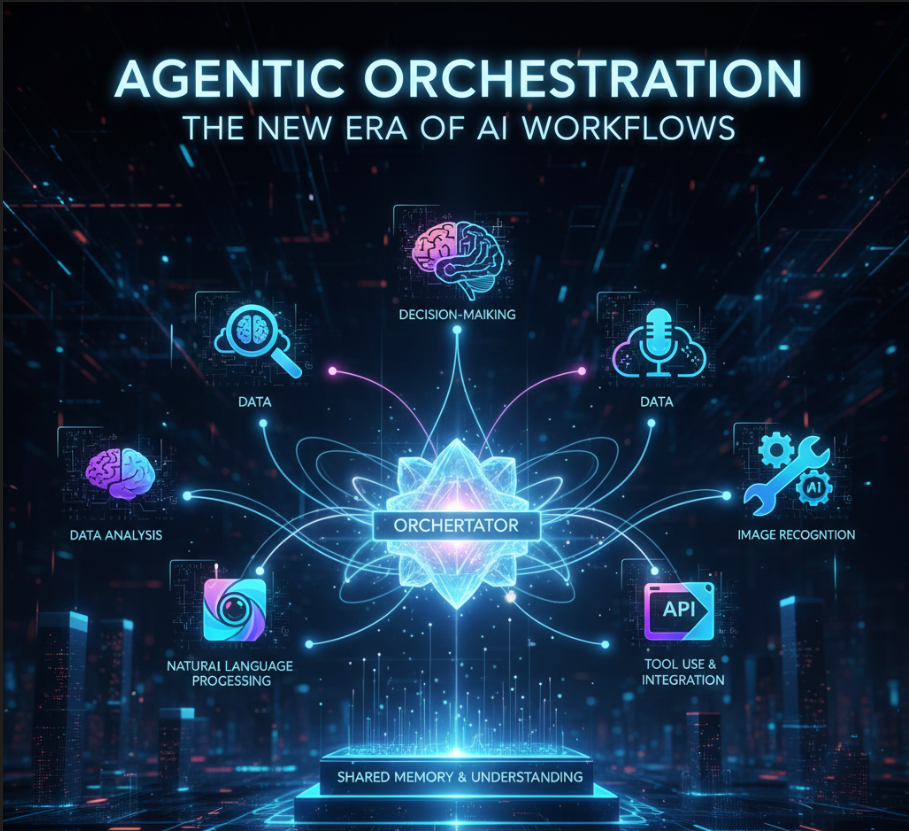
Agentic Orchestration: The New Era of AI Workflows (2026)
Last quarter, I decommissioned our third-generation workflow automation system. It had served us well for three years—deterministic scripts, carefully handcrafted decision trees, and rigid pipelines that executed with mechanical precision. Watching it shut down felt like witnessing the retirement of a reliable old workstation. Then I spun up our new agentic orchestration layer, and within forty-eight hours, it had already identified and fixed a data inconsistency that our previous system had missed for months. That moment crystallized what I’ve been observing across the industry: we are no longer just automating tasks. We are building systems that think.
The transition wasn’t instantaneous. We’d been flirting with AI-assisted automation for years—adding machine learning models to classification tasks, deploying language models for document processing—but these felt like incremental improvements to an aging infrastructure. What changed in 2026 wasn’t the individual components. It was how they connected. The emergence of robust agent frameworks, combined with increasingly capable foundation models, created a perfect storm for architectural transformation.
The Death of the Deterministic Pipeline
Traditional automation succeeded because it operated in a world of knowable variables. If this, then that. Input A produces output B. The rules were explicit, the paths were finite, and failure modes were predictable. We built sophisticated orchestrators around these principles—Airflow pipelines, AWS Step Functions, Azure Logic Apps. They worked because the problems they solved were bounded.
But 2026 has exposed the limits of that model. Modern AI workflows involve ambiguity, context-dependent decisions, and emergent behaviors that no flowchart can capture. When a large language model generates a response, it doesn’t follow a script—it weighs probabilities, considers context, and sometimes produces outputs that surprise even its creators. Trying to wrap deterministic automation around probabilistic systems is like trying to contain water in a sieve.
The industry has responded with agentic orchestration: a new architectural paradigm where autonomous agents coordinate, reason, and act on behalf of users. These aren’t the rule-based bots of the past. They are persistent, goal-oriented systems that perceive their environment, make decisions, and adapt in real time.
What Agentic Orchestration Actually Means
At its core, agentic orchestration replaces the explicit instruction set with implicit goal specification. Instead of telling a system exactly how to accomplish a task step by step, we tell it what outcome we want and let it figure out the path.
The shift mirrors the evolution from imperative to declarative programming, but at a higher level of abstraction. In the same way that SQL lets us describe the data we want rather than how to retrieve it, agentic orchestration lets us specify objectives rather than procedures. The difference is that the “how” now involves reasoning, planning, and multi-step execution that would be impractical or impossible to hand-code.
In our production environment, this manifests as a network of specialized agents working in concert. We have a data ingestion agent that monitors our upstream sources, detects schema drift, and decides whether to adapt or alert. We have a quality assurance agent that evaluates model outputs against business rules—not by hardcoding every rule, but by learning from examples and reasoning about edge cases. We have an escalation agent that knows when to involve humans and exactly what context to provide.
These agents communicate through a shared message bus with structured state. They maintain memory of previous interactions. They can delegate tasks to each other. They recover from failures not by restarting a linear pipeline, but by reassessing the current state and determining the next best action.
What makes this fundamentally different from traditional workflow engines is the loop. In conventional automation, execution flows from start to finish in one pass. In agentic orchestration, agents continuously re-evaluate their situation. If the data changes mid-process, they adapt. If a model returns an unexpected result, they reason about alternatives rather than failing. This feedback loop, previously the domain of human operators, now operates autonomously at scale.
Traditional Automation vs. Agentic Orchestration
| Aspect | Traditional Automation | Agentic Orchestration |
|---|---|---|
| Control Model | Explicit step-by-step instructions | Implicit goal specification |
| Decision Making | Deterministic branching logic | Probabilistic reasoning and planning |
| Error Handling | Predefined exception handlers | Self-diagnosis and adaptive recovery |
| Adaptability | Requires manual reconfiguration | Learns from feedback and evolves |
| State Management | Checkpoint-based, linear progression | Persistent context with bidirectional flow |
| Failure Mode | Cascade failures, pipeline breaks | Graceful degradation, autonomous retry |
| Scale Model | Vertical scaling of monolithic pipelines | Horizontal scaling of distributed agents |
| Human Oversight | Post-process review | Real-time intervention capability |
The Technical Reality Check
I want to be direct about something: agentic orchestration isn’t a silver bullet. We inherited significant complexity when we made the switch. Debugging an agent that made an unexpected decision is fundamentally different from debugging a failed script. The decision space is larger, the failure modes are stranger, and the debugging tools are still maturing.
We’ve also had to rethink observability entirely. Traditional metrics—throughput, latency, error rates—still matter, but they’re insufficient. We now track agent reasoning traces, decision confidence scores, and intervention frequency. Understanding why an agent chose one action over another has become a core engineering discipline.
Security presents another dimension of challenge. When agents can take autonomous actions, the attack surface expands. We’ve implemented sandboxing, approval gates for sensitive operations, and comprehensive audit trails. The principle of least privilege applies more strictly than ever.
When to Make the Switch
Not every workflow needs agentic orchestration. If your process is well-defined, rarely changes, and operates in a stable environment, traditional automation will likely serve you better—it’s simpler, more predictable, and easier to maintain. The agentic approach earns its place when you encounter problems that resist explicit programming: high variability, ambiguous success criteria, or the need to integrate diverse AI models into coherent workflows.
In our case, the tipping point came when we needed to coordinate five different foundation models across a customer-facing pipeline. Each model had different latency characteristics, failure modes, and output formats. Hardcoding the orchestration logic became unsustainable. The agentic layer abstracted that complexity and let us focus on outcomes rather than procedures.
The Road Ahead
What I’ve witnessed in the past eighteen months feels like a generational shift. We’re moving from programming computers explicitly to programming them intentionally—from detailed recipes to desired outcomes. The implications extend far beyond efficiency gains. Agentic orchestration fundamentally changes how we relate to our software systems. We become directors rather than scriptwriters. We specify intent and trust the system to find its way.
The tooling is catching up. Frameworks like AutoGen, CrewAI, and LangGraph have matured into production-ready platforms. The model-context-protocol ecosystem is enabling interoperability between agents from different vendors. We’re no longer experimenting in isolation—we’re building an ecosystem where agents can discover and collaborate with each other without manual integration work.
Looking forward, I see agentic orchestration becoming the default pattern for any workflow involving AI components. The economic argument is compelling: the cost of writing and maintaining explicit automation for complex, variable processes is rapidly exceeding the cost of training and governing agentic systems. We’re not just adopting a new technology—we’re accepting a new mental model for software development.
I’m not going to pretend the transition is effortless. It requires new skills, new mental models, and new tolerances for uncertainty. But the results speak for themselves. Our pipeline now handles edge cases it was never explicitly programmed to handle. It improves itself based on feedback. It surfaces issues we didn’t know existed before they became problems. That’s not just automation. That’s augmentation at the architectural level.
The deterministic era served us well. It built the foundation for everything that follows. But the workflows of 2026 demand something more: systems that can reason, adapt, and evolve alongside the problems they solve. That’s what agentic orchestration delivers.
Related: The Agentic Orchestration Layer: Microsoft’s Agent Framework RC and the .N.
Related: Implementing Gemini 3.1 Pro: Harnessing the Medium Thinking Mode for Agentic Wor.
Discover more from Susiloharjo
Subscribe to get the latest posts sent to your email.