The ASIC Counter-Offensive: How MatX’s $500M Breakthrough Challenges the CUDA Monoculture
In the vertical-scaling race of February 2026, the primary bottleneck for frontier laboratories is no longer just the quantity of parameters, but the “Memory Wall” of the hardware they run on. While Nvidia’s H-series and B-series GPUs have dominated through the sheer versatility of the CUDA ecosystem, a new challenger, MatX, has just secured $500 million in Series B funding to prove that general-purpose silicon is no longer sufficient for the AGI era.
Led by Jane Street and Leopold Aschenbrenner’s Situational Awareness fund, this capital injection signals a strategic shift in the semiconductor market: from versatile GPUs to hyper-optimized LLM-specific ASICs (Application-Specific Integrated Circuits).
The Architecture of Minimalism: TPU Pedigree
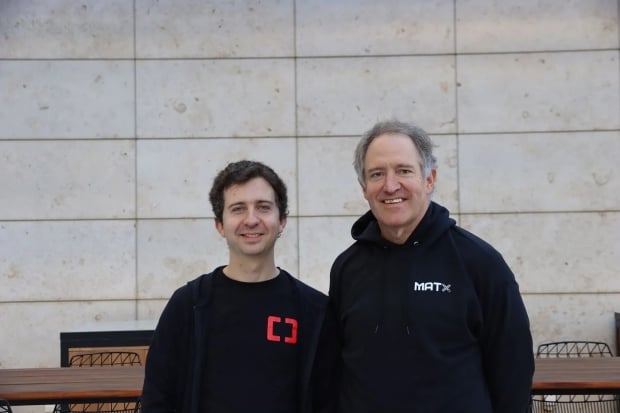
Founded by Reiner Pope and Mike Gunter—two of the primary engineers behind Google’s Tensor Processing Unit (TPU)—MatX is architecting a radical departure from the complexity of modern GPUs. The core thesis is simple: Nvidia chips are fast, but they are carrying 30 years of legacy baggage (graphics, ray tracing, and general HPC) that Large Language Models simply do not use.
MatX is discarding this baggage in favor of a minimalist, single-large-core architecture specifically designed for the massive matrix multiplications that dominate Transformer workloads.
Breaking the Memory Wall: The SRAM Advantage
In SiliconAngle’s technical breakdown, the defining characteristic of the MatX chip is its aggressive use of on-chip SRAM.
1. Direct Weight Injection: By storing model weights directly in SRAM cells—located microns away from the logic circuits—MatX bypasses the latency and bandwidth limitations of external HBM3e memory.
2. 10x Scale Factor: Initial benchmarks from the company suggest that this “weight-local” compute model can train and run 70B-parameter models up to 10 times faster than current-gen Nvidia hardware at a fraction of the power cost.
3. Unified Lifecycle Support: Unlike competitors like Groq (inference-only) or SambaNova, MatX claims their silicon is designed for the entire LLM lifecycle: Pre-training, Reinforcement Learning, and Inference (Prefill & Decode).
Strategic Context: Decoupling from CUDA
The $500M funding round is not just a bet on silicon; it is a bet on the erosion of the CUDA “moat.” By leveraging the JAX-based research ecosystem and compiler-driven optimization—similar to the modernization of legacy systems we discussed in the COBOL Resurrection analysis—MatX aims to provide a seamless transition for labs already using Google-style infrastructure.
This move mirrors the broader decentralization of infrastructure we are seeing in 2026. Just as Satellite IoT is bypassing terrestrial network limitations, MatX is bypassing the economic and supply-chain limitations of the Nvidia-TSMC-HBM stranglehold.
Conclusion: The Vertical AGI Stack
As frontier labs chase the next order of magnitude in intelligence, the hardware MUST become a first-class citizen in the architectural design. The MatX funding round confirms that the “GPT-5 class” models of late 2026 will likely be trained on silicon that didn’t exist when the research started.
We are moving away from the “One Chip to Rule Them All” era and toward a fragmented, specialized, and highly efficient hardware landscape where the winners are those who can shed the most legacy weight.
Strategic Technical Analysis
Discover more from Susiloharjo
Subscribe to get the latest posts sent to your email.