Implementing Model Context Protocol (MCP): A New Standard for Connecting AI Agents to Enterprise Data
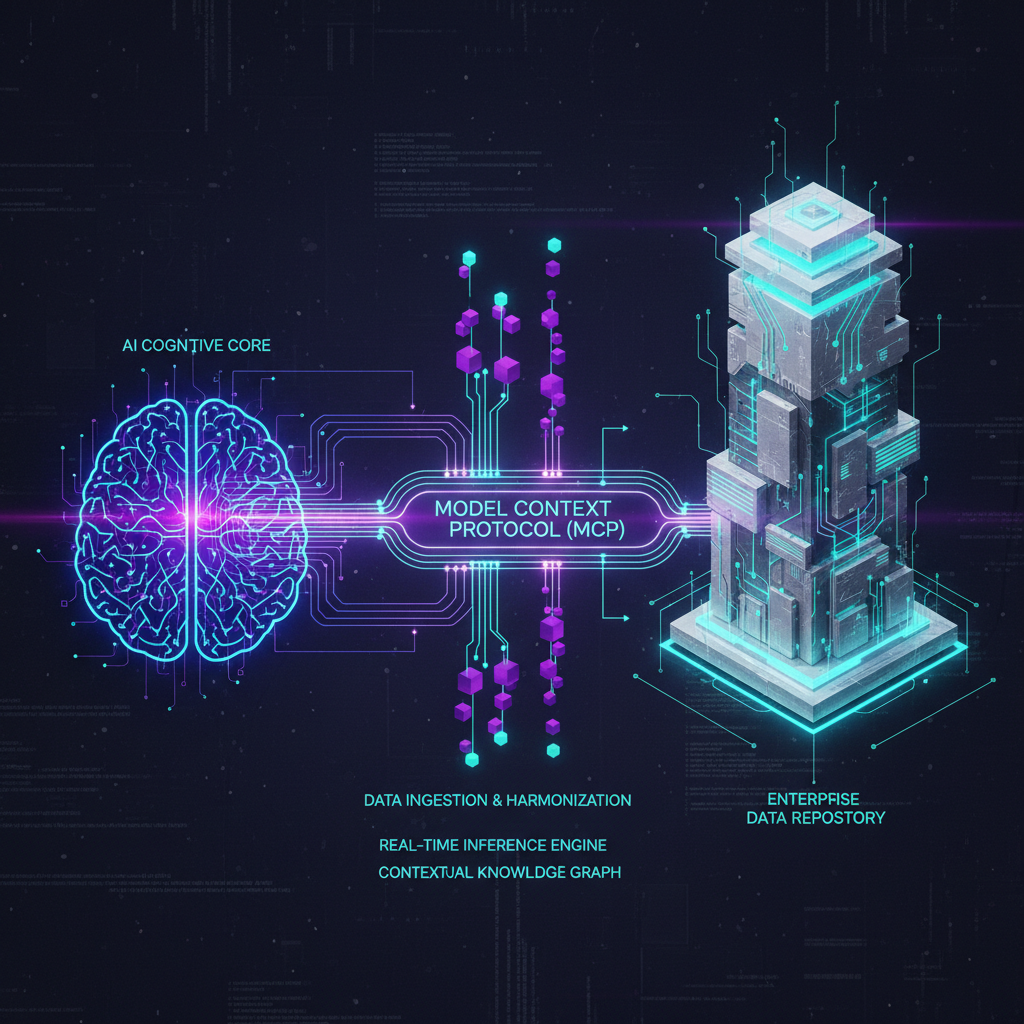
Implementing MCP AI Agent solutions has moved beyond experimental trends into strategic necessity for enterprises seeking to connect Large Language Models with internal databases, proprietary APIs, and enterprise tooling through a standardized interface. The Model Context Protocol (MCP) emerges as a critical communication bridge that separates the reasoning process—where LLMs make decisions—from the execution layer that handles actual database operations and tool interactions. This comprehensive guide examines how MCP functions at a deep technical level, why its client-server architecture represents a paradigm shift, and how production implementations like Uber’s uSpec demonstrate tangible business value at hyperscale.
MCP Architecture: Client-Server Design for AI Systems
MCP adopts the client-server pattern proven in traditional software architecture, but with a specific orientation engineered for AI Agent workflows. The architecture comprises three fundamental components that work in concert to enable scalable, maintainable AI implementations:
- The MCP Host: The orchestration layer (e.g., an IDE like Cursor, a framework like OpenClaw, or a custom enterprise agent).
- The MCP Client: The interface within the host that initiates requests and processes tool discovery.
- The MCP Server: The execution layer that exposes specific capabilities, data sources, or computational tools via a standardized protocol.
By standardizing how the host discovers and interacts with the server, organizations can decouple their internal data logic from the specific LLM being used. This modularity allows for “plug-and-play” agentic ecosystems where a single server (e.g., a Database Query Server) can be shared across multiple independent agents without custom integration code.
Uber uSpec: A Benchmark in Visual-to-Technical Compilation
One of the most profound production use cases for MCP in early 2026 is Uber’s uSpec. This system acts as a specialized AI compiler that translates visual design components from Figma directly into detailed technical specifications for multiple engineering platforms (iOS, Android, and Web). Before uSpec, generating these specifications manually required weeks of cross-functional coordination; now, it is accomplished in minutes.
uSpec achieves this by deploying an AI agent within the Cursor IDE that connects to a local Figma Desktop session via an MCP WebSocket bridge. This local connection is vital for enterprise security, as it avoids sending proprietary design data to a cloud-based Figma API. The agent “crawls” the component tree in Figma, extracting design tokens, variant axes, and visual intent with high precision. This data is then processed against Uber’s internal “Agent Skills”—structured Markdown files that encode years of platform-specific domain knowledge.
The Functional Divide: Reasoning vs. Execution Detail
The core value proposition of MCP lies in how it cleanly separates Reasoning (the brain) from Execution Detail (the hands). In an agentic swarm, a central Reasoning Engine is responsible for high-level strategy and tool selection, while the Execution Layer handles the low-level mechanics of data retrieval and operation. This separation is key to building parallel agent swarms that can execute tasks autonomously without overloading the central reasoning logic.
| Component | Role in MCP Ecosystem | Primary Responsibility |
|---|---|---|
| Reasoning Engine (LLM) | Brain | Strategy, Tool Selection, Intent Parsing |
| MCP Client | Interface | Discovery, Request Dispatch, Context Management |
| MCP Server | Hands | Tool Execution, Data Retrieval, DB Connectivity |
Standardizing Communication with JSON-RPC 2.0
MCP leverages the JSON-RPC 2.0 protocol for all client-server communications. This lightweight, transport-agnostic standard ensures that tools are discoverable and callable regardless of the underlying programming language used by the MCP server. Below is a sample representation of how an AI Agent might call a tool through an MCP server to query a corporate database:
{
  "jsonrpc": "2.0",
  "method": "tools/call",
  "params": {
    "name": "query_database",
    "arguments": {
      "query": "SELECT * FROM enterprise_specs WHERE component_id = 'UBER_BTN_01'",
      "db_context": "production_read_only"
    }
  },
  "id": "agent-req-001"
}
This standardized request allows the MCP server to execute the query, handle any database-specific authentication, and return the result in a format the agent’s reasoning engine can immediately utilize for its next step. The consistent structure of these tool calls is what enables the “Parallel Agent Swarms” mentioned in the future of agentic AI.
Enhancing Enterprise Security via Local Context
For large organizations, data exfiltration is a primary concern when deploying AI agents. By implementing MCP, enterprises can keep their most sensitive data within their own infrastructure. The MCP server acts as a gatekeeper that resides on the local machine or internal network. The LLM (reasoning engine) only receives the specific context it needs to perform its task, rather than having full access to the database or design environment.
In the case of Uber uSpec, the use of a local WebSocket bridge to the Figma Desktop app ensures that design tokens never touch the public internet in their raw form. This “Local Context Injection” is a foundational pattern for secure enterprise AI, providing a scalable way to leverage LLMs while maintaining strict compliance with data governance policies.
The Future: Toward Autonomous Agentic Swarms
As we advance through 2026, the adoption of MCP is the catalyst for moving from single-agent assistants to complex, autonomous swarms. In these swarms, multiple specialized agents (each with its own MCP client) work together to solve multi-stage problems. For example, a design agent might use an MCP server to extract Figma tokens, while a coding agent simultaneously uses another MCP server to verify if those tokens align with current React components in a Git repository.
This level of parallelization is only possible when the “plumbing”—the connection between reasoning and execution—is standardized. We discussed a similar evolution in how AI agents learn to adapt their own logic in our previous deep-dive on Beyond Fixed Logic: Meta Hyperagents and the Darwin Gödel Machine. The combination of recursive learning and standardized execution protocols like MCP will define the next decade of artificial intelligence.
Conclusion: Why AI Architects Must Adopt MCP Now
The Model Context Protocol is not just another API standard; it is the infrastructure for the next generation of autonomous systems. By separating reasoning from execution, organizations can build AI agents that are more secure, more scalable, and significantly easier to maintain. Whether you are building internal tools like Uber uSpec or deploying parallel agent swarms for complex data analysis, implementing MCP is the definitive path forward for enterprise AI architecture in 2026.
Related: Markdown for Agents: Cloudflare’s New Standard for the Web-for-AI Era.
Related: Anthropic Shipped Two New Models. They’re the Same Model..
Discover more from Susiloharjo
Subscribe to get the latest posts sent to your email.