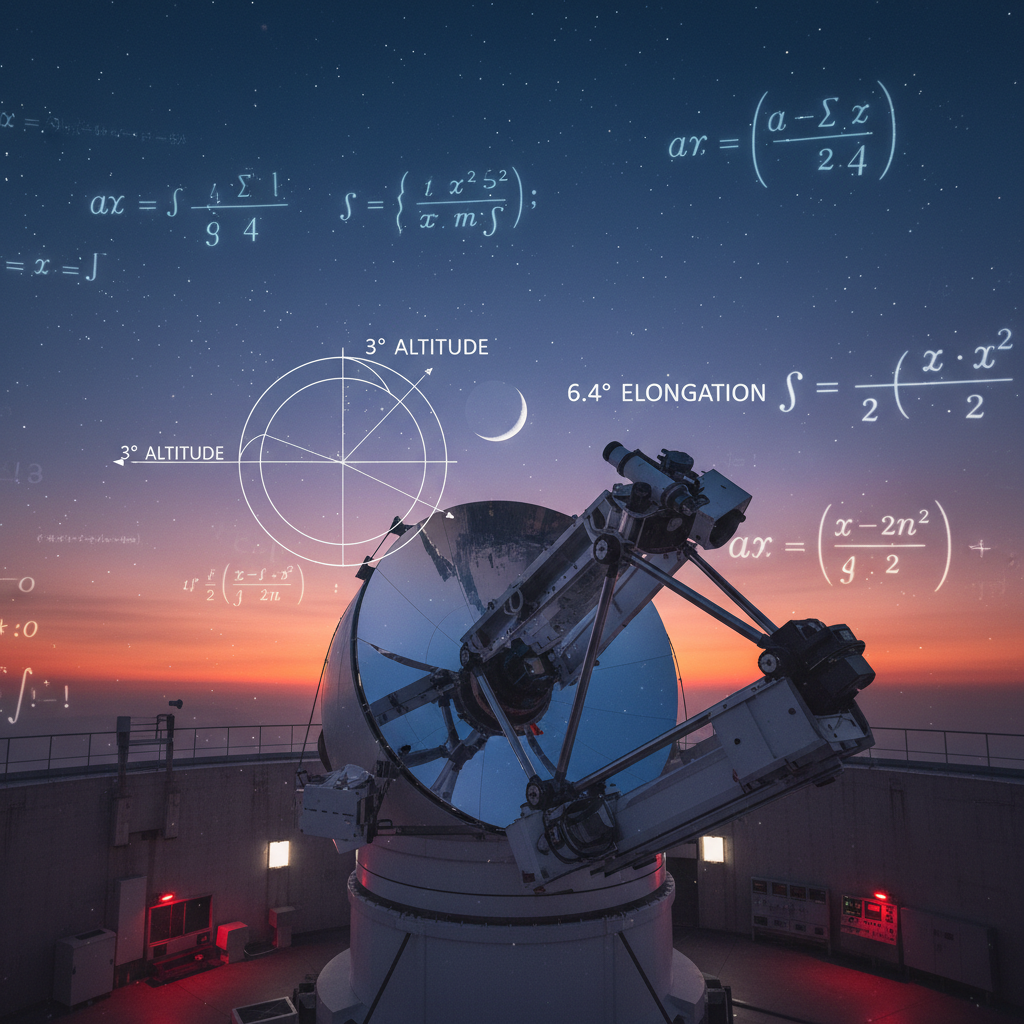
Hisab vs Rukyat: The Astronomical Algorithms and Mathematical Models Defining Idul Fitri 1447 H
As the Islamic lunar calendar approaches its culmination point, Indonesia faces a familiar astronomical divergence. The determination of 1 Syawal 1447 H—marking Eid al-Fitr 2026—relies on two fundamentally different methodological approaches: Hisab (astronomical calculation) and Rukyat (empirical lunar crescent observation). This division is not merely semantic; it represents a clash between computational precision and sensory verification, between algorithmic certainty and atmospheric reality—an interplay central to the Hilal Sighting Algorithm used across Indonesia.
For developers and engineers working in calendar systems, fintech platforms, and logistics networks across Indonesia, understanding the Hilal Sighting Algorithm is no longer optional—it is infrastructure-critical. The difference between celebrating Eid on March 20 versus March 21, 2026, carries profound implications for airline bookings, payroll cycles, and supply chain coordination. Observers note that the historical context of this divergence traces back to differing epistemological frameworks for lunar calendar establishment, as documented by the National Aeronautics and Space Administration (NASA).
The Mathematical Foundation: MABIMS Criteria and Neo-MABIMS
The Criteria for the Determination of the Beginning of the Ramadan, Syawal, and Dzulhijjah months adopted by the Indonesian Ministry of Religion (MABIMS) underwent a significant recalibration in 2022. The original 2-degree height threshold was revised to 3 degrees, with elongation requirements increasing from 4 degrees to 6.4 degrees. This “Neo-MABIMS” standard was not arbitrary—it was calibrated against human visual acuity limits, as documented in the MABIMS official criteria documentation.
Atmospheric extinction plays a decisive role. When the lunar crescent sits below approximately 3 degrees of altitude, water vapor and particulate matter in the lower atmosphere absorb and scatter lunar light to the point where visual confirmation becomes physiologically impossible for the average observer. The 6.4-degree elongation threshold addresses the angular separation between the Sun and Moon—essentially measuring how far the Moon has traveled from the solar conjunction point. Below this threshold, the illuminated fraction (illumination percentage) remains too slender for reliable naked-eye detection.
| Parameter | Legacy MABIMS | Neo-MABIMS (2022+) |
|---|---|---|
| Lunar Altitude | 2 degrees | 3 degrees |
| Elongation Angle | 4 degrees | 6.4 degrees |
Hisab Hakiki Wujudul Hilal: The Computational Approach
Hisab Hakiki Wujudul Hilal—the “actual calculation of hilal existence”—represents the mathematical framework employed by Majelis Tarjih and Tajdid of Muhammadiyah. This method requires three concurrent conditions to declare the new month:
- The Moon has passed the conjunction (New Moon) phase
- The geometric center of the Moon sets after the Sun
- The Moon’s altitude at sunset exceeds zero degrees
This approach is entirely computational. No telescope is pointed at the western horizon. Instead, the calculation relies on ephemeris data—precise orbital elements describing the Moon’s position in celestial coordinates. The algorithm accounts for:
- Mean anomaly: The Moon’s average position in its elliptical orbit
- True anomaly: Corrected for gravitational perturbations from the Sun
- Libration: The slight wobble affecting apparent position
- Topocentric versus geocentric coordinates: Observer location relative to Earth’s center
For 1447 H, Hisab calculations indicate that if the conjunction occurs before Maghrib on March 18, 2026, and the Moon sets after the Sun, the hilal is considered “existing” (wujud)—leading to 1 Syawal on March 20, 2026.
Imkanur Rukyat: The Possibility of Sighting
The Imkanur Rukyat criteria—literally “possibility of sighting”—represents a compromise between pure calculation and direct observation. Officially adopted by the Indonesian Ministry of Religion (Kemenag) and supported by Nahdlatul Ulama (NU), this approach requires that the Moon meets mathematically defined visibility thresholds before empirical observation is even attempted.
The logic is pragmatic: if atmospheric and geometric conditions render sighting impossible by definition, proceeding with observation becomes ceremonial rather than evidentiary. Imkanur Rukyat for Indonesia employs the Neo-MABIMS parameters: 3-degree minimum altitude and 6.4-degree minimum elongation.
This creates a critical bifurcation. If Hisab indicates the Moon exists but Imkanur Rukyat conditions are not met for actual sighting on the observation day (March 19, 2026), the new month is considered not to have started—pushing Eid to March 21.
The Hilal Sighting Algorithm: Delta-T and Julian Date Corrections
Behind every published hisab result lies a chain of astronomical corrections. The Hilal Sighting Algorithm begins with the Julian Date (JD)—a continuous count of days since noon Universal Time on January 1, 4713 BCE. For March 2026, the Julian Date provides the temporal anchor for all subsequent calculations.
The critical correction is Delta-T—the difference between Terrestrial Time (TT) and Universal Time (UT). This value, currently approximately 69 seconds and increasing non-linearly, accounts for Earth’s decelerating rotation. Failure to apply proper Delta-T corrections can introduce errors of several minutes in lunar position calculations—enough to flip a sunset calculation, as noted by Indonesia’s National Research and Innovation Agency (BRIN).
The computation pipeline typically follows this sequence:
- Convert civil date to Julian Date
- Calculate Sun’s mean longitude and mean anomaly
- Calculate Moon’s mean longitude, mean anomaly, and argument of latitude
- Apply nutation and aberration corrections
- Convert ecliptic coordinates to equatorial (right ascension/declination)
- Transform to horizontal coordinates (altitude/azimuth) for the observer’s latitude
- Apply refraction correction (altitude increase of ~0.5 degrees at horizon)
In Indonesia, the National Research and Innovation Agency (BRIN) and the Meteorological, Climatological, and Geophysical Agency (BMKG) maintain independent ephemeris services providing these calculations with sub-arcminute precision.
1 Syawal 1447 H: The March 2026 Astronomical Situation
The conjunction (Ijtimak) for the month of Syawal 1447 H is calculated to occur on March 18, 2026 at approximately 10:13 UTC. For Indonesia’s western observatories (Java, Sumatra), this falls before Maghrib—the sunset prayer window.
On the critical Istibat Day (determination day)—March 19, 2026—the key parameters present a marginal case:
| Parameter (March 19, 2026) | Value | MABIMS Threshold | Result |
|---|---|---|---|
| Lunar Altitude (Sunset Jakarta) | ~4.5 degrees | 3 degrees | Passes |
| Elongation (Geocentric) | ~6.2 degrees | 6.4 degrees | Fails |
| Moon Set Delay | ~12 minutes | Zero | Passes |
This is the crux of the 2026 divergence. The elongation angle—approximately 6.2 degrees geocentric—falls below the 6.4-degree MABIMS threshold by a mere 0.2 degrees. Topocentric (observer-specific) calculations might push this slightly higher, but the margin is razor-thin.
This produces the familiar split:
- Muhajirin (Hisab): 1 Syawal on March 20, 2026—calculational hilal exists
- NU/Kemenag (Imkanur Rukyat): 1 Syawal on March 21, 2026—elongation below threshold, sighting impossible by calculation
Modern Hilal Observatories: CMOS Sensors and Robotic Telescopes
Traditional rukyat relies on human observers scanning the western horizon with the naked eye or binoculars. Modern observatories have revolutionized this process. The Bosscha Observatory in Lembang, West Java, employs CMOS (Complementary Metal-Oxide-Semiconductor) sensors capable of detecting lunar crescents invisible to the naked eye.
These instruments operate through several technological layers:
- CCD/CMOS imaging: High-quantum-efficiency sensors capture lunar limb brightness
- Real-time image processing: Adaptive filtering removes atmospheric turbulence artifacts
- Photometric analysis: Measures absolute brightness difference between lunar crescent and sky background
- Robotic telescope mounting: Automated tracking eliminates human pointing error
Theoretically, modern sensors can detect crescents at elongation angles as low as 5 degrees—well below the MABIMS threshold. In practice, local atmospheric conditions (humidity, aerosol density, cloud cover) remain the limiting factor. A 6.2-degree crescent in clear conditions over the Indian Ocean might be photographable; the same crescent through Jakarta’s post-sunset haze might not.
Engineering Implications: Calendar as Critical Infrastructure
For software systems handling Indonesian users, the hisab-rukyat divergence is a genuine edge case. Payroll systems must accommodate floating holidays. Airline reservation APIs require dynamic date logic. Fintech platforms need holiday calendars that shift based on astronomical authority.
Observers note that the 2026 marginal case exposes the philosophical tension between mathematical prediction and empirical verification—and the engineering challenge of encoding religious determination criteria into deterministic code. The Hilal Sighting Algorithm is not merely an academic exercise; it is the invisible clockwork behind a nation’s temporal coordination.
As sensors improve and ephemeris precision increases, the gap between what can be calculated and what can be seen narrows. Yet the decision calculus—whether to trust the algorithm or the horizon—remains irreducibly human. For those tracking the intersection of cybersecurity and technical infrastructure in the region, the Handala digital artifact represents another layer of Indonesia’s complex technological landscape, as explored in the analysis of regional cyber warfare developments.
Conclusion: When Algorithms Meet the Horizon
The 1 Syawal 1447 H determination exposes the fragile boundary between computation and observation. At 6.2 degrees of elongation on March 19, 2026, the Moon technically exists above the horizon but below the MABIMS threshold—a mathematical half-step between celebration dates.
For engineers, this moment represents a case study in adversarial edge cases: systems that must handle binary outcomes (March 20 OR March 21) derived from inputs where the margin of error approaches the decision threshold itself.
Observational data from Bosscha Observatory and calculation services from BRIN will ultimately determine which date Indonesian Muslims mark the end of Ramadan 1447 H. Either way, the Hilal Sighting Algorithm continues its quiet work—translating celestial mechanics into civil time, one crescent at a time.
Related: Anthropic Shipped Two New Models. They’re the Same Model..
Related: Building with Image AI Models Drives Growth Over Chatbots.
Discover more from Susiloharjo
Subscribe to get the latest posts sent to your email.