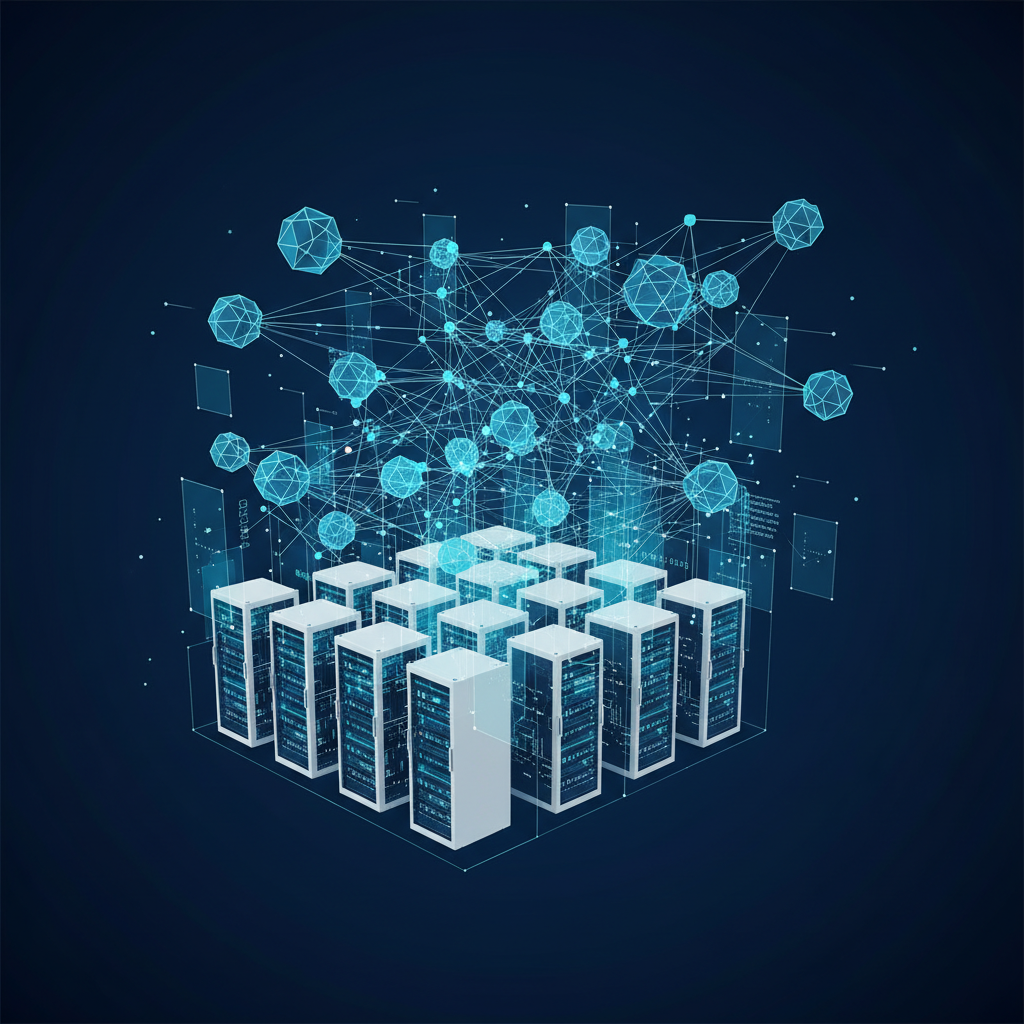
Google AI Infrastructure: 2026 TPU Architecture Deep Dive
TL;DR
- Google AI infrastructure 2026 centers on eighth-generation TPUs (8t for training, 8i for inference) with the Virgo Network connecting over 1 million chips across data centers
- Ads serving leverages VCG auction model with real-time ML targeting, Ad Quality Score, and expected conversion impact ranking
- Performance Max and AI Max automate creative generation using Veo and Gemini 3 Pro for agentic commerce workflows
- Data processing stack includes Bigtable, Spanner, Kafka, Pub/Sub, Beam, Flume, and BigQuery for petabyte-scale throughput
The term google ai infrastructure 2026 represents a new phase in distributed computing, marked by the deployment of eighth-generation Tensor Processing Units and the Virgo Network fabric capable of linking over one million accelerators into unified training clusters. This technical architecture underpins Google’s advertising platform, processing billions of ad requests daily with sub-100ms latency while powering generative AI features like AI Overviews and Performance Max campaigns.
Definition: Google AI infrastructure refers to the integrated hardware and software stack comprising custom TPU accelerators, the Virgo data center fabric, distributed storage systems (Bigtable, Spanner), and orchestration layers (Kubernetes/GKE) that collectively enable large-scale model training, real-time inference, and ad serving at global scale.
Core Components of Google AI Infrastructure: 2026 Architecture
The advertising platform rests on five interconnected subsystems that handle everything from user signal processing to auction settlement.
1. Ad Serving and Targeting Engine
Advanced machine learning algorithms analyze multiple user signals in real-time: search history, geographic location, device characteristics, and page content context. The targeting service matches ads to queries using behavioral patterns, purchase history, and demographic segments. This layer processes billions of signals daily, maintaining sub-50ms response times through distributed caching and pre-computed embeddings.
2. Auction and Ranking System
Google employs a Vickrey-Clarke-Groves (VCG) auction model to ensure fairness and optimize advertiser value. The ranking algorithm evaluates three primary factors:
- Bid Amount: Maximum CPC or CPA set by advertisers
- Ad Quality Score: Historical CTR, ad relevance, and landing page experience
- Expected Impact: Predicted conversion likelihood based on user context
This multi-factor ranking ensures that higher-quality ads can outrank higher-bidding competitors, maintaining user experience while maximizing platform revenue.
3. Campaign Optimization with Generative AI
Performance Max (PMax) and AI Max for Search represent the shift toward agentic commerce. These systems use generative models like Veo 3 and Gemini 3 Pro to create ad creatives dynamically, mixing assets based on predicted performance. The Google Ads Studio enables advertisers to input raw materials (product images, logos, value propositions) while the AI generates hundreds of variant combinations tested through multi-armed bandit optimization.
4. Data Processing Pipeline
The infrastructure relies on a layered data stack:
- Bigtable: NoSQL storage for high-throughput serving data
- Spanner: Globally distributed SQL for transactional consistency
- Apache Kafka & Cloud Pub/Sub: Event streaming for real-time signal ingestion
- Apache Beam & Flume: Batch and stream processing pipelines
- BigQuery: Petabyte-scale analytics for campaign reporting and model training
5. Distributed Architecture
Global load balancers distribute traffic across edge servers and CDNs, with sharding strategies ensuring horizontal scalability. Kubernetes orchestrates containerized microservices, while service mesh layers handle inter-service communication with mTLS encryption and circuit breaker patterns.
Hardware Infrastructure: TPU 8t and 8i Architecture
Google’s eighth-generation TPUs represent a bifurcation strategy optimized for distinct workload characteristics.
| Specification | TPU 8t (Training) | TPU 8i (Inference/RL) |
|---|---|---|
| Compute Performance | 3x previous generation | Optimized for low-latency |
| Max Scale | 9,600 chips per superpod | Deployed at edge for inference |
| Shared Memory | 2 PB per superpod | 288 GB HBM per chip |
| On-Chip SRAM | Standard | 384 MB (3x increase) |
| ICI Bandwidth | Standard | 19.2 Tb/s (2x increase) |
| Primary Use Case | Model training, fine-tuning | Agentic workflows, MoE models |
The TPU 8t scales to 9,600 chips with two petabytes of shared memory in a single superpod, targeting high-throughput training workloads. The TPU 8i triples on-chip SRAM to 384 MB and doubles inter-chip interconnect bandwidth to 19.2 Tb/s, critical for Mixture of Experts (MoE) models and reinforcement learning scenarios where latency matters more than throughput.
Complementary compute options include A5X bare metal instances powered by NVIDIA Vera Rubin NVL72 (see NVIDIA Vera Rubin HBM4 Architecture Breakdown), Axion N4A VMs with custom Arm-based CPUs, and fourth-generation Compute Engine VMs using Intel and AMD x86 processors.
Virgo Network: Connecting 1M+ Accelerators
The Virgo Network represents Google’s breakthrough data center fabric, employing a flat two-layer non-blocking topology that reduces network layers and minimizes latency compared to traditional three-tier designs.
Key architectural features include high-radix switches, multi-planar design with independent control domains, and fault isolation mechanisms that maximize workload goodput in systems with hundreds of thousands of chips. The network delivers up to 47 petabits per second of non-blocking bi-sectional bandwidth, connecting up to 134,000 TPU 8t chips within a single fabric and scaling to over one million TPUs across multiple data center sites.
For GPU workloads, Virgo supports A5X instances with up to 80,000 GPUs per data center and 960,000 GPUs across sites, enabling heterogeneous training clusters that combine TPUs and NVIDIA accelerators based on workload requirements.
2026 Evolution: AI Overviews and Agentic Commerce
Google’s advertising infrastructure is adapting to fundamental shifts in user behavior driven by AI Overviews integration. Ads now appear within AI-generated responses, requiring new ranking signals that evaluate relevance to synthesized answers rather than traditional keyword matching.
Query behavior is shifting toward longer, more detailed queries in AI environments. The infrastructure handles this through extended context windows and multi-turn conversation tracking, maintaining user session state across complex discovery-to-purchase journeys.
For developers building on this infrastructure, security hardening remains critical. The MCP Server Security Hardening Guide outlines authentication and authorization patterns relevant to AI agent integrations with advertising APIs.
Performance Optimizations in GKE
Google Kubernetes Engine has been transformed for agent-native workloads with accelerated node and pod startup times. Nodes start up to 4x faster, while pod initialization sees 80% reduction in latency through accelerated model loading and pre-warmed container images.
These optimizations matter for advertising workloads where seasonal spikes (Black Friday, holiday shopping) require rapid horizontal scaling without cold-start penalties that could degrade user experience during peak traffic periods.
Frequently Asked Questions
External References
For deeper technical documentation, refer to Google Cloud’s official resources on AI Infrastructure at Next 26 and the eighth-generation TPU announcement. The Virgo Network technical overview provides architectural details on the data center fabric. Additional insights on system design patterns can be found in the Google Ads System Design Handbook and Google Cloud AI Infrastructure on GitHub.
Understanding this infrastructure is essential for architects building AI-native advertising solutions. The question isn’t whether agentic commerce will dominate 2026, but whether existing infrastructure can handle the computational demands of autonomous buying agents negotiating with AI sellers in real-time auctions.
—
## Further Reading
– cPanel Zero-Day Exploit in the Wild — practical security analysis
– [Google AI Chips: Trillium vs H200 Deep Dive](https://susiloharjo.web.id/google-ai-chips-trillium-vs-h200-deep-dive-2026/) — hardware comparison
💬 **Have a similar experience?** Share it in the comments or contact us via our [contact page](https://susiloharjo.web.id/contact/).
Related: Google AI Infrastructure Ads Architecture: 2026 Deep Dive.
Related: Google AI Ads Infrastructure: Architecture Deep Dive.
Discover more from Susiloharjo
Subscribe to get the latest posts sent to your email.