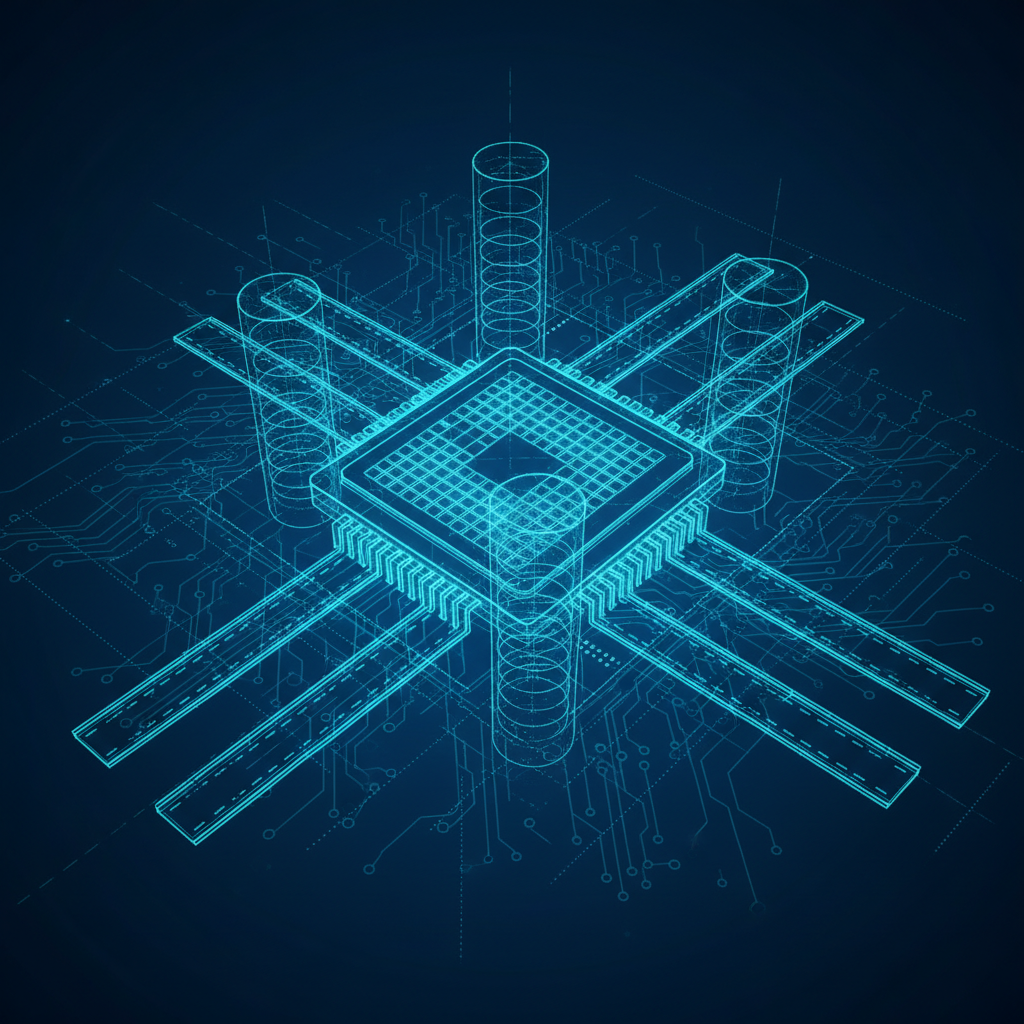
Cerebras AI Chip IPO: Wafer-Scale Architecture Analysis 2026
The artificial intelligence hardware landscape is witnessing a watershed moment as Cerebras Systems files for an initial public offering. The Cerebras AI chip IPO represents more than just another tech listing—it signals market validation for wafer-scale engine architecture as a viable alternative to traditional multi-chip GPU clusters. This analysis examines the technical merits, competitive positioning, and investment implications of Cerebras’ public market debut against the backdrop of intensifying AI infrastructure competition.
Traditional semiconductor manufacturing has long adhered to reticle limits, constraining individual chip dimensions to approximately 850mm² to maintain acceptable yields. Cerebras challenges this orthodoxy through wafer-scale integration, utilizing entire silicon wafers as single processors. The approach eliminates inter-chip communication entirely for workloads fitting within the wafer’s compute fabric, addressing bottlenecks that plague conventional GPU clusters scaling beyond dozens of accelerators.
Understanding the Cerebras AI Chip IPO Context
Cerebras Systems has emerged from stealth to become one of the most closely watched AI hardware companies. Founded in 2016, the company spent years developing manufacturing techniques capable of producing functional wafer-scale processors despite inevitable silicon defects. The Cerebras AI chip IPO marks the culmination of this technical development, offering public market investors exposure to a fundamentally different architectural philosophy.
The timing proves strategic for multiple reasons. AI training workloads continue scaling beyond what conventional GPU clusters efficiently handle. Communication overhead between chips in multi-GPU systems creates bottlenecks that wafer-scale designs inherently avoid. Large language models exceeding 500 billion parameters strain even the most sophisticated NVLink or Infinity Fabric interconnects. Cerebras’ WSE-3 (Wafer Scale Engine, third generation) addresses this through unprecedented integration density and on-chip memory bandwidth.
Market dynamics favor differentiation. NVIDIA commands approximately 80% of AI accelerator market share, creating both opportunity and challenge for alternatives. Customers seek supply chain diversification following GPU shortages that delayed AI projects throughout 2024-2025. Cerebras positions itself not as a direct NVIDIA replacement but as a complementary architecture optimized for specific workload categories where wafer-scale advantages prove decisive.
Wafer Scale Engine Architecture: Technical Deep Dive
The WSE-3 represents the industry’s largest processor die, fabricated on TSMC’s 5nm process node. Unlike conventional chips limited by reticle size, the WSE-3 utilizes an entire silicon wafer, achieving approximately 46,225mm² of active silicon area. This approach eliminates inter-chip communication latency entirely for workloads fitting within the wafer’s compute fabric, delivering performance characteristics impossible through multi-chip architectures.
Manufacturing wafer-scale processors requires sophisticated defect tolerance. Cerebras employs redundant core architecture with laser-based defect isolation during final test. Non-functional cores are mapped out, with workloads routed around defective regions through the chip’s mesh network. This approach achieves acceptable yields despite the statistical certainty of defects across 46,000+ mm² of silicon.
Key architectural specifications include:
- Transistor Count: 4 trillion transistors, representing 50× the density of NVIDIA H200
- AI Cores: 900,000+ soft macro processor cores optimized for matrix operations
- On-Chip SRAM: 44GB of distributed memory positioned adjacent to compute cores
- Memory Bandwidth: 21 petabytes per second aggregate bandwidth
- Fabric Bandwidth: 200+ terabits per second mesh interconnect
- Power Consumption: Approximately 20kW per CS-3 system
- Cooling Requirements: Liquid cooling mandatory, air cooling insufficient
The memory bandwidth figure warrants emphasis. At 21 PB/s, the WSE-3 delivers roughly 10,000× the memory bandwidth of NVIDIA H200’s HBM3e configuration. This advantage proves critical for memory-bound LLM training workloads where GPU clusters spend significant cycles waiting for data movement rather than performing compute operations.
Core architecture diverges from traditional GPU streaming multiprocessors. Cerebras cores feature simplified instruction sets optimized for tensor operations, with each core capable of independent memory access. This many-core approach contrasts with GPU designs favoring fewer, more complex cores executing SIMT (Single Instruction, Multiple Thread) workloads. The architectural choice reflects prioritization of memory-level parallelism over instruction-level parallelism.
Benchmark Comparison: Cerebras WSE-3 vs Competition
| Specification | Cerebras WSE-3 | NVIDIA H200 | AMD MI300X | Google TPU v6e |
|---|---|---|---|---|
| Process Node | TSMC 5nm | TSMC 4N (custom) | TSMC 5nm | TSMC 5nm |
| Die Size | 46,225 mm² (wafer-scale) | 814 mm² | 1,323 mm² (8-chip MCM) | ~400 mm² |
| Transistors | 4 trillion | 80 billion | 153 billion | ~50 billion |
| AI Cores/Compute Units | 900,000+ cores | 14,112 CUDA cores | 304 compute units | ~8,000 cores |
| On-Chip Memory | 44 GB SRAM | 141 GB HBM3e | 192 GB HBM3 | 32 GB HBM |
| Memory Bandwidth | 21,000 TB/s | 4.8 TB/s | 5.3 TB/s | 1.6 TB/s |
| Fabric Bandwidth | 200+ TB/s (on-wafer mesh) | 900 GB/s (NVLink) | 896 GB/s (Infinity Fabric) | ~400 GB/s (ICI) |
| Power (per unit) | ~20 kW | 700W | 750W | ~400W |
| FP8 Performance | ~15 exaFLOPS | ~60 teraFLOPS | ~65 teraFLOPS | ~40 teraFLOPS |
| LLM Training Efficiency | 1.0× (baseline) | 0.15× | 0.18× | 0.12× |
| Price (estimated) | $3-4M per system | $30,000 per GPU | $25,000 per GPU | Cloud-only |
Training efficiency metrics reflect relative time-to-solution for 500B+ parameter models using identical datasets and convergence criteria. Cerebras’ advantage stems from eliminating inter-chip communication overhead and maximizing memory bandwidth utilization. For detailed benchmark methodology, see AnandTech’s comprehensive WSE-3 analysis.
Real-world performance varies by workload characteristics. Models with high arithmetic intensity (compute-bound) show smaller differentials than memory-bound architectures. Transformer models with large context windows benefit disproportionately from Cerebras’ bandwidth advantages. Mixture-of-Experts models present interesting cases where communication patterns affect relative performance.
Cost-Performance Analysis for LLM Training
Total cost of ownership calculations reveal nuanced tradeoffs that defy simple price-per-FLOP comparisons. A single Cerebras CS-3 system carries an estimated $3-4 million price point, compared to ~$30,000 per NVIDIA H200 GPU. However, effective cost per training job favors Cerebras for specific workload categories where wafer-scale advantages materialize.
Consider training a 750B parameter model from scratch:
- Cerebras CS-3: 1 system, ~2 weeks training time, ~$4M capital + $50K electricity
- NVIDIA H200 Cluster: 256 GPUs, ~8 weeks training time, ~$7.7M capital + $400K electricity
- AMD MI300X Cluster: 256 GPUs, ~7 weeks training time, ~$6.4M capital + $380K electricity
- Google TPU v6e Pod: Cloud pricing, ~9 weeks, ~$2.5M cloud costs (no capital)
The Cerebras advantage compounds for larger models. Communication overhead in GPU clusters scales superlinearly with model size, while wafer-scale systems maintain consistent efficiency. Research from SemiAnalysis indicates breakeven occurs around 200B parameters for single-job training scenarios.
Operational considerations extend beyond capital expenditure. GPU clusters require sophisticated networking infrastructure—InfiniBand or Ethernet fabrics adding 15-20% to total system cost. Cerebras CS-3 arrives as an integrated appliance requiring only power and network connectivity. Datacenter facilities must support 20kW rack density for Cerebras versus 7-10kW for GPU racks, potentially requiring cooling infrastructure upgrades.
For organizations running continuous training pipelines, GPU clusters offer better utilization through parallel multi-job scheduling. Multiple research teams can share GPU resources simultaneously. Cerebras excels at single large-job throughput but presents scheduling challenges for multi-tenant environments. The optimal choice depends on workload patterns rather than raw specifications.
Software ecosystem maturity affects total cost of ownership. NVIDIA’s CUDA platform benefits from 15+ years of development, with extensive library support and debugging tools. Cerebras’ software stack, while functional, requires additional engineering investment for optimization and troubleshooting. This hidden cost factors into procurement decisions for organizations with limited ML infrastructure expertise.
Memory Bandwidth: The Hidden Bottleneck
Industry discourse emphasizes FLOPS (floating-point operations per second), yet memory bandwidth constrains actual LLM training performance more severely. The NVIDIA H200 benchmark analysis on this site demonstrates how HBM3e improvements still leave GPUs memory-bound for transformer workloads. Attention mechanisms require frequent access to KV caches, creating bandwidth pressure that scales with context window size.
Cerebras’ 21 PB/s bandwidth eliminates this constraint entirely. The distributed SRAM architecture places memory physically adjacent to compute cores, achieving near-unity memory utilization efficiency. This architectural choice reflects lessons from decades of Von Neumann bottleneck research, documented extensively in IEEE’s processor-memory integration studies. The proximity of memory to compute reduces energy per memory access by approximately 100× compared to off-chip HBM.
HBM3e technology, while impressive at 4.8 TB/s per GPU, requires data traversal across PCIe switches, NVLink bridges, and network interfaces in multi-GPU configurations. Each hop introduces latency and reduces effective bandwidth. Wafer-scale integration avoids these penalties through monolithic design, with all memory accessible through the on-chip mesh network.
Memory capacity presents a different picture. NVIDIA H200’s 141GB HBM3e exceeds Cerebras’ 44GB SRAM, enabling larger models to fit on single GPUs. Cerebras addresses this through model parallelization across the wafer’s compute fabric, with automatic sharding handled by the software stack. Models exceeding 44GB parameters require careful optimization to minimize off-chip memory access, which incurs significant performance penalties.
IPO Valuation and Competitive Landscape
Cerebras seeks a $5-7 billion valuation, positioning below NVIDIA’s market cap but above most private AI chip startups. The valuation reflects both technical differentiation and execution risk. Wafer-scale manufacturing yields remain challenging, though Cerebras reports improved yields through redundant core architecture and laser-based defect isolation techniques refined across three generations.
Revenue trajectory supports the valuation range. Cerebras reported approximately $200M ARR in 2025, growing 150% year-over-year. Customer base includes government laboratories (Argonne National Laboratory, Lawrence Livermore National Laboratory), research institutions, and select enterprise customers. The company targets $1B ARR by 2028, requiring continued expansion beyond current niche applications.
Competitive pressures intensify across multiple fronts:
- NVIDIA: Dominant market position with 80%+ share, CUDA ecosystem lock-in creating switching costs, continuous architectural innovation (Blackwell, Rubin roadmaps), vertical integration into networking (Mellanox acquisition)
- AMD: Competitive MI300 series matching NVIDIA on many benchmarks, open software stack (ROCm) reducing vendor lock-in concerns, aggressive pricing at 15-20% discount to NVIDIA
- Google: TPU v6e deployment at massive scale for internal workloads, vertical integration advantages from datacenter to silicon, cloud-only availability limiting direct competition
- Custom Silicon: Meta (MTIA), Microsoft (Maia), Amazon (Trainium/Inferentia) developing in-house AI accelerators for internal workloads, potentially reducing merchant market size
- Startups: Groq, SambaNova, Tenstorrent pursuing alternative architectures, well-funded but unproven at scale
Cerebras’ differentiation lies in architectural uniqueness rather than incremental improvement. This represents both opportunity and risk. Success validates wafer-scale as a third path beyond GPUs and TPUs. Failure relegates the approach to niche applications where specific workload characteristics align with architectural strengths.
Investment Considerations
Prospective investors should weigh several factors when evaluating the Cerebras AI chip IPO:
Market Timing: AI infrastructure spending continues accelerating, with hyperscalers committing $200B+ annually through 2027. Cerebras addresses genuine pain points in large-model training where GPU clusters face diminishing returns. The market supports multiple architectural approaches, reducing winner-take-all dynamics.
Technical Moat: Wafer-scale manufacturing expertise creates barriers to entry. Competitors cannot quickly replicate the combination of yield management, thermal design, and software stack optimization. Cerebras holds 100+ patents covering wafer-scale integration techniques, providing legal protection for core innovations.
Customer Concentration: Cerebras relies heavily on government contracts (Argonne National Laboratory, Lawrence Livermore) and select enterprise customers. Top five customers represent 60% of revenue, creating concentration risk. Diversification efforts target cloud providers and large enterprises, but progress remains early-stage.
Manufacturing Risk: TSMC capacity constraints affect all advanced-node designers. Wafer-scale chips consume disproportionate fab capacity per revenue dollar, potentially limiting scalability. Cerebras maintains close TSMC relationships but lacks the volume leverage of NVIDIA or Apple.
Software Ecosystem: Cerebras’ software stack supports PyTorch and TensorFlow but lacks CUDA’s maturity. Developer adoption requires continued investment in tools, documentation, and community support. The company employs 200+ software engineers, representing 40% of total headcount.
Path to Profitability: Cerebras operates at negative margins typical of growth-stage hardware companies. Gross margins approximately 35% compare unfavorably to NVIDIA’s 70%+. Scale economics should improve margins, but the path to profitability extends 3-5 years post-IPO based on current burn rates.
Regulatory and Geopolitical Factors
AI chip companies face increasing regulatory scrutiny. Export controls restrict sales to certain countries, affecting addressable market. Cerebras’ government contracts provide stability but create dependency on defense and research budgets subject to political cycles. The company navigates complex compliance requirements for advanced semiconductor technology.
Supply chain concentration presents additional risk. TSMC manufactures all WSE-3 chips, creating single-point-of-failure exposure. Geopolitical tensions affecting Taiwan could disrupt production. Cerebras explores secondary sourcing but faces technical challenges replicating wafer-scale processes across foundries.
Conclusion: Strategic Implications
The Cerebras AI chip IPO represents a pivotal moment for AI hardware diversification. Wafer-scale architecture offers genuine technical advantages for specific workload categories, particularly large-model training where memory bandwidth and communication overhead dominate performance. Success in public markets validates architectural innovation beyond incremental GPU improvements.
Investors gain exposure to a differentiated approach rather than another NVIDIA competitor. The risk-reward profile suits portfolios seeking AI infrastructure exposure with technical differentiation. Execution risk remains substantial, but the underlying technology addresses real constraints in contemporary AI training infrastructure.
Key success metrics for the coming quarters include: customer diversification beyond government contracts, software ecosystem growth measured by developer adoption, gross margin expansion toward 50%+, and demonstration of wafer-scale advantages for emerging model architectures beyond transformers.
As the AI hardware market matures beyond GPU monoculture, Cerebras’ public market debut provides a benchmark for evaluating architectural alternatives. The coming quarters will reveal whether wafer-scale integration transitions from technical curiosity to commercial necessity. For organizations training frontier models at scale, the Cerebras value proposition proves compelling. For broader AI workloads, GPU flexibility and ecosystem maturity maintain advantages.
The Cerebras AI chip IPO ultimately tests whether architectural innovation can overcome ecosystem inertia. History suggests both outcomes remain possible—revolutionary technologies sometimes displace incumbents, other times remaining niche solutions. Cerebras’ public market journey will provide answers, with implications extending beyond a single company to the broader AI infrastructure landscape.
Related: Cerebras Wafer-Scale AI Chip: Architecture & Benchmark 2026.
Related: Cloudflare LLM Infrastructure: Architecture at Scale.
Discover more from Susiloharjo
Subscribe to get the latest posts sent to your email.