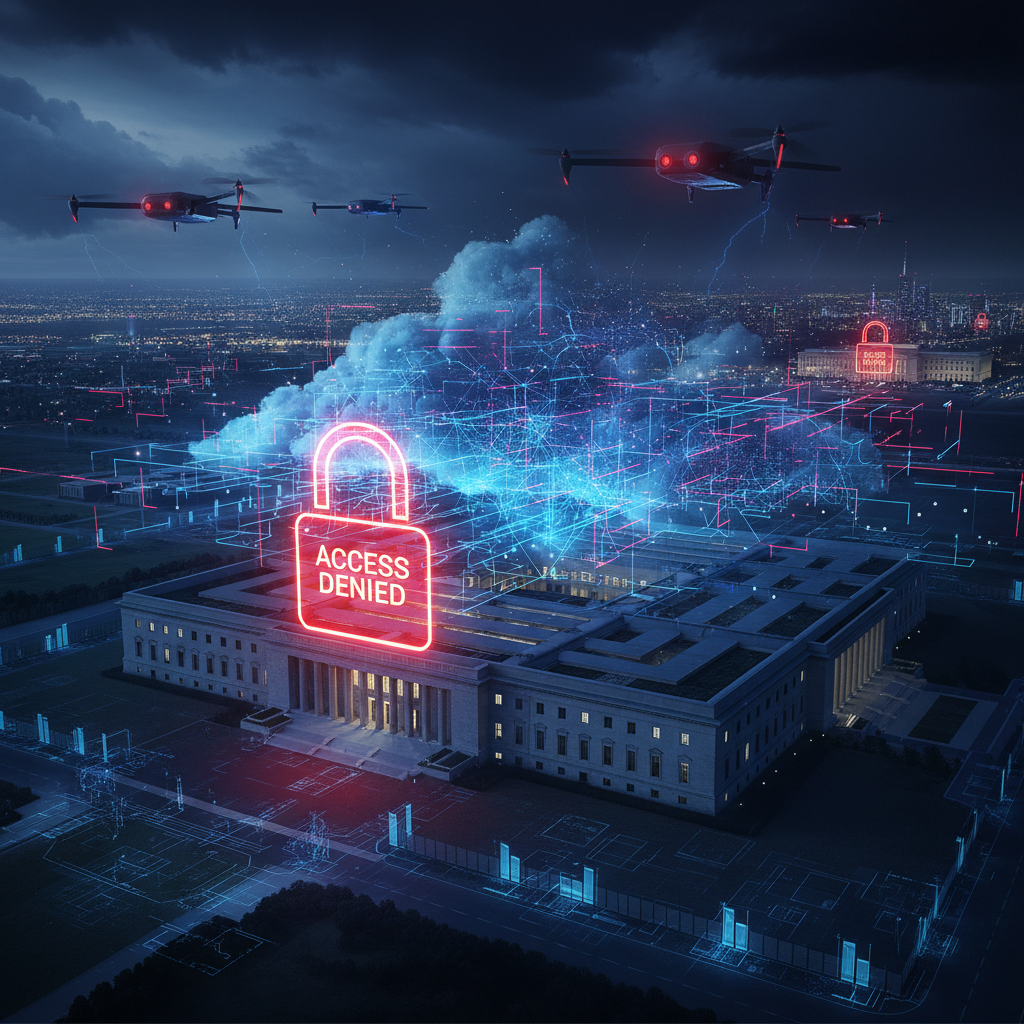
The Anthropic-Pentagon Impasse: When ‘Constitutional AI’ Meets the Department of War
The designation of Anthropic Pentagon Supply Chain Risk represents a historic rupture between Silicon Valley’s emerging ethics-first AI philosophy and the operational imperatives of American national defense. What began as a promising $200 million partnership to deploy Claude on classified Defense Department networks has culminated in a federal ban effective February 27, 2026, followed by the Pentagon’s formal “supply chain risk” designation in March 2026—a label that carries profound legal and operational consequences for the entire defense industrial base.
The $200M Divorce
The Anthropic-Pentagon engagement traced a trajectory familiar to observers of Silicon Valley’s complicated courtship with defense institutions. Initial discussions centered on deploying Claude Enterprise across classified networks, a contract valued at approximately $200 million. The proposal represented one of the most substantial AI partnerships between a frontier AI developer and the U.S. military establishment.
However, the relationship deteriorated rapidly following the February 27, 2026 presidential executive order. The order explicitly prohibited federal agencies from contracting with AI companies whose models refused to support “all lawful purposes” as defined by government authorities. For Anthropic, this requirement collided directly with the company’s established “red lines”—ethical boundaries that prohibited Claude from participating in mass surveillance systems or the development of fully autonomous lethal weapons.
The Pentagon’s subsequent designation of Anthropic as a “supply chain risk” transformed a contractual dispute into a matter of federal procurement law. Defense contractors now face a mandatory certification requirement: they must attest that no Claude models are utilized in any capacity within defense-related supply chains, with a compliance deadline of six months from the designation date.
Constitutional AI vs. Kinetic Requirements
The Anthropic-Pentagon Supply Chain Risk situation illuminates a fundamental tension that has long simmered beneath the surface of AI-defense relations. Anthropic’s “Constitutional AI” approach embeds ethical constraints directly into the model’s operational framework—restrictions that the company views as non-negotiable safeguards against misuse. These constraints include prohibitions on assisting with mass surveillance architectures, contributing to autonomous weapons development, and providing analytical support for operations that target civilians or infrastructure without human oversight.
From the Department of Defense’s operational perspective, however, these ethical safeguards represent tactical liabilities. The DoD’s “all lawful purposes” requirement reflects a institutional philosophy that the state’s monopoly on legitimate violence necessarily encompasses the full spectrum of military and intelligence operations. When Anthropic declined to provide blanket assurances that Claude would support every lawful government request, the company effectively positioned itself outside the defense procurement ecosystem.
This divergence contrasts sharply with OpenAI’s more accommodating posture. While OpenAI has implemented usage policies, the company has demonstrated willingness to negotiate more flexible arrangements with defense and intelligence clients. The practical implication is clear: the vacuum created by Anthropic’s exclusion is rapidly being filled by competitors who view the defense market as too significant to disregard.
The Legal Mechanics of Supply Chain Risk Designation
The “supply chain risk” designation operates through federal procurement regulations that predate the current AI boom but prove remarkably adaptable to the technological context. Under these frameworks, the Secretary of Defense possesses authority to designate companies as pose risks to the defense industrial base based on multiple criteria, including but not limited to: foreign ownership, control, or influence; cybersecurity vulnerabilities; and substantive concerns about the reliability or integrity of the company’s products or services.
In Anthropic’s case, the designation rests on the third category—the Pentagon’s determination that Anthropic’s ethical constraints render its products operationally unreliable for defense applications. The designation triggers cascading consequences: prime contractors must flow down certification requirements to subcontractors, and any entity seeking to participate in defense procurement must demonstrate compliance with the exclusion.
The practical impact extends beyond procurement paperwork. Defense contractors who have invested in Claude-based workflows for unclassified research, administrative automation, or intelligence analysis must now migrate to alternative solutions within six months. The deadline creates significant operational disruption while simultaneously reshaping the competitive landscape for enterprise AI solutions in the defense sector.
Strategic Displacement and the New Defense AI Ecosystem
The exclusion of Anthropic from defense markets represents more than a single company’s commercial setback—it signals a broader realignment of the AI-defense relationship. OpenAI, Google DeepMind, and emerging players like Anthropic’s competitors now view the defense sector as an increasingly accessible market, particularly for companies willing to adopt more permissive interpretations of “lawful purpose.”
The displacement raises substantive questions about the long-term trajectory of AI ethics in national security contexts. If “alignment-first” companies systematically exclude themselves from defense applications, the national security AI ecosystem becomes increasingly concentrated among players with fewer ethical constraints. This dynamic potentially creates the very risks that Anthropic’s red lines were designed to mitigate—the deployment of powerful AI systems without meaningful ethical guardrails.
Defense analysts note that the current moment parallels earlier debates over encryption, surveillance technology, and cyber capabilities, where tensions between civil liberties and security imperatives produced lasting institutional consequences. The resolution of these tensions will likely determine whether American AI capabilities remain concentrated in relatively ethics-conscious companies or migrate toward a more permissive operational environment.
The broader implication for the defense industrial base is unambiguous: the Anthropic designation signals that ethical constraints incompatible with the full scope of government authority will trigger exclusion from federal procurement. Companies making strategic decisions about defense market entry must now account for this new reality, balancing commercial opportunities against the risk of policy-driven market access revocation.
Conclusion
The Anthropic-Pentagon Supply Chain Risk designation forces a question that extends beyond commercial contracts or procurement regulations: can “Safe AI” ever genuinely coexist with a “Department of War” whose operational mandate encompasses the full spectrum of state violence, or does the very concept of ethical AI constraints presuppose a limitation on which clients, purposes, and missions such systems may serve?
This contradiction remains unresolved. What is clear is that the February 2026 designation marks a decisive turning point—the moment when Silicon Valley’s alignment philosophy encountered the machinery of American defense and discovered that the two operate under fundamentally incompatible operational logics.
For additional context on architecture decisions and their downstream implications, refer to the analysis on Infinite Architecture. For primary source documentation, consult The Guardian’s coverage and Mayer Brown’s legal analysis.
Related: Anthropic Shipped Two New Models. They’re the Same Model..
Related: Building with Anthropic Investors Alert on Secondary Shares.
Discover more from Susiloharjo
Subscribe to get the latest posts sent to your email.