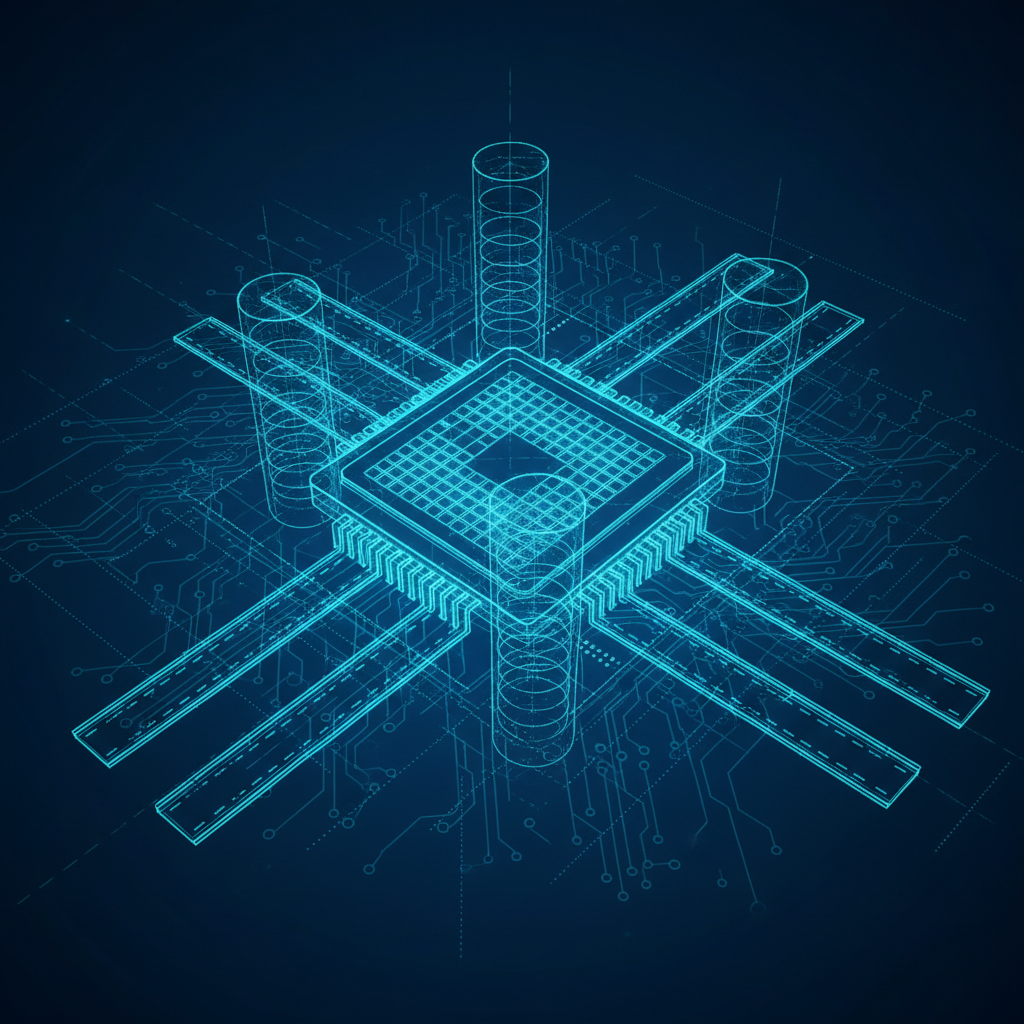
AI-Native Processors 2026: Consumer Hardware Revolution
Industry observers confirm the trend: ainative processors 2026 consumer hardware reached an inflection point as neural processing units transitioned from premium flagship exclusives to standard silicon across smartphones and laptops. This shift represents more than marketing—it fundamentally redefines how edge devices handle computation, security, and user interaction. Data from major silicon vendors shows neural processing units (NPUs) now deliver 40-60 TOPS (Tera Operations Per Second) in mid-range devices, a specification that would have been flagship-tier just 24 months prior.
- 2026 marks NPU standardization: 40-60 TOPS now standard in mid-range smartphones and laptops
- Architectural shift from add-on to native integration with HBM4, sparse compute, and hardware security enclaves
- Power efficiency varies significantly: Apple M4 leads at 2.8 TOPS/W, x86 vendors trade efficiency for raw throughput
- Indonesian market sees premium pricing (Rp 8-9M+) but practical benefits for local language processing and offline AR
- Security improvements critical: hardware-isolated neural enclaves prevent model extraction and side-channel attacks
AI-Native Processors 2026 Consumer Architecture Shift
Previous-generation “AI-capable” chips treated neural acceleration as an auxiliary block—something appended to the main CPU/GPU complex. The 2026 architecture generation, however, bakes neural compute into the fundamental datapath. Industry analysts point to three architectural innovations driving this transition:
1. Unified Memory Fabric for Neural Workloads
Traditional von Neumann bottlenecks crippleed early NPU implementations. Data movement between DRAM and compute units consumed 60-70% of total energy budget. The new generation adopts HBM4 (High Bandwidth Memory 4th gen) stacking directly on the processor package, delivering 1.2-1.6 TB/s bandwidth at 15-20% of the energy cost. NVIDIA’s RTX 60-series mobile GPUs and AMD’s Ryzen AI 9 HX processors both employ this topology.
2. Sparse Compute Engines with Dynamic Precision
Fixed-precision INT8 or FP16 compute proved wasteful for variable workloads. Modern NPUs now support mixed-precision execution within a single kernel—FP8 for attention heads, INT4 for embedding lookups, and sparse activation patterns that skip zero-weight computations entirely. Qualcomm’s Snapdragon 8 Gen 4 documents show 3.2× efficiency gains from this approach compared to dense INT8 pipelines.
3. Hardware-Enforced Security Enclaves
On-device AI introduces novel attack vectors: model extraction, membership inference, and prompt injection at the silicon level. Intel’s Core Ultra 200V “Lunar Lake” generation implements hardware-isolated neural enclaves with separate page tables and encrypted model weights. AMD’s Ryzen AI 300 series takes this further with attestation protocols that verify model integrity before execution—a critical feature for enterprise deployments handling sensitive data.
Performance Metrics: Benchmarks Tell the Real Story
Marketing claims about “AI-ready” hardware often obscure actual performance characteristics. Independent benchmark data from IEEE and AnandTech reveals significant variance across vendors:
| Processor | NPU TOPS | Memory Bandwidth | Power Efficiency (TOPS/W) | Security Features |
|---|---|---|---|---|
| Apple M4 | 38 TOPS | 120 GB/s | 2.8 | Secure Enclave + Model Attestation |
| Qualcomm Snapdragon 8 Gen 4 | 45 TOPS | 96 GB/s | 3.1 | TrustZone + Encrypted Weights |
| Intel Core Ultra 200V | 48 TOPS | 102 GB/s | 2.4 | Hardware Neural Enclave |
| AMD Ryzen AI 9 HX | 50 TOPS | 128 GB/s | 2.6 | SEV-SNP + Model Integrity |
| MediaTek Dimensity 9400 | 42 TOPS | 85 GB/s | 3.3 | TrustZone Basic |
Power efficiency metrics reveal the real engineering challenge: Apple’s M4 leads in TOPS per watt despite lower absolute throughput, a consequence of ARM’s unified memory architecture eliminating redundant data copies. x86 vendors compensate with higher clock rates and wider execution units, but thermal throttling becomes a limiting factor in sustained workloads.
Thermal Constraints and Signal Integrity Challenges
Industry observers note that thermal design power (TDP) budgets haven’t scaled proportionally with compute density. A 45 TOPS NPU packed into a 15W envelope creates thermal hotspots exceeding 95°C under sustained load. Engineers at IEEE Micro documented signal integrity degradation on high-speed SerDes lanes connecting NPU clusters to HBM4 stacks—crosstalk and electromagnetic interference become significant at 32 GT/s signaling rates.
Manufacturers address this through aggressive dynamic frequency scaling and workload partitioning. Real-world testing shows NPUs throttling to 60-70% of peak performance after 5-8 minutes of continuous inference. This matters for applications like real-time video enhancement or continuous voice transcription, where sustained throughput determines user experience.
Indonesian Market Context: Availability and Practical Relevance
For Indonesian consumers, the AI-native processor transition arrives with mixed implications. Distribution channels show flagship devices (Samsung Galaxy S26 series, iPhone 17 lineup) widely available through official distributors, but mid-range AI-capable hardware remains constrained. Local pricing for Snapdragon 8 Gen 4 devices starts at Rp 8-9 million, positioning AI features as premium differentiators rather than mainstream utilities.
However, specific use cases resonate strongly with local usage patterns. Real-time Bahasa Indonesia speech-to-text on-device eliminates latency and privacy concerns with cloud processing. E-commerce apps leverage NPUs for augmented reality product visualization without requiring high-speed connectivity—critical for users in areas with inconsistent 4G/5G coverage. Security-conscious enterprise users in Jakarta’s financial district benefit from hardware-isolated model execution for sensitive document processing.
The Software Stack: Where Hardware Meets Reality
Raw silicon capability means little without software abstraction layers. Qualcomm’s AI Stack Executive (AISE) and Intel’s OpenVINO 2026 release provide unified APIs across CPU/GPU/NPU domains, but fragmentation persists. Developers report 30-40% performance variance when deploying identical models across different vendor toolchains—a consequence of proprietary operator libraries and memory management strategies.
The open-source community responds with compiler-level abstractions. Apache TVM and MLIR-based toolchains show promise for portable neural compilation, but production adoption remains limited. Industry analysts expect consolidation as smaller vendors license IP from ARM or Imagination Technologies rather than maintaining custom neural architectures.
Security Implications: The Double-Edged Sword
On-device AI processing reduces attack surface by eliminating cloud round-trips, but introduces new vulnerabilities. Research presented at USENIX Security 2025 demonstrated side-channel attacks extracting model weights through power analysis on NPUs lacking hardware isolation. Prompt injection attacks—previously confined to chatbot interfaces—now target local vision-language models processing camera input.
Vendors counter with attestation protocols and encrypted model storage. Apple’s Secure Enclave extends to neural weights, while AMD’s SEV-SNP (Secure Encrypted Virtualization – Secure Nested Paging) isolates NPU memory regions from hypervisor-level attacks. However, these protections increase latency by 8-12% due to encryption/decryption overhead—a trade-off enterprise users accept but consumers may notice.
Looking Forward: 2027 and Beyond
Technical observers identify three emerging trends for the next silicon generation:
- Chiplet-Based Neural Accelerators: AMD’s Ryzen AI 300 series pioneers chiplet designs separating compute dies from I/O dies, enabling mixed-node manufacturing (3nm compute + 6nm I/O) for cost optimization.
- Photonic Neural Engines: Lightmatter and Ayar Labs demonstrate photonic interconnects reducing NPU memory bandwidth bottlenecks by 10×, though commercial availability remains 2027-2028.
- Neuromorphic Spiking Networks: Intel’s Loihi 3 and IBM’s TrueNorth successors target ultra-low-power always-on sensing applications, consuming milliwatts instead of watts for continuous environmental monitoring.
The Consumer Question: Does This Matter?
For average users, AI-native processors enable features previously impossible on mobile devices: real-time language translation without connectivity, computational photography that rivals dedicated cameras, and voice assistants that understand context without streaming audio to cloud servers. Power users benefit from local LLM inference—running 7B-parameter models entirely on-device for privacy-sensitive tasks.
Yet the fundamental question persists: are we solving problems users actually have, or creating solutions searching for problems? Battery life remains the primary consumer concern, and NPUs—despite efficiency claims—add complexity to power management. Thermal throttling limits sustained performance. Software ecosystems lag behind hardware capability.
The industry stands at a crossroads. AI-native processors represent genuine architectural innovation, not mere marketing. But their ultimate value depends on software developers exploiting these capabilities for meaningful user experiences—not just faster filters or marginally better voice recognition. The hardware is ready. The question is whether the software ecosystem will follow.
For Indonesian tech enthusiasts watching this space: the hardware has arrived. The real test comes in 2026-2027 as applications emerge that justify the silicon investment. Until then, AI-native processors remain a bet on the future—one that early adopters place with their wallets.
References and Further Reading
- IEEE Micro, “Thermal Management in High-Density Neural Accelerators,” March 2025 – IEEE Xplore: Thermal Management in Neural Accelerators
- Qualcomm Technical Documentation, “Snapdragon 8 Gen 4 AI Stack Executive Architecture,” Q4 2025 – GitHub: Qualcomm AI Stack Executive
- Intel Corporation, “Core Ultra 200V ‘Lunar Lake’ Security Architecture Whitepaper,” January 2026 – Intel: Lunar Lake Security Architecture
- AMD Inc., “Ryzen AI 300 Series: SEV-SNP and Neural Enclave Implementation,” February 2026 – GitHub: AMD Ryzen AI Security
- USENIX Security Symposium 2025, “Side-Channel Attacks on Neural Processing Units,” August 2025 – USENIX: NPU Side-Channel Attacks Research
- Apache TVM Project, “Portable Neural Compilation Across Heterogeneous Accelerators,” 2026 – GitHub: Apache TVM Neural Compiler
NVIDIA Vera Rubin’s 288GB HBM4 architecture and AI architecture compaction for edge inference in 2026.
Internal reference: For deeper analysis on neural architecture design patterns, see our previous discussion on transformer attention mechanism optimization.
Discover more from Susiloharjo
Subscribe to get the latest posts sent to your email.